Block landing · l shaped staircase cad block
Free L-shape staircase CAD blocks for AutoCAD
By Saumyajit Maity · Published 17 Jul 2025 · Updated 26 Feb 2026
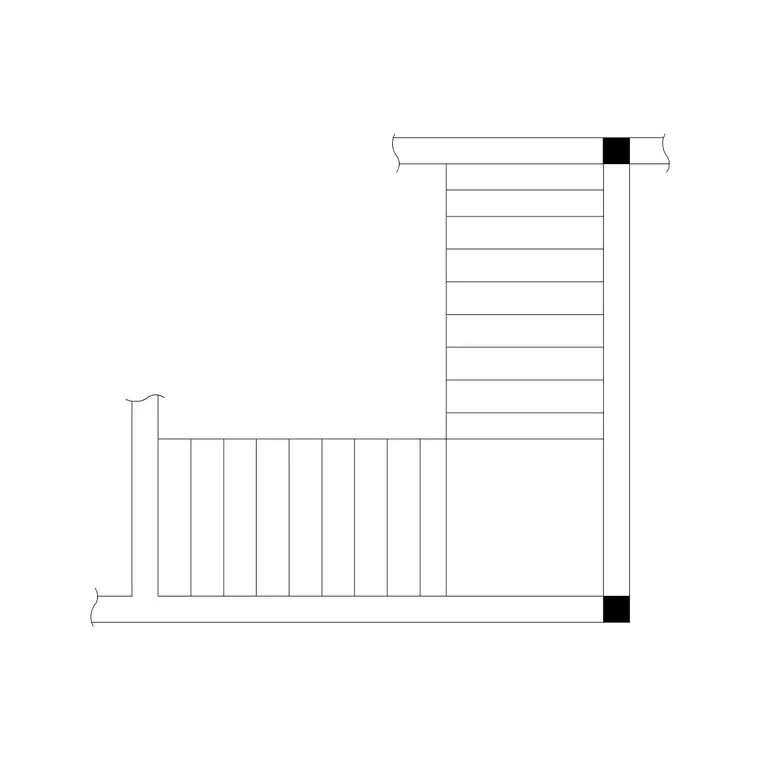
An L-shape staircase makes a single ninety-degree turn part way up — one flight, a quarter-turn at a landing (or a set of winders), then a second flight at right angles — so the stair tucks neatly into the corner of a room. This page collects free L-shape staircase CAD blocks in DWG and DXF, drawn in plan with the two flights and the corner landing, and in elevation showing the quarter-turn, ready to insert into AutoCAD 2004 or later. Everything is free for personal and commercial work, with no signup and no watermark.
The L-shape is the stair you choose when the entry and the exit want to be on adjacent walls rather than the same end of a stairwell. The blocks here are set out as a true quarter-turn so that, the moment you place one, the stair wraps the corner the way the room needs — the bottom flight off one wall, the turn at the landing, and the top flight rising along the perpendicular wall.
What an L-shape staircase block shows
In plan, an L-shape stair reads as one flight running along a wall, a square landing at the corner, and a second flight turning ninety degrees and running along the adjacent wall. The up arrow follows the L, and a break line marks where the upper flight passes over anything below. Some L-shape stairs replace the corner landing with winder treads — pie-shaped treads that turn the corner without a flat landing — and the block will show whichever arrangement it is drawn for.
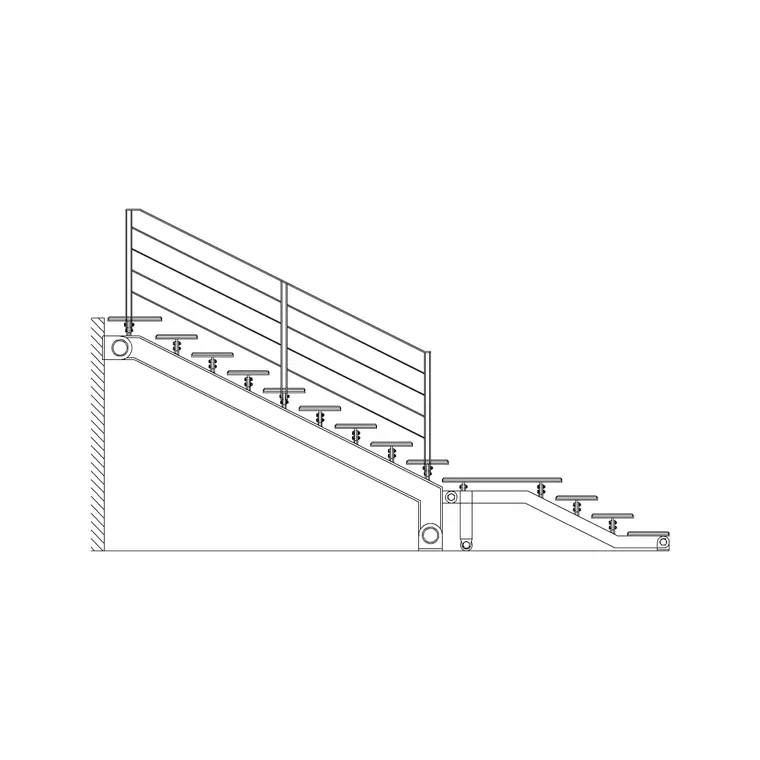
In elevation the stair shows the first flight rising to the landing, the landing, and the second flight continuing up in the turned direction. Because the two flights run on perpendicular walls, a single elevation only sees one of them face-on, which is why an L-shape often benefits from a plan plus a section to read fully.
L-shape versus dog-leg and straight
Picking the right turning stair comes down to where the doors want to be. A straight flight runs in one direction with the entry and exit at opposite ends — simple but long. A dog-leg makes a full half-turn so the exit sits back above the entry at the same end. An L-shape makes a single quarter-turn so the exit sits on a wall at right angles to the entry. Each suits a different plan shape.
The L-shape's advantage is that it follows two adjacent walls and leaves the corner usable, which is why it suits a room where the stair should hug the perimeter rather than sit in the middle. If your stairwell is a tall narrow slot, a dog-leg packs in better; if you have a long run available, a straight flight is the cleanest. Because every stair block here is editable, you can trial an L-shape against a dog-leg early without redrawing the surrounding plan.
Landing or winders at the turn
There are two ways an L-shape turns the corner, and the block reflects which one. A quarter-landing is a flat square platform at the turn — easier to use, safer, and the more common choice where space allows. Winders are tapered treads that fan around the corner, saving the length a landing would take but giving narrower walking room on the inside of the turn.
When you place the block, check which it uses against your design intent. A landing reads as a pause and is kinder underfoot; winders read as a continuous climb and save floor area. The walking line on a winder set is measured back from the inside corner, just as on a spiral, so the going stays usable away from the pinch point. Whichever you place, confirm the going, the winder geometry and the headroom against your local building regulations, since winders in particular are tightly governed.
Typical L-shape staircase dimensions
An L-shape is sized by the flight width, the rise and going of the treads, and the corner landing (or winder set). The overall footprint is an L of two flight-lengths meeting at a landing roughly the flight width square. Domestic flight widths commonly sit in the region of 800–1000 mm, with the landing at least as deep as the flight is wide so a person can turn.
Rise and going fall in the normal comfortable stair band, with the total risers split either side of the turn. The number of treads before and after the landing depends on where the turn best suits the plan — often the landing is placed a few treads up rather than exactly halfway. Headroom over the landing and under the upper flight is the figure to watch. Treat these as ranges to design within and confirm rise, going, width, landing and headroom against your local building regulations.
Inserting and orienting the block
The blocks are drawn full size in millimetres. Insert at scale 1 in a millimetre drawing, 0.001 in a metre drawing, or set INSUNITS to millimetres so AutoCAD rescales on insertion. A natural insertion point is the inside corner of the L — the point where the two walls meet — so the stair seats into the corner and you can dimension both flights from that datum.
An L-shape has a handedness: the turn can go left or right. Use MIRROR to flip the block to the correct hand for your room, then ROTATE to align the bottom flight with the entry. Because the stair is a single block reference, mirroring and rotating keep both flights and the landing coordinated. Keep it on a dedicated stair layer so you can freeze it for the shell plan and thaw it for the furnished drawing.
Where L-shape staircase blocks are used
L-shape stairs suit plans where the stair should follow two walls and free up the centre of a room: open-plan homes where the stair wraps a corner, offices and small commercial spaces, and any layout where the entry and exit naturally sit on perpendicular walls. The quarter-turn also softens a long climb by breaking it with a landing, which makes the stair feel less steep than an equivalent straight flight.
Because the blocks are free and licence-clear, they cover a quick residential concept as readily as a developed scheme where the stair has to coordinate across plans, section and detail. Pair them with the other stair blocks in the stairs category when a building mixes an L-shape main stair with a compact spiral or a feature circular stair, and use the plan and elevation together so the quarter-turn is fully described.
Free download
Browse the full library — DWG & DXF, no signup.
Questions
Frequently asked
What is an L-shaped staircase?+
An L-shaped (quarter-turn) staircase has one flight, a single ninety-degree turn at a corner landing or set of winders, then a second flight at right angles. The two flights run along adjacent walls, so the stair wraps the corner of a room in an L shape.
What's the difference between an L-shape and a dog-leg stair?+
An L-shape turns ninety degrees (a quarter-turn), so the exit sits on a wall perpendicular to the entry. A dog-leg turns a full 180 degrees, so the upper flight runs back over the lower one at the same end. Choose the block that matches where your doors need to be.
Do the L-shape blocks use a landing or winders at the turn?+
It depends on the block — some use a flat quarter-landing, others use tapered winder treads to save floor area. The download page notes which arrangement a block is drawn for. A landing is easier underfoot; winders save length.
Are the L-shape staircase blocks free for commercial use?+
Yes. Every block downloads free in DWG and DXF with no signup, no watermark and no attribution requirement, and they are cleared for commercial project work.
Related downloads
Blocks for this guide
Related categories
Related guides
Block landing
Free Spiral Staircase CAD Blocks — DWG Download
Download free spiral staircase CAD blocks in DWG and DXF — plan and elevation, drawn to real tread radii for AutoCAD. No signup, free for commercial use.
Block landing
Free Circular Staircase CAD Blocks — DWG Download
Download free circular staircase CAD blocks in DWG and DXF — curved stairs in plan and elevation, drawn to scale for AutoCAD. No signup, commercial-use OK.
Block landing
Free Metal Staircase CAD Blocks — DWG Download
Download free metal staircase CAD blocks in DWG and DXF — steel stairs in plan and elevation with stringers and balustrade. No signup, commercial OK.