Curated pack · elderly care furniture cad blocks
Free elderly-care furniture CAD block pack for AutoCAD
By Sumana Kumar · Published 2 Apr 2025 · Updated 23 Mar 2026
Designing for older adults and assisted living means furniture that supports easy sitting and standing, beds that carers can reach from both sides, and circulation that suits walking frames and wheelchairs. This free elderly-care furniture CAD block pack collects those pieces — high-seat riser armchairs, profiling and adjustable care beds, bedside and overbed tables, grab-rail and handrail layouts, accessible WCs and shower seats, and walking-aid and carer clearance figures — in DWG and DXF at true millimetre dimensions, ready for AutoCAD 2004 or later. All free for personal and commercial work, no signup, no watermark, no attribution.
Use the pack for care and nursing homes, assisted-living and retirement housing, hospital wards, rehabilitation units and accessible private homes. Because the blocks are scaled, dropping in a care bed with carer access either side, or a high-seat chair with stand-up space in front, turns the supportive layout the brief demands into something you can verify on the drawing.
Care environments balance independence with assistance: enough clearance for a carer or a hoist beside a bed, grab rails where transfers happen, and seating that an older person can rise from unaided. Scaled blocks let you plan all of that precisely, and a note of caution applies — these are planning aids drawn to typical ranges, not a substitute for the care-design and accessibility standards governing your project.
What's in the elderly-care pack
The set covers supportive, care-focused furniture. Seating: high-seat riser armchairs with arms for push-up support, and bariatric-width options. Sleep and care: profiling and height-adjustable care beds, with carer-access and hoist-clearance overlays, plus bedside cabinets and overbed tables. Bathroom: accessible WCs with grab rails, shower seats and level-access shower zones. Support: wall grab-rail and corridor handrail layouts. People and aids: a walking-frame user and a carer figure for clearance checks.
The defining trait is supported transfer — chairs and beds drawn with the clear space a person or carer needs around them. Care beds ship with a carer-access overlay so you can confirm reach on both sides before you commit the layout.
Typical elderly-care dimensions to design around
Use these commonly-cited ranges as a starting point, and verify against your project's standard. High-seat riser chairs are often drawn with a raised seat height around 480–520 mm to ease standing, versus a typical 420–460 mm domestic seat. Care beds are commonly around 900–1000 mm wide and 2000–2100 mm long, height-adjustable for carer comfort. Clear carer access is frequently planned at roughly 900 mm or more on at least one long side of a bed, with more where a hoist is used. Grab rails are typically set around 700–800 mm above the floor near a WC.
These figures vary by country, care model and building type, so treat them as typical planning values rather than fixed requirements. The point of the scaled blocks is to let you overlay whichever clearance your standard mandates and test it directly on the plan.
How to use the set to plan a care room
Plan the transfers first. Place the care bed and confirm clear carer access down at least one long side, with hoist clearance if the care plan needs it; overlay the carer-access block to check it. Set the high-seat chair where a resident can rise with space to step forward and a grab point within reach. Position the bedside cabinet and overbed table so they are reachable from the bed without obstructing the carer's access route.
In the bathroom, insert the accessible WC with grab rails and confirm transfer space and a clear approach for a walking frame or wheelchair; add a shower seat to the level-access shower. Run corridor handrails continuously along circulation routes. Drop the walking-frame and carer figures at the key transfer points to confirm the space genuinely works. Keep the clearance overlays on a dedicated layer so you can test, demonstrate to a reviewer, then freeze them for a clean plot.
Plan and elevation views
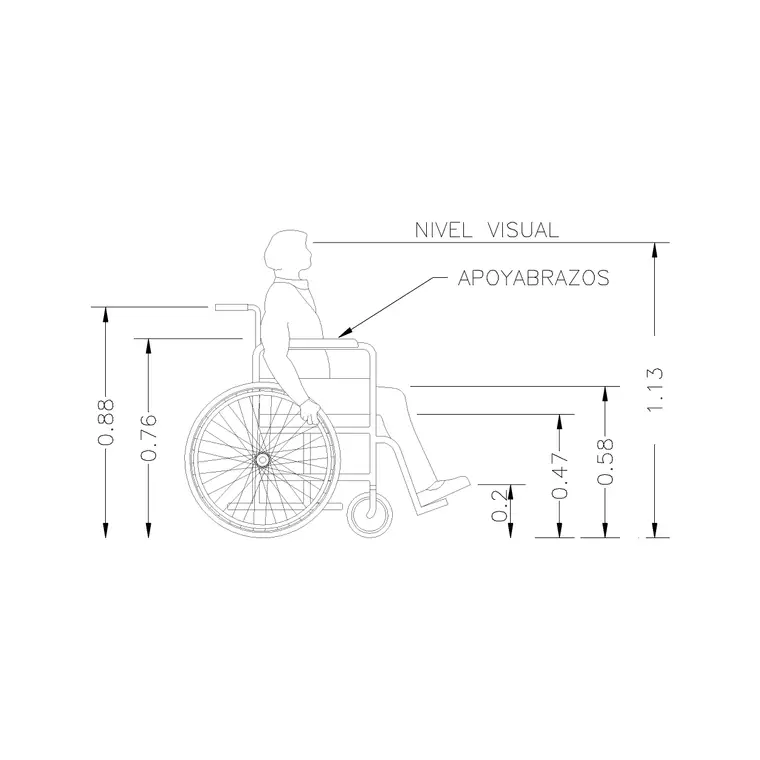
In plan you arrange the furniture and overlay the carer and walking-aid clearances that the care model requires. In elevation you confirm the heights that make care furniture work — the raised riser-chair seat, the adjustable bed range and the grab-rail heights at the WC and shower. Many blocks ship both views in one DWG, so a single download gives plan and elevation.
Elevation is important here because so much of care design is about heights: seats high enough to rise from, rails at the right level, beds that adjust for the carer. The elevation blocks carry those care-appropriate heights so a section or bathroom elevation reflects the real supportive setup.
Per-item notes
- High-seat riser chair: raised seat and supportive arms — leave clear stand-up space in front and a grab point within reach. - Care bed: overlay the carer-access block and confirm clear space on at least one long side, more for a hoist. - Overbed table: must reach across the bed without blocking the carer's access route. - Accessible WC with rails: keep the transfer space clear of the door swing and approachable by a walking frame. - Shower seat: pair it with a level-access shower zone and a grab rail within reach of the seat. - Corridor handrail: run it continuously; breaks at doors should be planned, not accidental.
Where the elderly-care pack is used
Elderly-care blocks suit any setting designed around older or less-mobile adults: care and nursing homes, assisted-living and retirement housing, hospital wards and rehabilitation units, day centres and accessible private homes. Combine them with the people, furniture and kitchen categories where you need accessible kitchen runs or additional figures.
Because they are free and licence-clear, they fit care-design statements, design-review submissions, student briefs and concept plans where you need to show supportive, accessible layouts without licensing fuss. Used early, the clearance overlays catch transfer and access problems while they are still cheap to fix on the drawing. As with all accessibility planning, confirm the exact requirements against the care and accessibility standards for your jurisdiction.
Free download
Browse the full library — DWG & DXF, no signup.
Questions
Frequently asked
Do these care blocks meet accessibility or care-design standards?+
They are drawn to commonly-cited dimension ranges as planning aids, not as a compliance guarantee. Care and accessibility requirements vary by country, care model and building type, so always confirm the exact clearances against the standard governing your project and use these blocks to test against it.
Why are high-seat chairs drawn higher than normal armchairs?+
A raised seat — often around 480–520 mm versus a typical 420–460 mm — makes standing up easier for older adults, and supportive arms give a push-up point. The blocks are drawn to that raised height so the elevation reflects the real ergonomic intent.
How much carer space should I leave beside a care bed?+
Clear carer access is frequently planned at roughly 900 mm or more on at least one long side, with additional space where a hoist is used. Overlay the carer-access block on the plan and check it against your project's care standard.
Will these files open in older AutoCAD and free viewers?+
Yes. The DWG files target AutoCAD 2004 and later and open in current AutoCAD, AutoCAD LT, BricsCAD, DraftSight and free DWG viewers such as Autodesk's online viewer.
Related downloads
Blocks for this guide
Related categories
Related guides
Curated pack
Free Wheelchair-Accessible CAD Block Pack — DWG
Free wheelchair-accessible CAD block pack in DWG and DXF — wheelchair figures, turning circles, accessible WCs and clearances in plan for AutoCAD layouts.
Curated pack
Free Child-Safe Furniture CAD Block Pack — DWG
Free child-safe furniture CAD block pack in DWG and DXF — low tables, child chairs, cots, play furniture and kid figures in plan and elevation for AutoCAD.
Curated pack
Free CAD Blocks for Rendering Pack — DWG & DXF
Free CAD blocks for rendering — scale people, trees, furniture and paving in DWG/DXF to populate plans before you take them into a render engine. No signup.