Block landing · double bowl sink cad block
Free double-bowl sink CAD blocks for AutoCAD
By Sumana Kumar · Published 3 Aug 2023 · Updated 22 Jun 2026
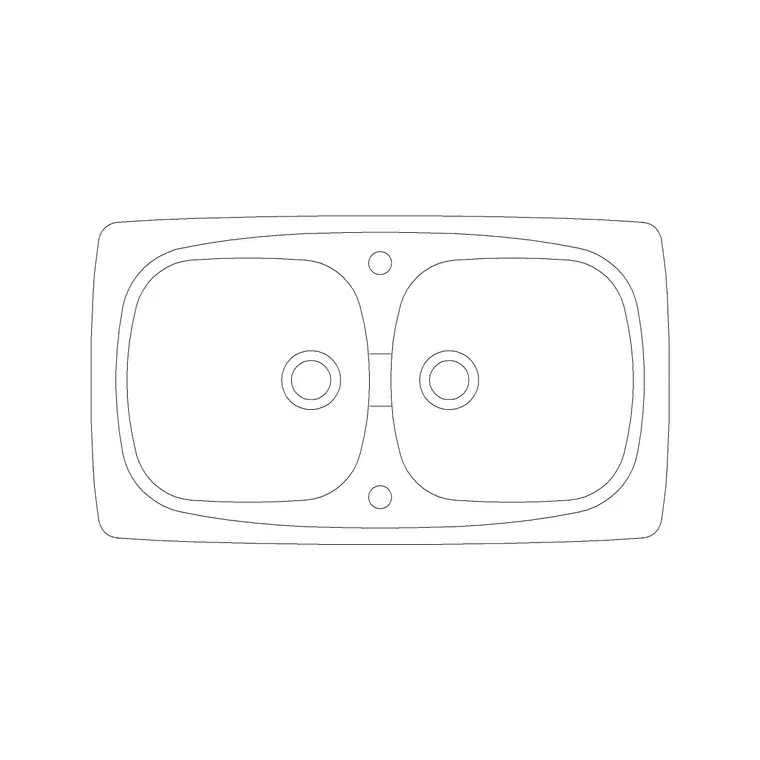
The double-bowl sink is the workhorse of the family kitchen, and a scaled double-bowl sink CAD block lets you place one knowing it will actually fit the cabinet beneath it. This page collects free double-bowl sink CAD blocks in DWG and DXF — two-bowl units in the 800–1000 mm range, including curved-front and square-bowl styles — drawn in plan view at true size for AutoCAD 2004 or later. All free for personal and commercial use, no signup, no watermark.
Two bowls let you separate tasks: wash in one, rinse or drain in the other, or keep a soaking bowl going while you prep. That convenience comes at a cost in worktop, which is exactly why drawing it to scale matters — a double sink demands a wider base cabinet and leaves less run for preparation, and the plan is where you weigh that trade-off. Blocks like the 880 mm curved double and the 690 mm compact double cover the common sizes so you can test the fit against the real cabinet width before committing.
What a double-bowl sink block shows
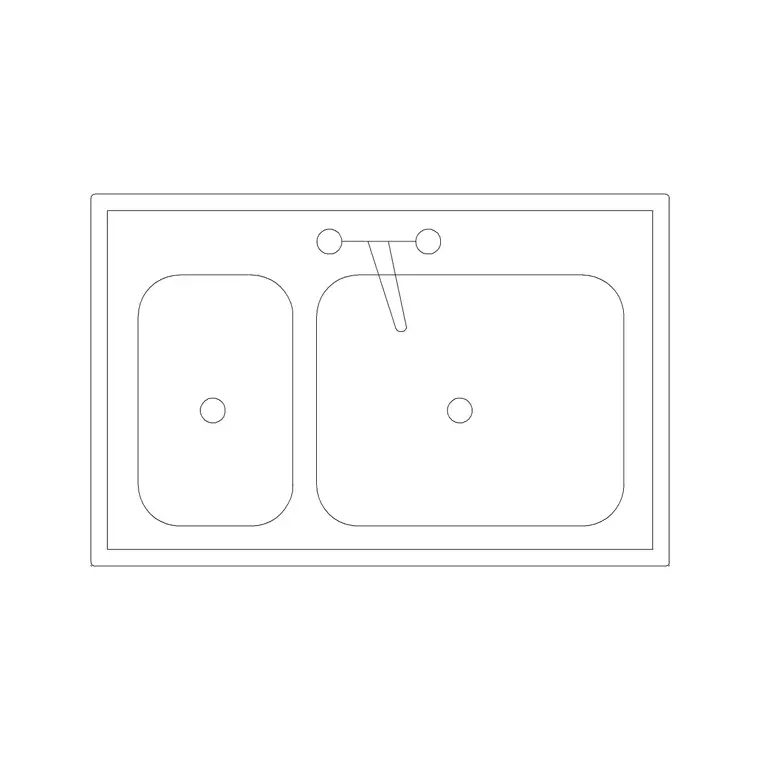
A double-bowl block draws the sink top with two bowls cut into it, side by side, plus the tap position at the back. Some are symmetric — two equal bowls — and some are 1.5-bowl style with a large main bowl and a smaller half bowl. The plan view shows both bowls inside the unit outline, which is what you need to check the unit against the cabinet and to set out the waste, because a double sink usually has two wastes joined to a single trap.
Styles vary: the 880 mm curved double has a softened front edge, while square-bowl doubles read as crisp rectangles. Whichever you choose, the block footprint is the worktop cut-out, so snapping it to the cabinet line tells you straight away whether the unit fits.
Typical double-bowl sink dimensions
Work to these ranges. Double-bowl sink top width: commonly 800–1000 mm, with sizes like 690 mm for a compact double and 880 mm for a generous one. Front-to-back depth: around 480–600 mm to suit a 600 mm worktop. Each bowl: roughly 300–400 mm wide for an equal-bowl sink, or one large bowl plus a half bowl in a 1.5-bowl layout. Bowl depth: 160–200 mm into the cabinet.
The key planning fact is the cabinet beneath. An 800–1000 mm double sink generally needs an 800 mm or 1000 mm base unit, not a single 600. A 690 mm compact double is the size to reach for when you want two bowls but only have an 800 mm cabinet to give. Dropping the scaled block onto the cabinet run makes that fit obvious.
Double versus single and 1.5-bowl
Choosing between bowl counts is a worktop-versus-function call. A single bowl saves the most worktop; a full double gives you two equal bowls for washing and rinsing; a 1.5-bowl splits the difference with a main bowl plus a small half bowl handy for rinsing veg or holding a colander. The 1.5 is popular because it offers some of the double's flexibility without the full width.
On the drawing, the trade-off is visible. Lay the single, the 1.5 and the double blocks along the same run and you can see how each eats into the preparation worktop and how wide a cabinet each demands. For a family kitchen where the cook works at the sink, the double usually earns its width; for a kitchen leaning on a dishwasher, a single or 1.5 often makes more sense.
How to insert and place the double sink
The blocks are drawn full size in millimetres: insert at scale 1 in a millimetre drawing, 0.001 in a metre drawing, or set INSUNITS to millimetres for automatic rescaling. Use INSERT or drag from a tool palette.
Pick the back edge of the sink top as the insertion handle and snap it to the back of the worktop, centred over its base cabinet. Because a double sink is wide, place it where you have the cabinet width — usually a longer external-wall run near the window — and let the hob, oven and fridge fall around it. With two bowls there are two wastes, so keep the block on a services-aware layer and dimension both bowl centrelines so the plumber can set out the trap and the double waste cleanly.
Where double-bowl sinks are used
Double-bowl sink blocks belong in family kitchen plans, larger apartment and house layouts, holiday-let kitchens and any scheme where the cook genuinely works at the sink. They also appear in light commercial kitchenettes and staff kitchens where two bowls speed up washing.
Use the double alongside the single and counter-sink blocks in the sinks-and-faucets category so you can compare the options on one drawing, and combine it with the hob, oven, hood and cabinet blocks to build the full kitchen layer. Where a scheme repeats the same kitchen across many units, standardise on one double-bowl block so a single BEDIT change updates every instance at once.
Free download
Browse the full library — DWG & DXF, no signup.
Questions
Frequently asked
How wide is a double-bowl kitchen sink?+
Double-bowl sink tops are commonly 800–1000 mm wide, with compact doubles around 690 mm and generous ones around 880 mm. They usually need an 800 mm or 1000 mm base cabinet rather than a single 600 mm unit.
What is the difference between a double bowl and a 1.5-bowl sink?+
A double bowl has two equal-size bowls; a 1.5-bowl sink has one large main bowl plus a smaller half bowl. The 1.5 gives some of the double's flexibility in a narrower unit, which suits kitchens short on worktop.
What view are the double-bowl sink blocks drawn in?+
They are plan-view (top-view) blocks showing both bowls inside the sink top, ready to lay onto a worktop run and to set out the twin wastes against the drainage drawing.
Are the double-bowl sink blocks free for commercial use?+
Yes. Every block downloads free in DWG and DXF with no signup, no watermark and no attribution requirement, and they are cleared for commercial project use.
Related downloads
Blocks for this guide

Related categories
Related guides
Block landing
Free Sanitary Fixtures CAD Blocks — DWG Download
Download free sanitary fixtures CAD blocks in DWG and DXF — WCs, wash basins, urinals and sinks in plan and section for AutoCAD sanitary plans.
Block landing
Free Kitchen Faucet / Mixer Tap CAD Block — DWG
Download free kitchen faucet and mixer tap CAD blocks in DWG and DXF — monobloc and pull-out mixers in plan and elevation. No signup, commercial OK.
Block landing
Free Kitchen Sink Unit CAD Block — DWG Download
Download free kitchen sink unit CAD blocks in DWG and DXF — single, double and 1.5-bowl sinks with drainers in plan and section. AutoCAD 2004+, no signup.