Block landing · dog leg staircase cad block
Free dog-leg staircase CAD blocks for AutoCAD
By Sumana Kumar · Published 27 Mar 2026 · Updated 24 Jun 2026
A dog-leg staircase is the most common stair in houses and small buildings: two parallel flights running in opposite directions, joined by a half-landing, so the stair doubles back on itself within a compact rectangular footprint. This page collects free dog-leg staircase CAD blocks in DWG and DXF, drawn in plan with both flights and the landing, and in elevation showing the switchback, ready to insert into AutoCAD 2004 or later. Everything is free for personal and commercial work, with no signup and no watermark.
The dog-leg earns its popularity by fitting a full storey climb into a tidy box against a wall, with no awkward central void. The blocks here are set out as a true half-turn — up one flight, around the half-landing, up the second flight directly above the first — so the moment you place one you can check it against the stairwell walls, the head clearance at the landing, and the door positions on each floor.
What a dog-leg staircase block shows
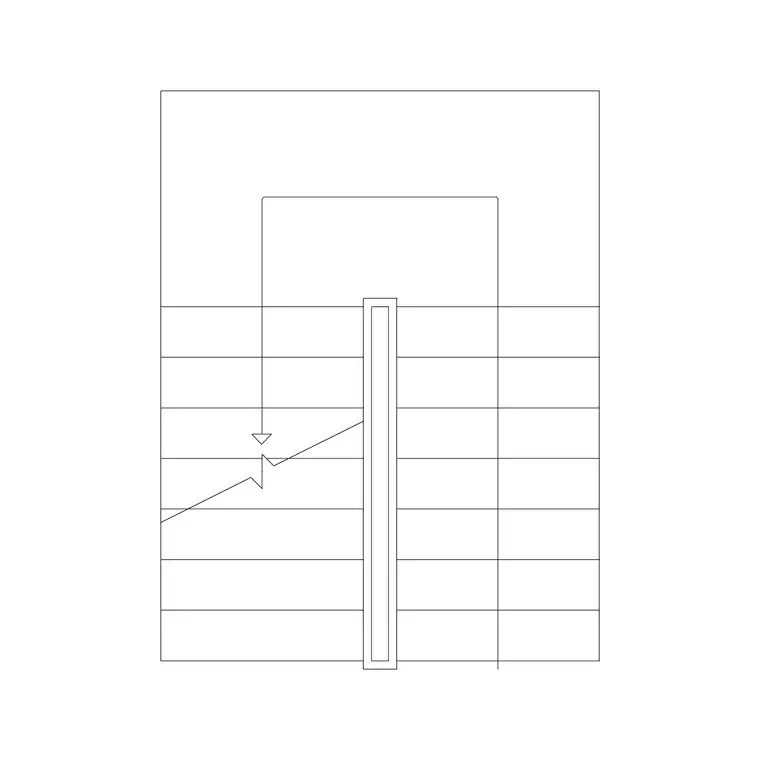
In plan, a dog-leg stair reads as two flights side by side running in opposite directions, separated by a half-landing at the turn, with the up/down arrows showing that the lower flight climbs one way and the upper flight returns the other. A break line marks where the upper flight passes over the lower. The two flights typically share a common stringer wall down the middle, which is the line that makes a dog-leg instantly recognisable from a switchback or open-well stair.
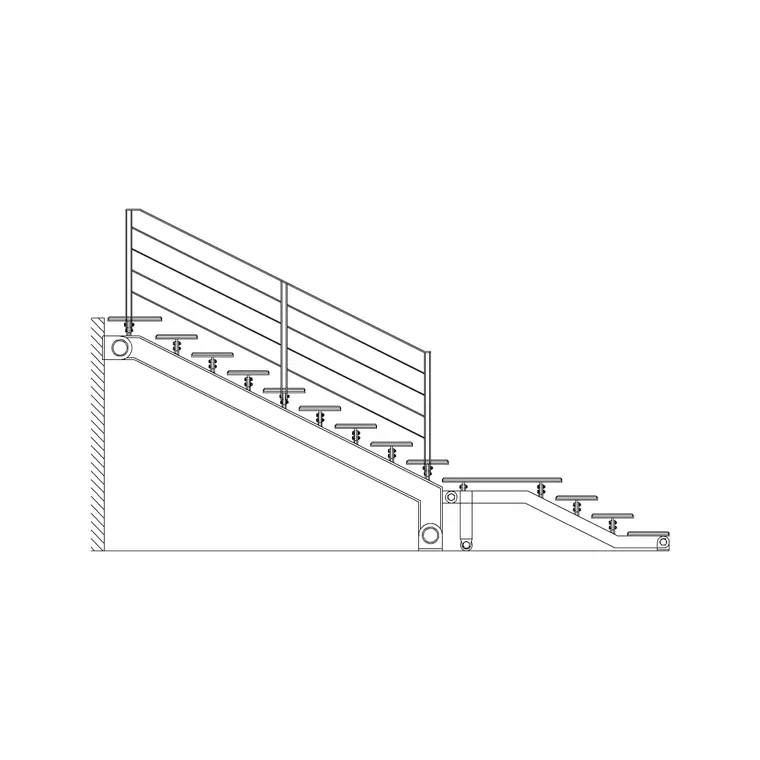
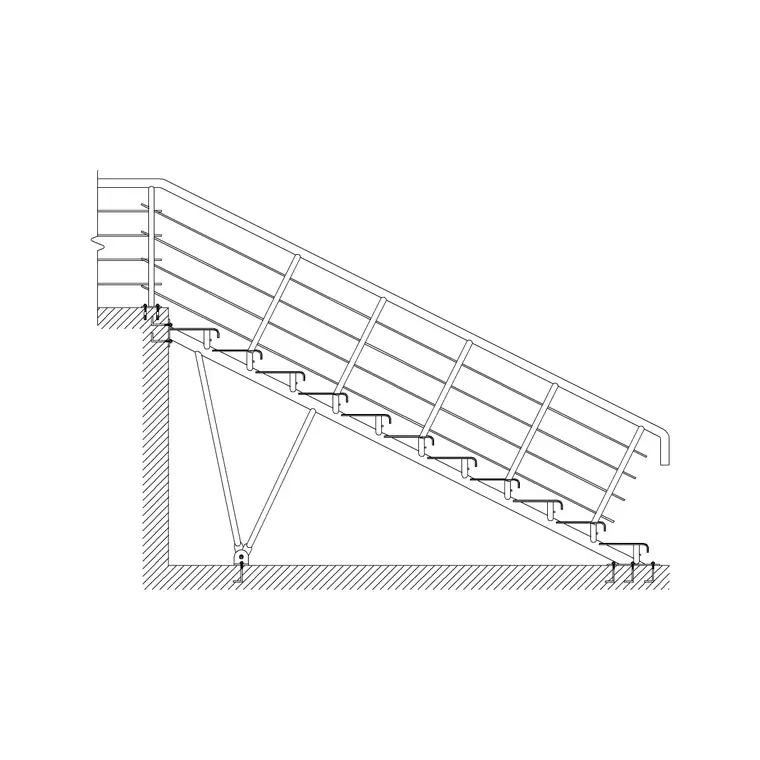
In elevation the stair shows the lower flight rising to the half-landing, the landing itself, and the upper flight rising in the return direction. This view is what proves the headroom at the half-landing and confirms the floor-to-floor height is split sensibly between the two flights.
Dog-leg versus other turning stairs
It is worth being clear which turning stair you are placing. A dog-leg (half-turn) stair has the two flights immediately adjacent with no gap between them, sharing a central stringer. A switchback with an open well leaves a slot between the flights. An L-shaped (quarter-turn) stair turns through ninety degrees at a landing rather than doubling fully back. Each has a different footprint and a different feel.
Choosing the dog-leg block matters because of how it sits in a plan: it stacks the two flights in one rectangle, which is why it suits a stairwell between two rooms or against a party wall in a terraced house. If your plan needs the entry and exit on adjacent walls rather than the same end, an L-shaped block is the better fit; if you want a feeling of openness, a stair with an open well reads differently.
Views and what's included
Dog-leg downloads here usually pair a plan with an elevation, and some add a section. The plan is the workhorse — it goes into the floor layout, sets the stairwell footprint, and locates the doors at the bottom and top. Because a dog-leg serves two levels, the plan often shows the lower flight on the ground-floor drawing and the upper flight (with the break line) overlaid, so a single block describes the stairwell on both floors.
The elevation and section describe the rise and the landing and are what you place on the stair detail sheet. Keep the flights, the landing and the balustrade on sensible layers so the same block produces a clean architectural plan and a detailed stair drawing without rework.
Typical dog-leg staircase dimensions
A dog-leg is sized by the flight width, the going and rise of the treads, and the half-landing. The overall stairwell is roughly twice the flight width across (the two flights side by side plus the central stringer) by the length needed for the going of one flight plus the landing depth. Domestic flight widths are commonly in the region of 800–1000 mm, with wider flights for more generous or shared stairs.
Rise and going sit in the normal comfortable stair band, with the number of risers split between the two flights either side of the half-landing. The half-landing should be at least as deep as the flight is wide so a person can turn comfortably. Headroom under the upper flight and over the landing is the figure to watch. Treat all of these as ranges to design within and confirm rise, going, width, landing size and headroom against your local building regulations before finalising the stair.
Inserting and placing the block
The blocks are drawn full size in millimetres. Insert at scale 1 in a millimetre drawing, 0.001 in a metre drawing, or set INSUNITS to millimetres so AutoCAD rescales on insertion. A natural insertion point for a dog-leg is the bottom corner of the lower flight where it meets the stairwell wall, so the stair seats cleanly into the corner of the well and you can dimension from a known datum.
Use ROTATE to swing the whole stair to the orientation the plan needs, and MIRROR to flip the handedness so the lower flight starts from the correct side of the well. Because the stair is one block reference, those moves keep the two flights and the landing perfectly coordinated. Keep it on a dedicated stair layer to freeze for the shell plan and thaw for the furnished drawing.
Where dog-leg staircase blocks are used
The dog-leg is the default domestic stair, so these blocks turn up in nearly every house, flat and small-building drawing: terraced and semi-detached houses, apartments, small offices, and anywhere a compact stairwell between two floors is wanted. It is the stair architects reach for first when a plan has a normal storey height and a rectangular slot to put the stair in.
Because the blocks are free and licence-clear, they suit everything from a quick residential concept to a coordinated set where the stairwell has to read consistently across the ground-floor plan, the upper-floor plan, the section and the detail. Pair them with the other stair blocks in the stairs category when a scheme mixes a main dog-leg stair with a secondary spiral or a feature circular stair elsewhere in the building.
Free download
Browse the full library — DWG & DXF, no signup.
Questions
Frequently asked
What is a dog-leg staircase?+
A dog-leg (half-turn) staircase has two parallel flights running in opposite directions, joined by a half-landing, so the stair doubles back on itself. The two flights sit immediately adjacent and usually share a central stringer, fitting a full storey climb into a compact rectangle.
What's the difference between a dog-leg and an L-shaped stair?+
A dog-leg makes a half-turn (180 degrees) so the upper flight runs directly back over the lower one. An L-shaped stair makes a quarter-turn (90 degrees) at a landing, so the entry and exit sit on adjacent walls rather than the same end. Pick the block that matches your stairwell shape.
Do the dog-leg blocks include plan and elevation?+
Most pair a plan with an elevation, and some add a section. The plan locates the stairwell on both floors with a break line for the upper flight; the elevation and section describe the rise and the half-landing. Each download page lists the views included.
Are the dog-leg staircase blocks free for commercial use?+
Yes. Every block downloads free in DWG and DXF with no signup, no watermark and no attribution requirement, and they are cleared for commercial project work.
Related downloads
Blocks for this guide
Related categories
Related guides
Block landing
Free Spiral Staircase CAD Blocks — DWG Download
Download free spiral staircase CAD blocks in DWG and DXF — plan and elevation, drawn to real tread radii for AutoCAD. No signup, free for commercial use.
Block landing
Free Circular Staircase CAD Blocks — DWG Download
Download free circular staircase CAD blocks in DWG and DXF — curved stairs in plan and elevation, drawn to scale for AutoCAD. No signup, commercial-use OK.
Block landing
Free Metal Staircase CAD Blocks — DWG Download
Download free metal staircase CAD blocks in DWG and DXF — steel stairs in plan and elevation with stringers and balustrade. No signup, commercial OK.