Curated pack · dining room cad block pack
Free dining room CAD block pack for AutoCAD
By Sumana Kumar · Published 27 Mar 2022 · Updated 7 Apr 2026
A dining room is dimensionally simple but ruthless about clearances: a table that seats six on paper fails the moment a chair can't pull back without hitting the wall. This free dining room CAD block pack collects the furniture that makes or breaks that layout — rectangular and round dining tables, place settings, dining chairs and complete dining sets — in DWG and DXF, drawn at true millimetre sizes and ready to insert into AutoCAD 2004 or later. Free for personal and commercial work, no signup, no watermark.
Use the pack for residential dining rooms, open-plan kitchen-diners, restaurants and hotel function spaces. Because the tables are drawn to real seat-per-side modules with the chairs in place, the pull-out and circulation space around the set is something you can see, not something you have to remember.
The blocks are built as sets — table plus the right number of chairs already spaced — so you drop a six-seater into a room, check the clearance to the walls, and the dining zone is resolved in one move.
What's in the dining room pack
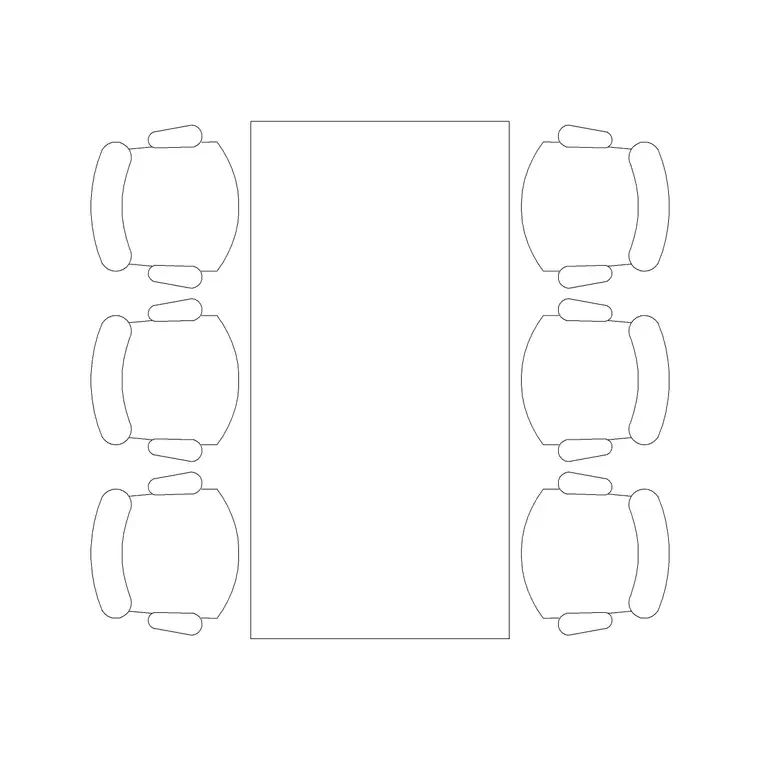
The pack centres on dining sets, because the table and its chairs have to be considered together. There are rectangular tables drawn for four, six and eight covers — including a six-person rectangular dining table with the chairs already placed — alongside round tables for more sociable, compact rooms and the loose dining chairs you add or swap.
Each set is a clean plan-view block you can copy, mirror and rotate as a unit. The table outline, the chairs and the place settings are arranged on a sensible layer convention so you can show a fully laid table for a presentation or strip it back to the bare footprint for a setting-out plan. Keep the lot on a furniture layer and the dining zone toggles on and off cleanly.
How to use the set together
Place the table where the room or the open plan wants its centre of gravity — under a pendant light, aligned with a window, or as the hinge between a kitchen and a living zone. Then check the one number that governs a dining room: at least 1000 mm of clear floor from the table edge to the nearest wall or furniture, so a diner can pull a chair back and stand. Where that gap is also a walkway, push it to 1100–1200 mm.
The six-person set ships with the chairs already spaced along the sides and ends, so the cover spacing is correct out of the box. Rotate the whole set to the room, confirm the perimeter clearance on every side, and the layout is done. For a bespoke arrangement, drop a bare table and array the chair block around it at your own spacing.
Table and seating notes
Dining tables follow a per-cover module: allow roughly 600 mm of table edge per person so elbows don't clash, which is why a six-seater rectangular table lands around 1500–1800 mm long, and an eight-seater 2000–2400 mm. Depth across a rectangular table is usually 900–1000 mm so two people can sit opposite with serving space down the middle.
Chairs need around 450–500 mm of width each and, crucially, pull-back space behind them — budget about 750 mm from the table edge to let a chair slide out and a person rise, then the circulation gap on top of that. The six-person set bakes the cover spacing in; for round tables, remember a round top seats people more flexibly but needs a clear diameter that can eat a small room quickly.
Rectangular vs round tables
Choosing between a rectangular and a round dining table is a real layout decision, not just a style one. A rectangular table suits long rooms, seats more for a given footprint, and aligns naturally with a wall or a galley kitchen-diner — it's the workhorse, and the six-seater here is drawn for exactly that. A round table seats people more sociably, has no head of the table, and tucks better into a square or awkward room, but its clear diameter grows fast: a four-seater round is comfortable, a six-seater round needs a surprisingly large clear floor.
Drop both into the plan and compare. The scaled blocks let you see whether the rectangular set leaves a usable walkway down one side, or whether the round table's diameter swallows the circulation. That's a five-second test with blocks and an expensive mistake without them.
Plan view for layouts
Dining work is almost entirely plan: the table, chairs and settings seen from above with the pull-back and circulation space checked all round. The plan blocks are what you array when a restaurant repeats a two- or four-top across a floor, or mirror when an open-plan kitchen-diner is handed.
Keep the dining set on a furniture layer so you can freeze it for a clean shell plan and thaw it for the furnished version. For restaurant and function layouts, tag each set as a block so you can extract a cover count straight from the drawing — the dining equivalent of a seating schedule.
Who uses the dining room pack
Interior designers use it to lay out residential dining rooms and open-plan kitchen-diners quickly. Architects use it to prove a dining space works at the proposed size. Restaurant and hospitality designers use the sets to plan covers, check circulation between tables, and count seating capacity from the drawing.
Because the blocks are free and licence-clear, the same pack serves a single dining-room scheme or a multi-cover restaurant fit-out. Pair it with the living-room and furniture sets to lay out a complete open-plan living-dining space from one consistent library.
Free download
Browse the full library — DWG & DXF, no signup.
Questions
Frequently asked
How many covers do the dining tables seat?+
The pack includes rectangular tables for four, six and eight — including a six-person rectangular set with chairs placed — plus round tables for compact rooms. Each is drawn on a real per-cover module of roughly 600 mm of table edge per person.
How much clearance should I leave around a dining table?+
Allow at least 1000 mm of clear floor from the table edge to the nearest wall or furniture so a chair can pull back, and 1100–1200 mm where that space is also a walkway. The scaled blocks make the check visual.
Are the dining room blocks free for commercial use?+
Yes. Every block downloads free in DWG and, where available, DXF, with no signup, no watermark and no attribution requirement, cleared for commercial projects.
Can I use these for a restaurant layout?+
Yes. Array the table sets across the floor, check the gaps between them, and tag each as a block so you can extract a cover count — the dining equivalent of a seating schedule — straight from the drawing.
Related downloads
Blocks for this guide
Popular blocks to download
Related categories
Related guides
Curated pack
Free Office CAD Block Pack — DWG & DXF
Free office CAD block pack in DWG and DXF — desks, workstations, conference tables and reception furniture in plan view. No signup, commercial-use OK.
Curated pack
Free Reception Area CAD Block Pack — DWG
Free reception area CAD block pack in DWG and DXF — reception desks, waiting seating and scale figures for lobby layouts. No signup, commercial-use OK.
Curated pack
Free Restaurant CAD Block Pack — DWG & DXF
Free restaurant CAD block pack in DWG and DXF — dining tables, chairs, bar stools and high chairs for cafe and restaurant layouts. No signup, commercial OK.