Block landing · corner bathtub cad block
Free corner bathtub CAD blocks for AutoCAD
By Saumyajit Maity · Published 22 Jun 2024 · Updated 17 May 2026
A corner bathtub tucks into the junction of two walls, presenting a diagonal or curved front to the room. It is the bath you reach for when a square or awkwardly-shaped bathroom wastes a corner that a straight bath cannot use, or when the design wants a generous, often larger bathing area set on the diagonal. This page collects free corner bathtub CAD blocks in DWG and DXF — triangular and offset corner baths — drawn to true size and ready for AutoCAD 2004 or later, free for personal and commercial work with no signup and no watermark.
The corner bath's geometry is its whole story: it fills two walls and faces the room across a diagonal, which changes how it is set out and how much floor it commands. Because the diagonal front projects further into the room than a straight bath edge, drawing it from a correctly-proportioned block is the only reliable way to see whether it really fits the corner you have in mind.
How a corner bath sets out differently
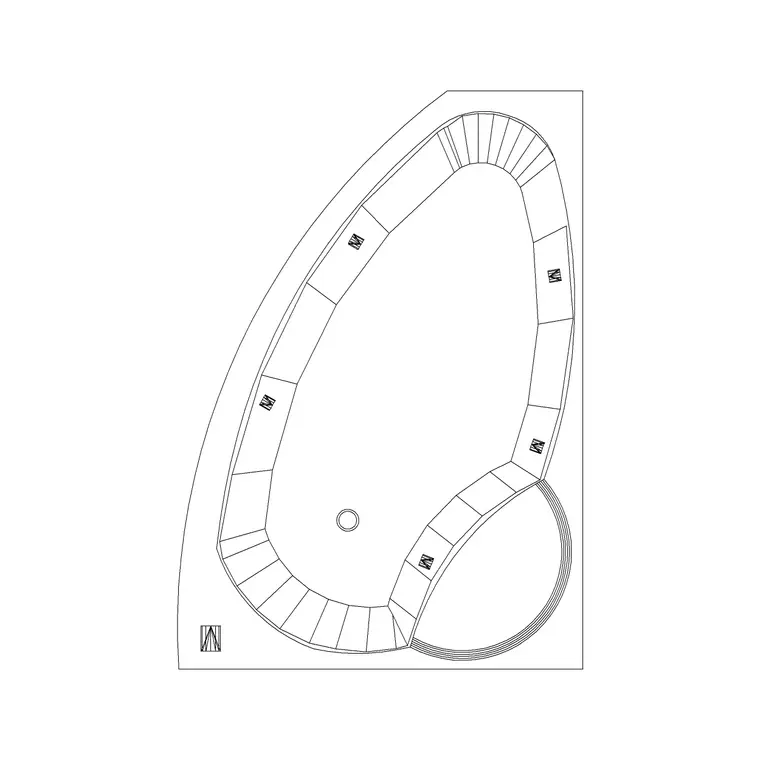
A corner bath is shaped to sit against two walls meeting at 90 degrees, with the bathing area filling the corner and the front edge running diagonally — either a single straight diagonal (triangular) or a curved sweep — across the room. An offset corner bath is asymmetric, longer along one wall than the other, which suits a room where one wall is longer.
Unlike a rectangular bath, a corner bath's footprint is governed by its two wall lengths and the diagonal between them, not a simple length and width. The block shows both wall edges, the diagonal front and the tap position so you can seat it in the corner and read exactly how far the front projects into the room.
Plan view is where the corner bath earns its block
The plan view is the critical one for a corner bath, because the diagonal front is hard to judge by eye. The plan shows the two wall edges, the inner bowl and the front sweep, so you can place the bath in the corner and immediately see the floor it takes and the clear space left in the room.
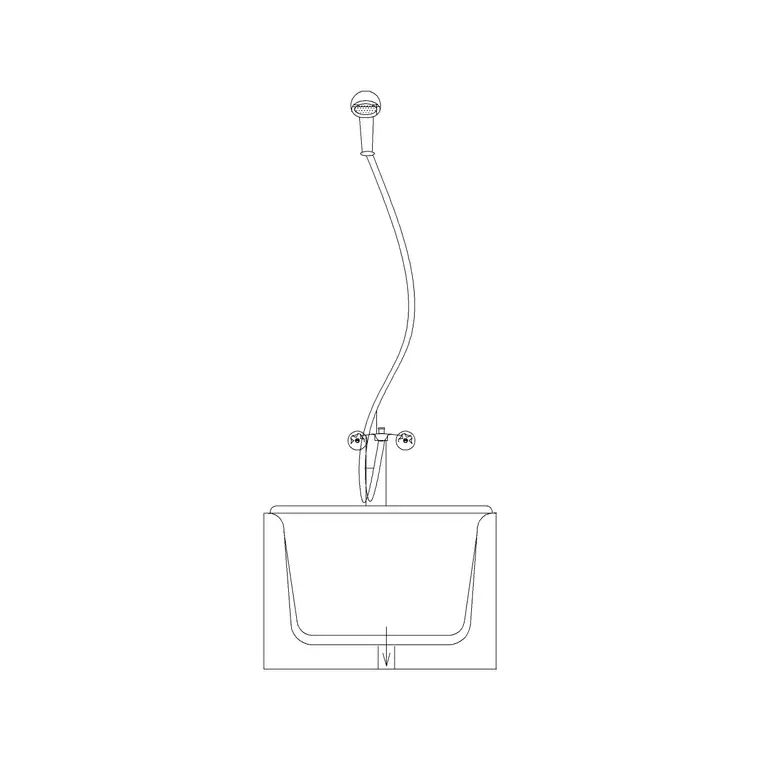
For tiling and presentation you also use an elevation, drawn face-on to one wall, showing the bath panel that follows the diagonal or curved front at the rim height. A section can show the internal depth. Many downloads pair the plan with an elevation so one file covers both the corner fit and the tiled face.
Typical corner bath dimensions
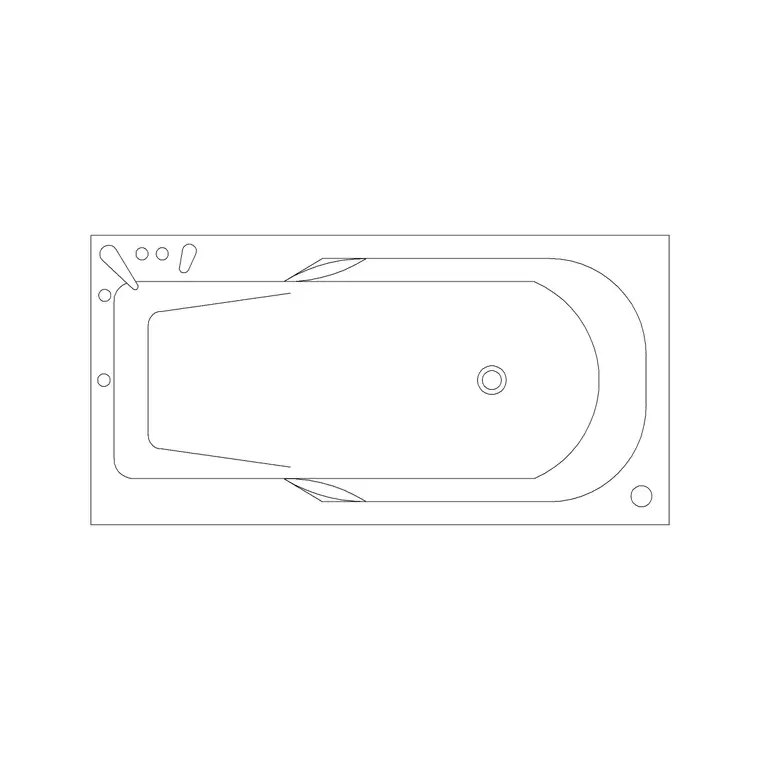
Design around these figures. Symmetric corner bath: commonly 1200–1500 mm along each wall. Offset corner bath: often around 1500–1700 mm on the long wall and 700–1000 mm on the short wall. Rim height: 500–560 mm above the floor, as for a straight bath. The diagonal front projects into the room well beyond a straight bath's 700 mm depth, so the bath commands a larger triangle of floor.
Leave clear access along the diagonal front so a person can step in, and remember the corner bath, while it uses the corner, often needs more total floor area than a straight bath of similar bathing length. Check the projection against the room before committing.
Seating the bath in the corner
The blocks are drawn full size in millimetres — insert at scale 1 in a millimetre drawing, or set INSUNITS to millimetres for automatic rescaling. Use INSERT, snap the bath's corner point to the internal corner of the two walls, and rotate if the offset bath needs its long edge on a particular wall.
Push both wall edges hard against the walls, draw the bath panel along the diagonal or curved front, and check the projection into the room. Mark the tap/waste end — usually in the corner or along one wall — for the plumber. Keep the bath on a sanitaryware layer so it freezes off a structural plan and thaws back for the furnished and tiling drawings.
When to choose a corner bath
Reach for a corner bath block when a bathroom is broadly square and a straight bath would leave an unusable corner, or when the client wants a large, indulgent bathing area set on the diagonal. They suit master en-suites and larger family bathrooms where floor area is available, and rooms where the door, window and other fixtures leave a corner as the natural bath position.
Avoid them in tight bathrooms where the diagonal projection eats too much floor — a straight rectangular bath is more space-efficient there. Because the corner bath is a separate scaled block, you can test it against a straight bath in the same room and see directly which uses the floor better. Pair it with the WC, basin, shower and faucet blocks to complete the sanitary layer.
Coordinating the diagonal front and access
The corner bath's diagonal front is both its appeal and its constraint, so the block helps you coordinate it. The front projects further into the room than any straight bath edge, which can clash with a door swing, a basin or a circulation route — clashes that are obvious on the plan once the true-size block is in place but easy to miss when sketching. Drop the block in early and walk the door swing and the route to the WC past the projecting front.
Access is the other coordination point. A person steps in over the diagonal front, so leave a clear approach there rather than against a wall. For an offset corner bath, the longer arm gives a more comfortable lie, so orient it with the long arm where the user's legs go. Keeping the bath as a scaled block lets you set the panel line, dimension both wall edges and fix the tap position so the diagonal front builds exactly as drawn.
Free download
Browse the full library — DWG & DXF, no signup.
Questions
Frequently asked
What is a corner bathtub?+
A corner bathtub sits against two walls meeting at 90 degrees, with the bathing area in the corner and a diagonal or curved front facing the room. It can be symmetric (triangular) or offset, with one arm longer than the other.
Does a corner bath save space?+
It uses an otherwise wasted corner, which helps in a square room, but its diagonal front projects further into the room than a straight bath, so it often needs more total floor area. Drop the scaled block in to check the projection against your room.
What size are corner baths?+
Symmetric corner baths are commonly 1200–1500 mm along each wall; offset versions run around 1500–1700 mm on the long wall and 700–1000 mm on the short wall. The rim height is around 500–560 mm, as for a straight bath.
Are the corner bathtub blocks free for commercial work?+
Yes. They download free in DWG and, where available, DXF, with no signup, no watermark and no attribution requirement, and they are cleared for commercial project use.
Related downloads
Blocks for this guide
Related categories
Related guides
Block landing
Free Bathroom Fixtures CAD Blocks — DWG Download
Download free bathroom fixtures CAD blocks in DWG and DXF — toilets, wash basins, bathtubs, showers and vanities drawn in plan and elevation. No signup, commercial OK.
Block landing
Free Sanitary Fixtures CAD Blocks — DWG Download
Download free sanitary fixtures CAD blocks in DWG and DXF — WCs, wash basins, urinals and sinks in plan and section for AutoCAD sanitary plans.
Block landing
Free Toilet / WC CAD Blocks — DWG Download
Download free toilet / WC CAD blocks in DWG and DXF — close-coupled, back-to-wall and commode pans in plan and elevation for AutoCAD. No signup, commercial OK.