Room guide · coffee shop cad blocks
Free coffee shop CAD blocks for AutoCAD plans
By Saumyajit Maity · Published 13 Apr 2024 · Updated 14 Mar 2026
A coffee shop reads like a cafe but plans like a workshop built around one piece of equipment: the espresso bar. Everything orbits the barista station — the queue feeds into it, the collection point hangs off the end of it, the milk fridge and grinder live behind it, and the seating is whatever the rest of the floor allows. Get the bar wrong and no amount of pretty seating will save the service; get it right and even a tiny unit runs smoothly through a morning rush.
This page is for laying out a specialty coffee shop in AutoCAD: order-and-collect at the counter, a mix of perch seating and tables, and a strong identity at the bar. The free CAD blocks here cover the seating and dressing side of that plan — counter and ledge stools, small two-top tables, a four-top, planters and statement pendants — all DWG, scaled, free for commercial use, no signup. You supply the bar joinery; these populate the room around it.
The one idea to hold onto is the difference between dwell and grab-and-go. A grab-and-go shop is mostly queue and counter with a few perches; a destination coffee shop is mostly seating with a counter at one end. Decide which you are designing before you place a single table, because it changes how much floor goes to the queue versus the covers.
The bar is the plan
In a coffee shop the espresso bar is the fixed object everything else negotiates with. It has a customer face (order, pay, collect) and a working face (machine, grinder, fridge, sink) with the barista in the gap between. The customer face dictates where the queue forms and where finished drinks are handed over; the working face dictates the back-of-bar depth you must reserve.
Draw the bar and its zones first. Reserve a barista working zone behind it, place the queue against the customer face, and mark the collection point at the downstream end so people who have ordered move past the till rather than back into the line. Only once that loop is clean do you start placing seating, because the seating cannot be allowed to choke the order loop.
Seating and dressing blocks
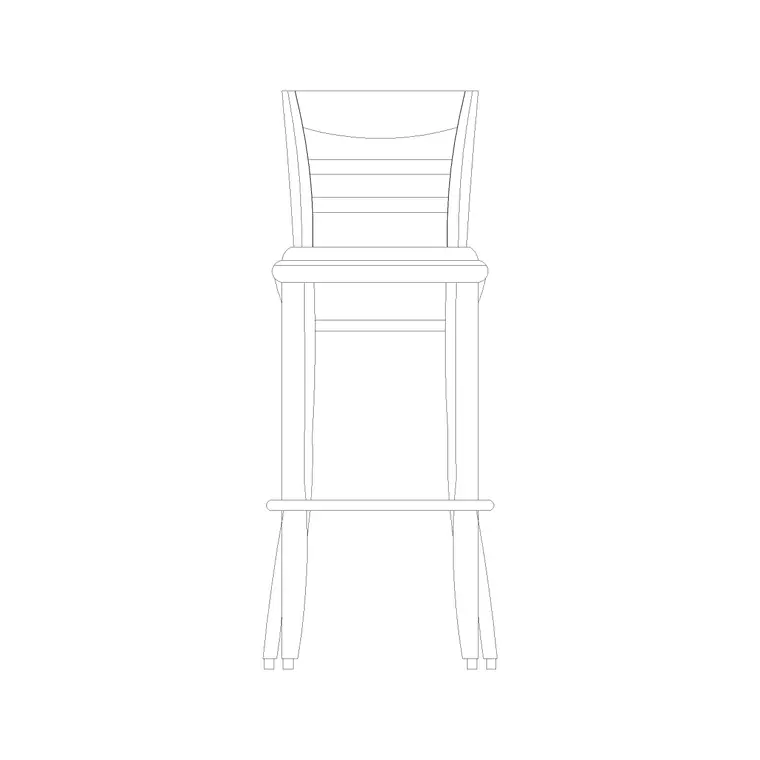
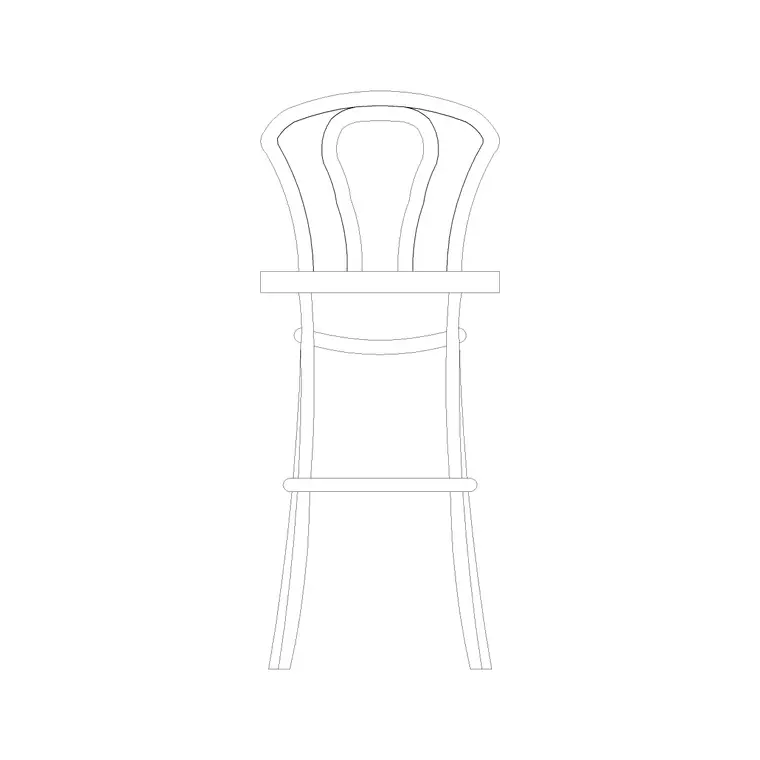
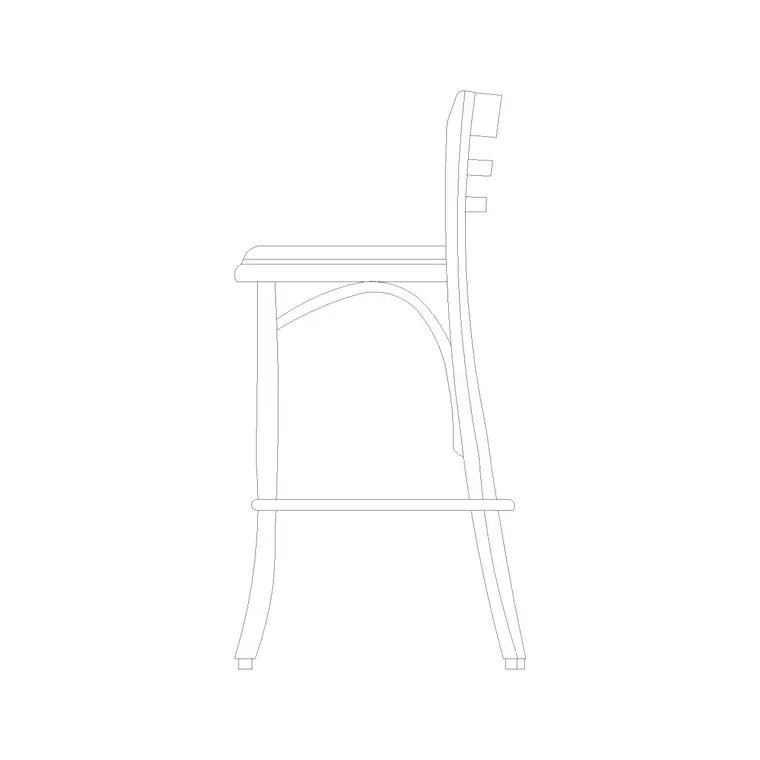
Coffee shops favour perch and small-table seating. The wooden bar stool, round-back stool and bar stool with wooden strip sit at the counter, the window ledge and any high communal table — they add covers without the floor a chair-and-table needs. For sit-down covers, the 600mm and 800mm dia two-tops and the 800mm square two-top scatter along walls and into corners; the 1000mm four-seater takes the larger group or the laptop crowd. The Audi chair plan block rings the tables.
Dress the room to match the brand: a medium potted plant or an indoor large plant on MS legs screens the queue and softens the hard surfaces, and a long suspended metal chandelier or a Frisbi-style pendant over the communal table gives the elevation its hero moment. Scaled blocks mean the perch count and the table count are both real numbers you can read off the plan.
Coffee shop dimensions to design around
Reserve a barista working zone of roughly 900–1000mm clear behind the customer face of the bar so two staff can pass during a rush. The customer-side queue lane wants about 900mm and length for your peak — a grab-and-go shop may need five metres of queue, a destination shop far less.
Counter and high-table stools sit at counters around 1050–1100mm with seats near 750–800mm and roughly 550–600mm of counter per stool. Window-ledge perches want a ledge depth of 300–400mm. Low tables follow cafe figures: two-tops 600–800mm across, a four-top about 1000mm, 600mm of edge per person, 450mm of chair pull-out. Keep a clear 900mm route from door to counter and one accessible, standard-height table reachable without weaving through perches.
Assembling the floor in AutoCAD
Block out the bar footprint and hatch the barista working zone so nobody parks seating in it. Draw the queue lane from door to till as a polyline and confirm the collection point sits downstream so ordered customers flow past, not back into the line.
Now layer in seating. Line the window and any high communal table with stool blocks at 550–600mm centres. Array the small tables into the remaining floor, ringed with chairs, keeping 700–900mm walkable between edges. Drop a planter to screen the queue from the nearest seated guest and hang the pendant over the communal table in both plan and elevation. Put bar, working zone, perches, tables, chairs, planting and lighting on separate layers so you can count perch covers and table covers as two honest tallies.
Dwell versus grab-and-go
Decide the shop's personality and let it drive the floor split. A grab-and-go unit gives most of the floor to a generous queue and counter, with a row of window perches and maybe two tables — it is about throughput, not lingering. A destination coffee shop flips that: a compact bar at one end and the bulk of the floor in comfortable seating, a communal table under a feature pendant, planters between zones.
Use the blocks to show the chosen split clearly. If it is grab-and-go, the drawing should be mostly queue and perches; if it is a destination, the drawing should be mostly tables with the bar tucked at one end. Count the covers either way so the client sees what the personality costs in seats.
Common coffee-shop mistakes
- Placing seating in the barista working zone, so staff trip over a stool every rush. - A collection point upstream of the queue, sending ordered customers back through the line. - Treating it as a cafe and forgetting to reserve back-of-bar depth for the machine, grinder and fridge. - A hero pendant hung over a table that gets moved, leaving the light stranded over a walkway. - Window perches with no ledge depth, so there is nowhere to rest a cup in the elevation.
Draw the bar and its zones first, prove the order loop, then place the scaled seating around it.
Free download
Browse the full library — DWG & DXF, no signup.
Questions
Frequently asked
How much working space does a barista bar need behind the counter?+
Reserve roughly 900–1000mm clear behind the customer face of the bar so two staff can pass during a rush, plus depth on the back wall for the machine, grinder, fridge and sink. Hatch that zone on the plan so no seating creeps into it.
What is the difference between a grab-and-go and a destination coffee shop plan?+
A grab-and-go shop gives most of the floor to queue, counter and a few window perches for throughput. A destination shop puts a compact bar at one end and fills the rest with comfortable tables and a communal table under a feature pendant. Decide which before you place a table, because it changes the floor split.
Are the coffee shop CAD blocks free to use commercially?+
Yes. Every block is DWG, free for personal and commercial use, with no signup and no watermark, ready for a paid fit-out drawing.
Where should counter and ledge stools sit?+
At the espresso bar, along the shopfront ledge and at any high communal table — places where a perch adds a cover without the floor a full chair-and-table needs. Allow about 550–600mm per stool and a ledge depth of 300–400mm.
Do you supply the espresso bar joinery as a block?+
The pack supplies the seating and dressing side — stools, tables, chairs, planters and pendants. The bar itself is bespoke joinery you draw to suit your machine and layout; block out its footprint and the barista working zone first, then arrange these blocks around it.
Related downloads
Blocks for this guide

Related categories
Related guides
Room guide
Free Restaurant Layout CAD Blocks — DWG Download
Free restaurant CAD blocks in DWG — dining tables, chairs, bar stools, planters and chandeliers for AutoCAD seating plans. No signup, commercial OK.
Room guide
Free Bar Lounge CAD Blocks — DWG Download
Free bar lounge CAD blocks in DWG — bar stools, lounge sofas, low tables, planters and chandeliers for cocktail bar plans. No signup, commercial OK.
Room guide
Free Hotel Room CAD Blocks — DWG Download
Free hotel room CAD blocks in DWG — double bed, lounge chair, table, lamp and planter for standard guest-room plans. No signup, commercial OK.