Room guide · classroom cad blocks
Free classroom CAD blocks for AutoCAD layouts
By Sumana Kumar · Published 27 Jan 2024 · Updated 25 Apr 2026
A classroom is a sized room before it is anything else. The number of students, the sightlines to the board, the gap a teacher needs to walk between rows, and the door that must clear a desk all decide the layout long before you pick colours. Starting from scaled CAD blocks means the plan is correct by construction: you can see the moment two desk rows leave no aisle, or a back row falls outside a comfortable viewing angle to the teaching wall.
This page collects free classroom CAD blocks in DWG and DXF — single and paired student desks, stackable chairs, a teacher's table and human figures for occupancy checks — drawn at true millimetre dimensions and ready to insert into AutoCAD 2004 or later. Everything is free for personal and commercial work, with no signup and no watermark.
Use the blocks to lay out a standard teaching classroom, a science or computer room, a special-needs room with wider circulation, or an examination hall. Because each block is drawn to scale, you can test seating capacity, aisle widths and the all-important clear teaching zone at the front in the same pass.
Who uses a classroom and what the layout has to do
A classroom serves one teacher and a cohort of students for a sustained period, so the plan has to support three things at once: every student can see and hear the front, the teacher can reach every desk, and the room can empty quickly in an emergency. Those three jobs pull in different directions — packing desks in helps capacity but kills circulation and sightlines — so the layout is always a negotiation.
The teaching wall (board, screen or smartboard) anchors the room. Desks face it, and the first row should sit far enough back that students aren't craning up at the board. From there the rows step back, and the back row sets the room's real capacity. Lay the teaching wall and the door positions first, then fill the floor with desk blocks — the empty corners and edges will tell you where storage and a reading nook can go.
Zoning the room: teaching wall, seating field, circulation
Think of a classroom in three zones. The teaching zone is the clear strip across the front — board, teacher's table, demonstration space — usually 1500–2000 mm deep so the teacher can move and students at the front aren't pressed against the wall. The seating field is the main body of desks. The circulation is the aisle grid that threads between them.
Keep a main aisle from the door to the teaching zone clear at all times; it doubles as the escape route. Side and cross aisles between desk clusters let the teacher reach individuals. Drop a human-figure block into an aisle to sanity-check that an adult can pass a seated student without turning sideways — if they can't, the layout is too tight and capacity has to give.
The CAD blocks that furnish a classroom
The core furniture is small and repetitive, which is exactly what blocks are good for.
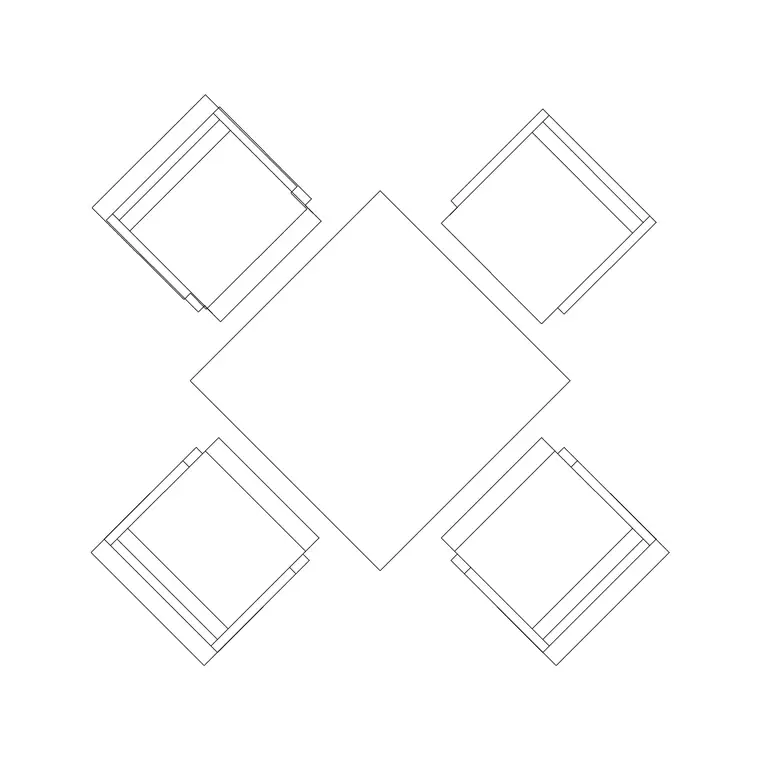
- Student desks — single or paired tables. A 1000mm Table 4P or 800mm Table 4P block, split or used whole, stands in for shared work tables in primary and project rooms; narrower single desks suit exam layouts. - Chairs — a stackable student chair, arrayed one per desk position. Keep them on their own layer so you can show the room with and without seating. - Teacher's table — an office-style desk at the front, often turned to face the class or angled into a corner. - Human figures — seated and standing figures (including child figures) to confirm occupancy and check that sightlines and aisles work with bodies in them, not just furniture outlines.
Array one desk-and-chair pair into a grid to build the seating field, then thin it out where you need wider aisles.
Dimensions and clearances to design around
Reach for these ranges when you check a classroom layout; treat them as design guidance, not a code substitute. Student desk: roughly 600–700 mm wide and 500–600 mm deep for a single, larger for shared tables. Desk-top height: about 700–760 mm for older students, lower for primary. Chair seat height: 380–460 mm depending on age group.
For circulation, allow around 500 mm of pull-out space behind a chair to sit and stand, a main aisle of at least 900–1100 mm, and cross aisles wide enough for the teacher to pass — often 500–700 mm between desk backs and the next row's fronts. Keep the first desk row back from the board so the viewing angle stays comfortable, and don't push the back row so far that text on the board becomes unreadable. Dropping scaled blocks in turns each of these from a calculation into a glance.
Building the classroom plan from blocks
Draw the room shell, then mark the teaching wall and door swings. Place the teacher's table and define the front teaching strip. Now insert one student desk, add its chair, and group them — or just keep them aligned. Use ARRAY (rectangular) to repeat the pair into rows and columns matching your capacity target.
Walk the aisles with a human-figure block to confirm clearances, then delete or shift rows until the circulation reads cleanly. Put desks, chairs, the teacher zone and figures on separate layers so you can issue a furniture plan, a clean shell, and an occupancy diagram from the same drawing. When the grid is right, WBLOCK a single desk-chair unit so the next classroom in the building reuses it.
Common classroom layout mistakes
The frequent errors are all about people, not furniture. First, a missing or blocked main aisle — desks arrayed edge to edge look efficient but leave no escape route and no teacher access; always keep the door-to-front path clear. Second, the front row crammed against the board, forcing students to look steeply upward. Third, ignoring door swing: an inward-opening door that clips the first desk is a daily nuisance and a hazard.
A subtler mistake is forgetting the teacher's own working space — the front strip gets eaten by an oversized desk or stored equipment, leaving nowhere to demonstrate. Finally, sizing chairs and desks for adults in a primary room: child figures in the catalogue exist precisely so you can check that the furniture and the bodies match the age group.
Free download
Browse the full library — DWG & DXF, no signup.
Questions
Frequently asked
How many desks can I fit in a classroom?+
It depends on the room size and the aisle widths you keep. Lay the teaching strip and door swings first, then array scaled desk-and-chair blocks and remove rows until a human-figure block can walk every aisle. The blocks turn capacity into something you can see rather than estimate.
Which view should classroom blocks be in?+
Use plan-view blocks for the layout — desks, chairs and figures seen from above, which is what you array into rows. Elevation blocks are useful for a board wall or storage-unit elevation, but the seating plan itself is built in plan.
Are child-scale figures available for primary classrooms?+
Yes. The people category includes child figures alongside adult ones, so you can populate a primary or nursery-age room with correctly scaled bodies and check that desks, chairs and aisles match the age group rather than defaulting to adult dimensions.
Will these classroom blocks open in older AutoCAD or free viewers?+
Yes. The DWG files target AutoCAD 2004 and later, which opens in current AutoCAD, AutoCAD LT, BricsCAD, DraftSight and free DWG viewers, so the whole layout is usable whatever CAD tool your school or studio runs.
Related downloads
Blocks for this guide

Related categories
Related guides
Room guide
Free School Library CAD Blocks — DWG Download
Free school library CAD blocks in DWG and DXF — reading tables, chairs, a circulation desk and figures to plan a library in AutoCAD. No signup.
Room guide
Free Bank Branch CAD Blocks — DWG Download
Free bank branch CAD blocks in DWG and DXF — teller counters, advisory desks, seating and figures to plan a branch interior in AutoCAD. No signup.
Room guide
Free Co-Working Hub CAD Blocks — DWG Download
Free co-working hub CAD blocks in DWG and DXF — hot desks, workstations, meeting tables, sofas and figures to plan a shared office in AutoCAD.