Curated pack · classical furniture cad blocks
Free classical and traditional furniture CAD blocks
By Saumyajit Maity · Published 11 Aug 2025 · Updated 2 Jan 2026
Classical and traditional furniture carries detail that modern pieces shed: rolled and scrolled arms, turned and cabriole legs, button-tufted backs, carved aprons and symmetrical silhouettes. Capturing that in a drawing takes blocks built with those flourishes already in them, so this free pack gathers the traditional pieces a period or heritage scheme needs — rolled-arm and Chesterfield-style sofas, wingback and bergère chairs, carved coffee and console tables, and classical table lamps — in DWG and DXF, drawn to true sizes and ready for AutoCAD 2004 or later. Everything is free for personal and commercial work, with no signup and no watermark.
Use the pack to lay out formal living rooms, hotel lobbies, period restorations, boardrooms and any interior where a traditional register is the brief. The blocks are scaled, so even with all that ornament they let you check the footprint a wingback actually claims, the spacing of a symmetrical seating group, and the clearance around a carved centre table.
Traditional rooms are usually arranged with symmetry and a clear focal point — a fireplace, a window, a central table — and the furniture is placed to honour that axis. A pack built for the style gives you the matched, mirror-able pieces that symmetry demands, so a pair of wingbacks flanking a fireplace lands balanced on the first try.
What the classical pack includes
The set spans the traditional vocabulary. Seating: rolled-arm and Chesterfield-style three- and two-seat sofas, wingback and bergère armchairs, and upholstered side chairs. Tables: carved and turned-leg coffee tables, round centre tables, console and side tables with shaped aprons. Lighting and accent: classical table lamps with turned bases and shaded heads to top a console or side table.
Each piece is drawn with its characteristic outline — the scroll of an arm, the curve of a cabriole leg — so the plan and elevation read as genuinely traditional rather than a box with a label.
Sizes to design around for traditional pieces
Reach for these ranges. A traditional three-seat sofa runs roughly 2000–2300 mm long and 850–950 mm deep; a Chesterfield reads a touch deeper because of the rolled arms. A wingback chair occupies about 750–850 mm wide and 850–950 mm deep — wider than a modern accent chair once the wings and rolled arms are counted. Carved coffee tables sit a little higher than modern ones, around 400–450 mm, and round centre tables span 900–1200 mm.
For a symmetrical seating group, allow at least 450 mm between a sofa and a centre table, and a 900 mm walkway around the arrangement so the formality isn't cramped. The scaled blocks make these balance checks visual.
Arranging a traditional room around an axis
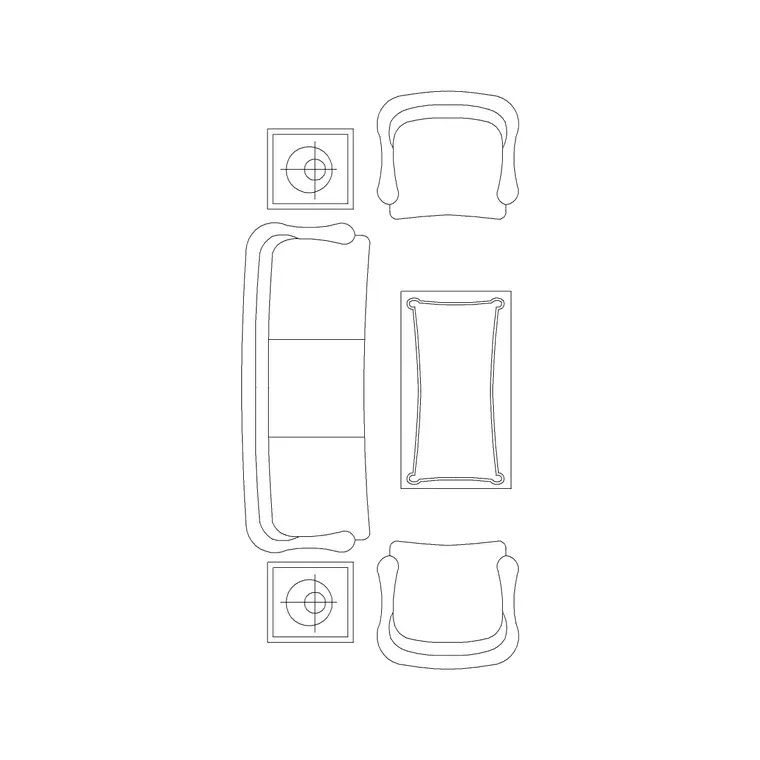
Traditional layouts start from a focal point and a line of symmetry. Identify the axis — usually the fireplace or the main window — and place the sofa square to it. Flank the focal point with a mirrored pair of wingback or bergère chairs, then centre the coffee or centre table on the axis between them.
Keep the furniture on a dedicated layer so the symmetrical arrangement can be frozen for a clean architectural plan and thawed for the furnished one. Mirroring is your friend here: draw one half of the symmetrical group, then MIRROR the chairs and side tables across the axis so the balance is exact rather than eyeballed.
Per-item notes
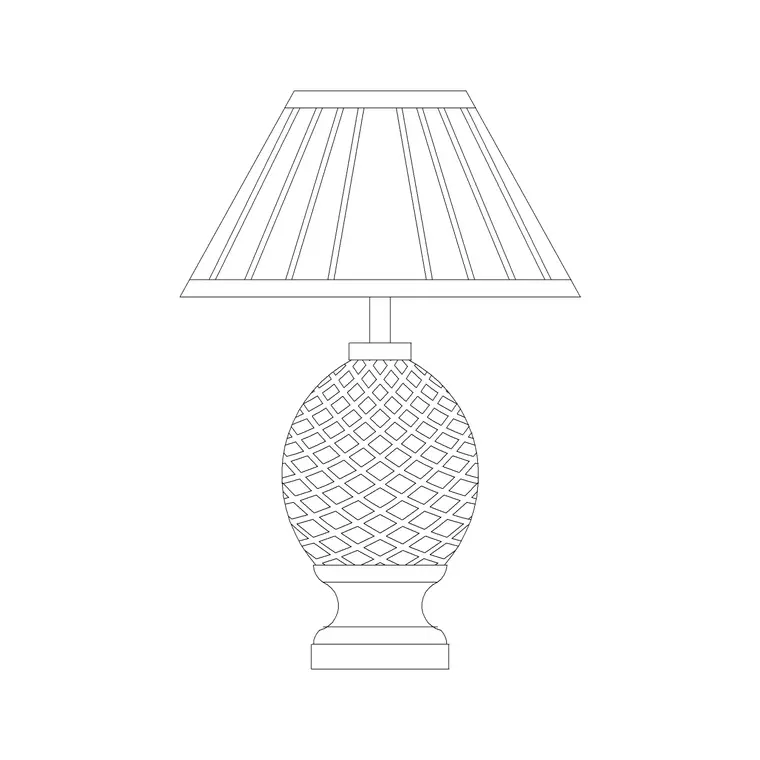
- Rolled-arm / Chesterfield sofa: the rolled arms add to the footprint, so check the overall width including the scrolls, not just the seat. - Wingback / bergère chair: ideal in mirrored pairs flanking a focal point; the wings make it read as a generous, enclosing seat in both plan and elevation. - Carved centre table: place it on the room axis; a round table reinforces a symmetrical, formal arrangement better than a rectangle. - Classical table lamp: drop it onto a console or side table in elevation to finish the period look; its turned base and shade are what signal 'traditional' at a glance.
Every block is a single reference you can mirror, copy and rotate, and edits to the definition propagate to all instances.
Plan and elevation for period schemes
For the layout you work in plan: the sofa, chair and table footprints arranged symmetrically and checked for clearance. The plan blocks are what you mirror and array to build the balanced group a traditional room wants.
For presentation drawings, interior elevations and joinery details you switch to elevation, where the ornament earns its keep — a Chesterfield's buttoning, a cabriole leg, a lamp's turned base all read face-on. Many blocks ship both views, so a single download serves both the symmetrical plan and the period elevation.
Who uses a classical pack
Interior designers working on heritage, hospitality and high-end residential schemes use it to lay out formal rooms quickly. Architects use it to furnish period restorations and listed-building interiors with appropriately styled, scaled pieces. Students use it for conservation and interior projects where the right register and licence-clear blocks both matter.
Pair the classical furniture set with the lighting category for matching classical lamps and the accessories category for framed art and mirrors, so a whole traditional room is dressed from one consistent, free block library.
Free download
Browse the full library — DWG & DXF, no signup.
Questions
Frequently asked
How are these different from the modern furniture pack?+
These blocks carry traditional detail — rolled and scrolled arms, turned and cabriole legs, button-tufting and carved aprons — and are sized for the deeper, more enclosing proportions of period furniture, so a layout built from them reads as classical rather than contemporary.
Are the classical furniture blocks free for commercial projects?+
Yes. Every block downloads free in DWG and, where available, DXF, with no signup, no watermark and no attribution requirement, and they are cleared for commercial use.
Can I mirror the chairs to make a symmetrical pair?+
Yes, and it's the recommended workflow. Place one wingback or bergère, then use MIRROR across the room axis so the flanking pair is perfectly balanced — the foundation of a traditional arrangement.
What units and scale are the blocks drawn at?+
Full size in millimetres. Insert at scale 1 in a millimetre drawing, or set INSUNITS to millimetres so AutoCAD rescales automatically if your template uses different units.
Related downloads
Blocks for this guide
Related categories
Related guides
Curated pack
Free Modern Furniture CAD Block Pack — DWG/DXF
Free modern furniture CAD block pack in DWG/DXF — modular sofas, low coffee tables, sideboards and accent chairs. No signup, commercial use OK.
Curated pack
Free Minimalist Interior CAD Block Pack — DWG
Free minimalist interior CAD blocks in DWG/DXF — clean-line sofas, plain tables and pared-back storage for AutoCAD. No signup, commercial use OK.
Curated pack
Free Luxury Interior CAD Block Pack — DWG/DXF
Free luxury interior CAD blocks in DWG/DXF — relaxers, dressing tables, statement seating and decorative lamps for high-end schemes. No signup needed.