Curated pack · cad blocks for floor plans
Free CAD blocks for floor plans in DWG and DXF
By Sumana Kumar · Published 25 Jul 2023 · Updated 17 Jan 2026
A floor plan is read from above, so the blocks that make it work are the ones drawn in true plan view: furniture seen as footprints, people shown as scale figures, paving and surfaces laid out as fills. This pack gathers exactly those — the plan-view library you reach for to furnish a layout quickly and keep its proportions trustworthy. Every block is drawn at real millimetre sizes, downloads in DWG (DXF where available), and is free for commercial work with no signup or watermark.
The point of a furnished floor plan is communication. A bare shell of walls tells a client almost nothing; the same plan with a sofa group, a dining set, a few figures and a paved terrace instantly reads as a home people could live in. Because these blocks are correctly scaled, that storytelling never costs you accuracy — every clearance, circulation path and door swing stays honest the moment the furniture lands.
Use the pack across residential, commercial and landscape plans. The blocks array cleanly, sit on sensible layers, and carry from an early concept plan through to a coordinated drawing without redrawing the furniture at each stage.
What the floor-plan pack includes
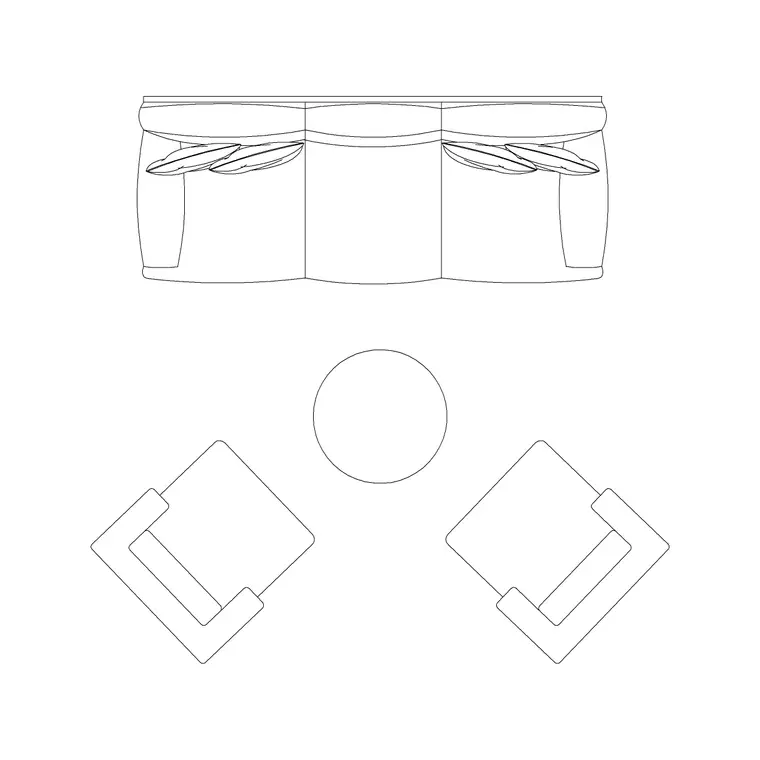
The set covers the plan-view essentials. Furniture footprints — a sofa group is the anchor of most living-room plans, and the same logic extends to dining sets, beds and desks — give each room its function at a glance. Scale human figures sized to a real adult footprint let you check that doorways, corridors and seating gaps actually work for the people who will use them. Paving blocks lay out terraces, paths and external surfaces so the plan reads beyond the building line.
Everything is drawn as a clean plan footprint, not a cluttered 3D projection flattened onto the page, so the blocks read correctly at typical plan scales of 1:50 and 1:100 without turning into ink soup.
Furnishing a plan room by room
Work outward from the fixed points. In a living room, place the sofa group against the main wall and build the seating arrangement around it, leaving a comfortable gap to the coffee table and a clear route through the room. In bedrooms, set the bed first because it dominates the space; in offices, lead with the desk run. With each piece sitting at true size, you can immediately see whether a room is generous or tight.
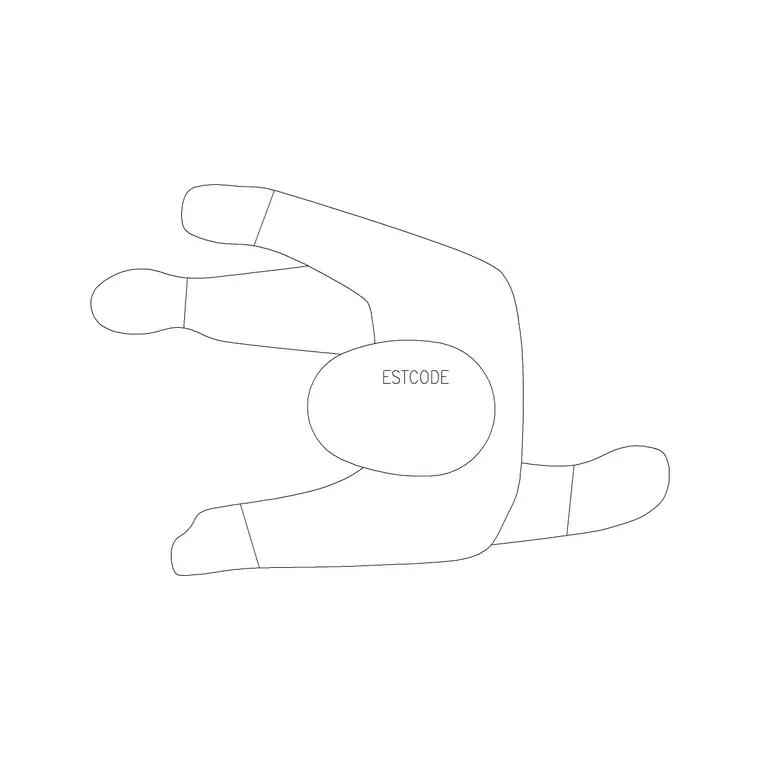
Drop scale figures into the key circulation points — the entrance, the kitchen, a corridor pinch — to sanity-check that people can move and pass. A figure standing in a doorway is the fastest way to spot a clearance that looks fine on paper but fails in life.
Layers that make a plan readable
Put furniture on a dedicated furniture layer rather than leaving it on layer 0. Giving the furniture its own colour and lineweight lets you produce two drawings from one file: freeze the layer for a clean structural plan, thaw it for a fully furnished presentation plan. Put people and paving on their own layers too, so you can toggle the entourage independently of the architecture.
This discipline pays off when a plan goes through revisions. Walls move, the furniture stays on its layer, and you re-check the layout in seconds rather than hunting furniture mixed in with the structure.
Scale and insertion for plan blocks
These blocks are drawn full size in millimetres. In a millimetre drawing, insert at scale 1 and the furniture lands at real size; in a metre template insert at 0.001, or simply set INSUNITS to millimetres so AutoCAD rescales on insertion. Use INSERT, pick a sensible insertion point — the centre of a sofa, the trunk of a tree, the corner of a paving panel — and rotate to suit the room.
Because each piece is a single block reference, you can copy a furnished arrangement around a plan, and a later edit to the block definition updates every instance at once. Resist scaling furniture to fill an awkward gap; a sofa that has been stretched 10% to look balanced is a sofa that will not fit when the layout is built.
Per-item notes for plans
- Sofa group (plan): the centrepiece of most living-room layouts. Place it first, then arrange the rest of the seating and the circulation around it. - Scale figures (plan): use as a ruler at doorways, corridors and seating gaps. A real adult occupies roughly a 450–550 mm shoulder width in plan; check tight spaces against that. - Paving (plan): lay out terraces, paths and forecourts as fills to extend the plan past the walls; keep them on their own layer so the building reads clearly. - Trees (when shown in plan): for landscape and site plans the canopy seen from above adds context; vary the size so planting looks natural rather than arrayed.
Who uses a furnished floor plan
Furnished plans appear in almost every drawing set: architects use them to test layouts and present schemes, interior designers to lay out furniture and FF&E, estate agents and developers for marketing plans, and students for studio and portfolio work. A free, licence-clear plan-block library suits all of them because the same drawing can carry from a quick concept through to a coordinated set.
Pair the pack with category-specific blocks — kitchen appliances, bathroom fittings, office furniture — to furnish any room type. Because the blocks are free for commercial use, they slot straight into paid client work without a licensing question.
Free download
Browse the full library — DWG & DXF, no signup.
Questions
Frequently asked
Are these blocks drawn in true plan view?+
Yes. The furniture, figures and paving here are drawn as plan footprints seen from above, the correct projection for a floor plan, so they read cleanly at 1:50 and 1:100 without flattening a 3D view onto the page.
How do I furnish a plan quickly?+
Lead each room with its dominant piece — sofa in a living room, bed in a bedroom, desk in an office — then build the rest around it. Keep furniture on its own layer so you can produce both a clean shell and a furnished plan from one drawing.
Will the furniture stay correctly scaled?+
As long as you insert at the right units. The blocks are drawn full size in millimetres; insert at scale 1 in a millimetre drawing or set INSUNITS to millimetres. Avoid stretching furniture to fill gaps, which breaks real clearances.
Can I use these for client and marketing plans?+
Yes. Every block is free for commercial use with no attribution, so furnished plans for client presentations, property marketing and competition work are all fine.
Related downloads
Blocks for this guide


Related categories
Related guides
Curated pack
Free CAD Blocks for Rendering Pack — DWG & DXF
Free CAD blocks for rendering — scale people, trees, furniture and paving in DWG/DXF to populate plans before you take them into a render engine. No signup.
Curated pack
Free CAD Blocks for Elevation Drawings Pack — DWG
Free CAD blocks for elevation drawings — trees, scale figures and entourage in DWG/DXF to dress facades and street elevations in AutoCAD. No signup.
Curated pack
Free CAD Blocks for Section Drawings Pack — DWG
Free CAD blocks for section drawings — scale figures, furniture and trees in DWG/DXF to populate building sections in AutoCAD. No signup, commercial OK.