Curated pack · beauty parlour cad blocks
Free beauty parlour CAD block pack for AutoCAD
By Saumyajit Maity · Published 15 Apr 2026 · Updated 10 May 2026
A beauty parlour differs from a hair salon in one decisive way: most of its services need privacy and a person lying down, so the plan is less about a mirror wall and more about treatment cubicles, lighting and the strip of floor a therapist needs beside each bed. Setting that out in AutoCAD is quicker when the fixtures are already scaled. This free beauty parlour CAD block pack gathers the pieces you place most — facial and waxing beds, makeup and manicure stations, a pedicure chair, low storage and trolleys, a private treatment cubicle and a reception desk — in DWG, drawn at true dimensions for AutoCAD 2004 or later. Everything is free for personal and commercial work, with no signup and no watermark.
Use the pack to decide which services are open-floor and which need an enclosed cubicle first, then place the beds with the therapist's working strip clear on at least one long side. Because the blocks carry their real footprint, you can test the cubicle size and the privacy gap between stations the moment they land.
A beauty parlour also has practical duties an ordinary room skips: privacy for treatments that need it, good task lighting at the makeup and nail stations, and a hygienic trolley and storage position beside each bed. Starting from scaled blocks means those needs are real distances on the plan rather than something resolved when the partitions go up. This pack is the treatment-led companion to a general salon layout, focused on the cubicle and the bed rather than the cutting chair.
What the beauty parlour pack covers
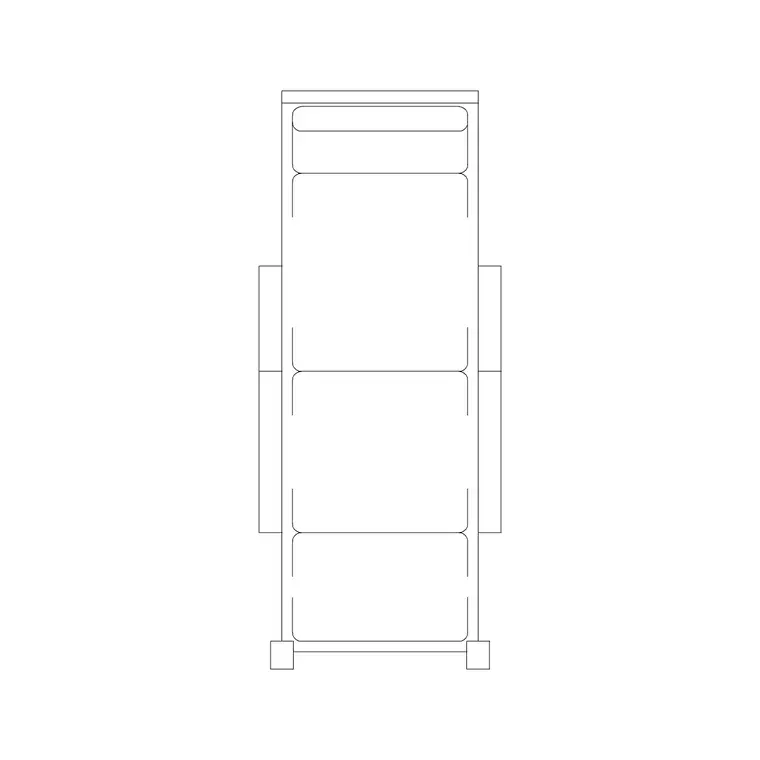
The pack spans treatment and front of house. Treatment beds: facial and waxing beds drawn with the therapist's working strip beside them. Stations: makeup stations with a mirror and seat, and manicure tables for two seated people. Feet: a pedicure chair with the foot bath and operator stool envelope. Support: low storage units and a mobile trolley footprint to sit beside a bed. Privacy: an enclosed treatment cubicle outline. Front of house: a reception desk and a small waiting cluster.
Because a parlour often repeats the same cubicle, the bed-and-trolley arrangement is built so you can group it and copy the whole cubicle along a wall, keeping each treatment room consistent.
Standard beauty parlour dimensions to design around
Use these ranges as planning references, not fixed specs. A facial or waxing bed is typically around 700–800 mm wide and 1850–2000 mm long, and a therapist needs a working strip of roughly 600–750 mm down at least one long side, ideally both for facials. An enclosed treatment cubicle therefore wants enough floor for the bed, the working strips, a trolley and a step inside the curtain or door — often around 2000–2500 mm in the smaller dimension.
A makeup or manicure station needs roughly 600–800 mm of width per seated person with task lighting at the mirror, and a pedicure chair with its foot bath and operator stool claims around 1200–1500 mm of depth. Drop the scaled blocks in and these clearances read straight off the plan.
Building the beauty parlour layout from the blocks
Split the services first: decide which are open-floor — makeup, nails, sometimes pedicure — and which need an enclosed cubicle, usually facials and waxing. Place the cubicles along a quiet wall with the bed positioned so the therapist has a clear working strip, then group the cubicle and repeat it for each treatment room so every one is consistent.
Set the makeup and manicure stations in the better-lit open area near the front, and keep the pedicure chair where a client can sit longest in comfort. Put a trolley beside each bed and low storage within reach. Keep beds, stations, storage, cubicles and reception on separate layers so a services-and-privacy plan and a furnished plan come from the same drawing without redrawing anything.
Per-item notes: beds, cubicles and stations
The treatment bed is the block the cubicle is built around, so place it first and let the working strips, trolley and any wax-heater position follow it; draw the working strip as floor on a setting-out layer so it is never encroached. The cubicle is the defining feature of a parlour over a salon — show the bed, both working strips and the step inside the door or curtain, and note the partition on a separate layer for a later elevation.
The makeup and manicure stations earn their value from lighting as much as footprint, so place them where the task light is good and note the mirror line. The pedicure chair is deceptively deep once the foot bath and operator stool are added — always keep the operator's stool envelope clear in front.
Plan view and the privacy split
Beauty parlour planning is a plan-view discipline: you arrange treatment cubicles, open stations and reception seen from above, so every block here is drawn in plan. That is the view that proves each cubicle fits its bed and working strips, the open stations have their task space, and the route between front of house and treatment rooms stays clear.
Draw the line between open-floor and private-cubicle zones on a setting-out layer and confirm the cubicles have real enclosure, not just a notional curtain. If you need a cubicle or makeup-station elevation for the joinery and lighting, draw it separately on its own layer; the plan blocks fix the positions that elevation must follow. Working plan-first keeps the privacy and working strips honest before any partitions are detailed.
Who uses the beauty parlour pack
Interior designers and beauty fit-out specialists use it to turn a shell into a costed, treatment-led layout quickly and to repeat a consistent cubicle along a wall. Architects use it to plan a parlour within a mixed-use unit with believable, scaled fixtures. Students use it for studio briefs and portfolio boards where licence-clear blocks matter.
Because the blocks are free and unrestricted, the same pack carries from a single treatment room to a multi-cubicle parlour. Pair it with the furniture and office categories to add the reception, waiting seating and back-office furniture that complete the unit, and you can fit out the whole parlour from one consistent library — and reach for the broader salon pack when the brief also includes hair.
Free download
Browse the full library — DWG & DXF, no signup.
Questions
Frequently asked
What is in the beauty parlour CAD block pack?+
Facial and waxing beds, makeup and manicure stations, a pedicure chair, low storage and trolleys, an enclosed treatment cubicle outline and a reception desk — all drawn in plan at true scale for AutoCAD.
How big should a treatment cubicle be?+
Enough for the bed, a therapist's working strip of roughly 600–750 mm down at least one long side, a trolley and a step inside the door — often around 2000–2500 mm in the smaller dimension. The scaled blocks let you check this directly.
Are the beauty parlour blocks free for commercial use?+
Yes. Every block downloads free in DWG with no signup, no watermark and no attribution requirement, and they are cleared for commercial project use.
What units are the blocks drawn in?+
Millimetres, full size. Insert at scale 1 in a millimetre drawing, or set INSUNITS to millimetres so AutoCAD rescales the block automatically on insertion.
Related downloads
Blocks for this guide
Related categories
Related guides
Curated pack
Free Office CAD Block Pack — DWG & DXF
Free office CAD block pack in DWG and DXF — desks, workstations, conference tables and reception furniture in plan view. No signup, commercial-use OK.
Curated pack
Free Reception Area CAD Block Pack — DWG
Free reception area CAD block pack in DWG and DXF — reception desks, waiting seating and scale figures for lobby layouts. No signup, commercial-use OK.
Curated pack
Free Restaurant CAD Block Pack — DWG & DXF
Free restaurant CAD block pack in DWG and DXF — dining tables, chairs, bar stools and high chairs for cafe and restaurant layouts. No signup, commercial OK.