Block landing · bbq grill cad block
Free BBQ grill CAD blocks for AutoCAD
By Sumana Kumar · Published 1 Apr 2025 · Updated 27 Apr 2026
A BBQ grill is the heart of an outdoor kitchen and a fixture that shows up on more terrace and garden drawings every year. This page collects free BBQ grill CAD blocks in DWG and DXF — freestanding kettle and trolley barbecues, gas grills on carts, and built-in grill modules for masonry outdoor kitchens — drawn at true millimetre dimensions and ready to insert into AutoCAD 2004 or later. Everything is free for personal and commercial work, with no signup and no watermark.
Use these blocks to lay out outdoor kitchens, terrace cooking zones, garden BBQ areas and hospitality grill stations. Because a grill is a heat source, the plan view is the one you lean on: it lets you place the grill, set its working clearances, and keep it the right distance from seating, planting, the house wall and any combustible boundary.
What a BBQ grill block contains
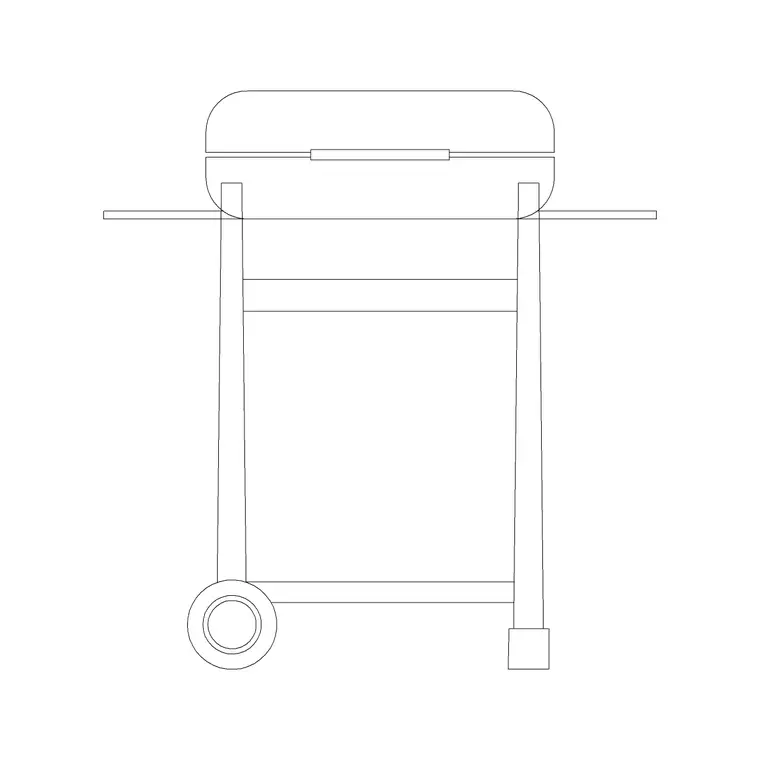
A BBQ grill block draws the cooking unit and the space around it. A freestanding grill shows the firebox or grill body, the lid, the side shelves and the trolley or legs, with the footprint in plan and the full unit in elevation. A built-in grill module shows the drop-in grill set into a masonry or framed counter, often as part of a longer outdoor-kitchen run with worktop, sink and storage either side.
Each grill is editable geometry on sensible layers so you can recolour the body, freeze the side shelves, or drop the grill into a counter outline you draw yourself. The plan footprint is what governs the working space and the clearances; the elevation carries the grill height and the lid clearance, which matters under a pergola or a canopy. Because the grill is a single block reference, you can rotate it to face the cook into the garden and copy it where a station repeats.
Plan for clearances, elevation for the outdoor kitchen run
For laying out an outdoor cooking zone you work in plan: the grill seen from above, positioned with a clear working space in front and safe distances to anything combustible. The plan block is what you place to set out the cook's station and to check the grill sits clear of the seating, the table and any timber structure. A grill needs the cook to stand and work in front of it, so the plan is where you reserve that space.
The elevation comes into play for an outdoor kitchen run, where the grill sits in a counter alongside worktop, a sink and storage. Drawing the run face-on shows the grill height in the counter, the worktop level and the lid clearance — the geometry you need to coordinate a built-in grill with the masonry around it. Many blocks ship both views, so one download covers both the plan layout and the kitchen-run elevation.
Typical BBQ grill sizes to design around
Use these ranges as a starting point. A freestanding kettle barbecue is roughly 500–600 mm across the bowl, with a trolley footprint extending to 700–900 mm wide once the side shelves are counted. A gas grill on a cart is commonly 1.0–1.4 m wide including shelves. A built-in grill module drops into a counter and is typically 700 mm–1.0 m wide, set into a 600 mm-deep masonry run.
For working space, allow at least 900 mm–1.0 m of clear floor in front of the grill so the cook can stand and work, and keep a safe distance from combustible walls, fences and planting as the grill type and local guidance require. These are typical figures, not fixed specifications — the appliance and the safety requirements drive the real numbers. The blocks are drawn full size so you can check the footprint and the clearances directly in the layout.
How to insert and place the grill
These grill blocks are drawn in millimetres. Insert at scale 1 in a millimetre drawing, 0.001 in a metre template, or set INSUNITS to millimetres so AutoCAD rescales on insertion. Run INSERT or drag the DWG onto the drawing, pick the insertion point at the centre of the grill body, and rotate it so the cook faces into the space rather than at a wall.
For a built-in grill, draw the counter run first, then drop the grill module into the worktop outline at the right position, leaving worktop landing space either side for plates and prep. For a freestanding grill, place it with the working clearance in front and the safe distance to combustibles checked. Keep the grill on an external-kitchen or equipment layer so you can show or hide the cooking zone independently of the rest of the terrace.
Where BBQ grill blocks are used
BBQ grill blocks appear in outdoor kitchen designs, terrace and patio layouts, garden BBQ areas, poolside cooking stations, and hospitality and resort grill kitchens. Landscape and outdoor-living designers use them to plan the cooking zone of an external kitchen; architects add them to terrace layouts to show amenity; hospitality designers use them to lay out a grill station with its prep, plating and circulation space.
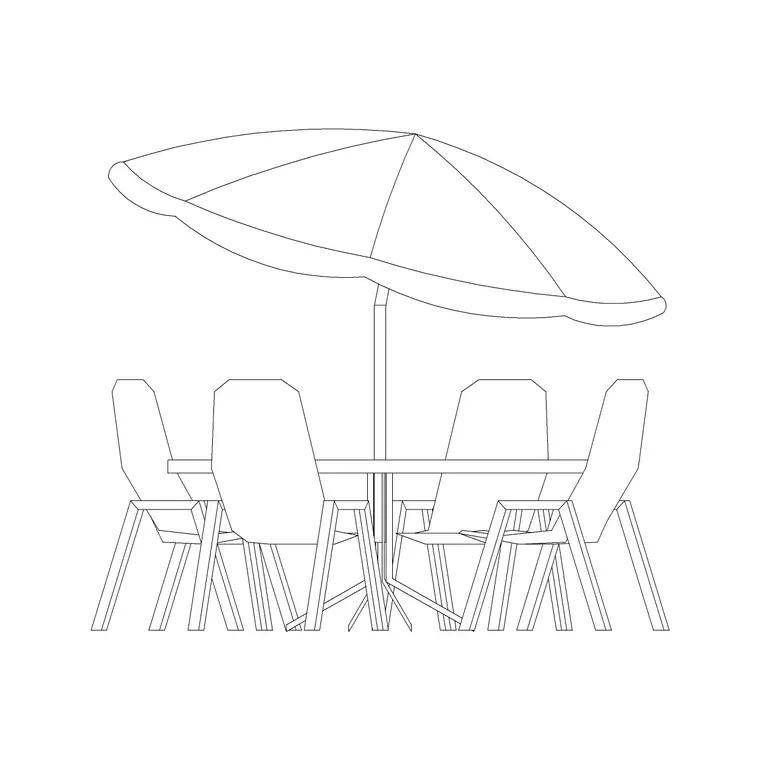
Pair the grill with the outdoor table, seating and worktop or storage blocks to build a complete outdoor kitchen — a grill in a counter run, a prep surface, a dining table and seating on a paved terrace. Because the grill is the working heart of the space, getting its clearances and its place in the counter run right is what makes the outdoor kitchen drawing usable.
Designing the cooking zone safely
A BBQ grill is the one piece of outdoor furniture that needs a safety-led layout, and the scaled block is what lets you design that zone properly. The cook needs room to stand and work, so reserve a clear working space in front of the grill and keep it out of the main circulation route so people aren't walking through the cook's space. Place the grill block, then draw that working zone around it and check it doesn't overlap the dining or seating area.
Distance to combustibles is the second consideration. A grill near a timber fence, a pergola post, a fabric canopy or low planting needs a sensible separation, and the real figure depends on the appliance type and local guidance — but drawing the grill to scale lets you measure and show that separation rather than eyeball it. For a covered or built-in grill, the elevation also lets you check the lid clears any overhead structure and that there is room for the heat and smoke to rise clear. Keeping the grill as scaled geometry turns the whole outdoor-kitchen layout into a set of measurable checks the drawing can prove.
Free download
Browse the full library — DWG & DXF, no signup.
Questions
Frequently asked
What types of BBQ grill are included?+
The set covers freestanding kettle and trolley barbecues, gas grills on carts, and built-in grill modules for masonry outdoor kitchens — drawn in plan and, in many cases, elevation for outdoor-kitchen runs.
Are the BBQ grill CAD blocks free for commercial use?+
Yes. Every grill block downloads free in DWG and, where available, DXF, with no signup, no watermark and no attribution requirement, and they are cleared for commercial project use.
How much working space does a grill need in front of it?+
Allow at least 900 mm–1.0 m of clear floor in front of the grill so the cook can stand and work, and keep a safe distance from combustible walls, fences and planting per the appliance type and local guidance. The scaled block lets you draw these zones.
Can I drop a grill into an outdoor kitchen counter?+
Yes. The built-in grill module is drawn to drop into a 600 mm-deep masonry run. Draw the counter outline first, then place the grill module in the worktop at the right position with landing space either side.
Related downloads
Blocks for this guide
Related categories
Related guides
Block landing
Free Garden Fence CAD Blocks — DWG & DXF
Download free garden fence CAD blocks in DWG and DXF — timber, panel and contemporary boundary fences drawn in plan and elevation, AutoCAD 2004+, no signup.
Block landing
Free Wrought-Iron Gate CAD Blocks — DWG
Download free wrought-iron and metal gate CAD blocks in DWG and DXF — ornamental garden gates in elevation and plan with swing arcs. No signup.
Block landing
Free Main Entrance Gate CAD Blocks — DWG
Download free main entrance gate CAD blocks in DWG and DXF — driveway, sliding and double-swing gates drawn in elevation and plan with swing arcs. No signup.