Room guide · dining room cad blocks
Dining room CAD blocks for table and seating layouts
By Sumana Kumar · Published 16 Apr 2026 · Updated 11 May 2026
A dining room is organised around one object — the table — and the single most important thing about the design is not the table itself but the space around it. People pull chairs out, sit, and walk behind those chairs to reach the far seats, and every one of those movements needs clearance. A dining room that looks fine on a plan but ignores the pull-out and circulation gaps becomes a room where the end chairs are unusable. Designing it well is mostly about getting those gaps right.
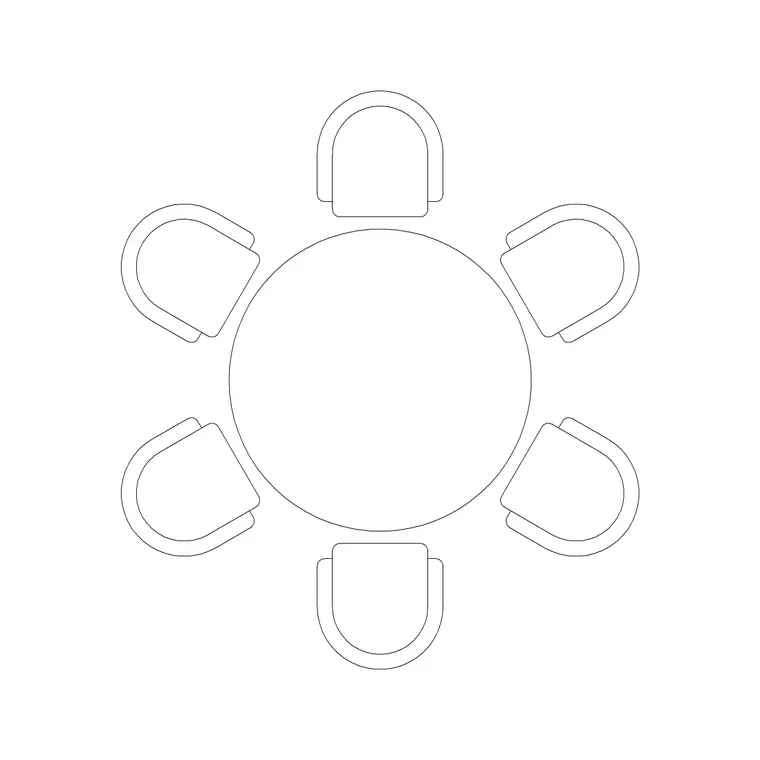
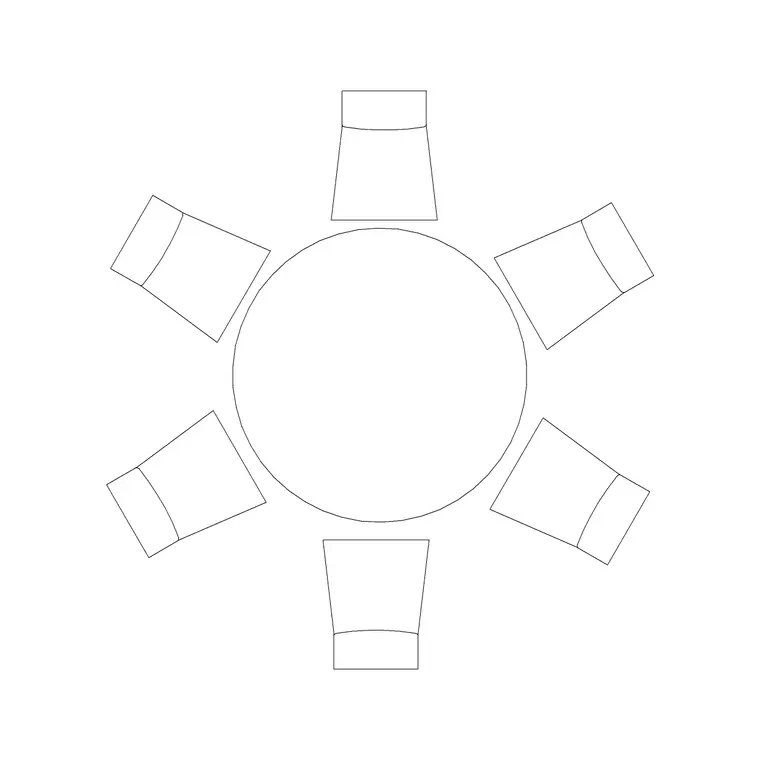
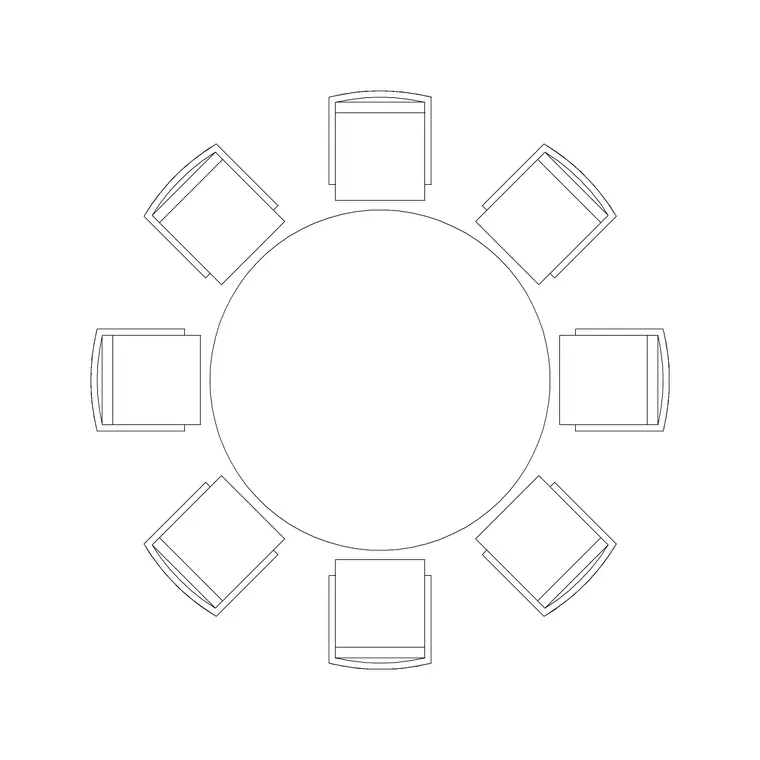
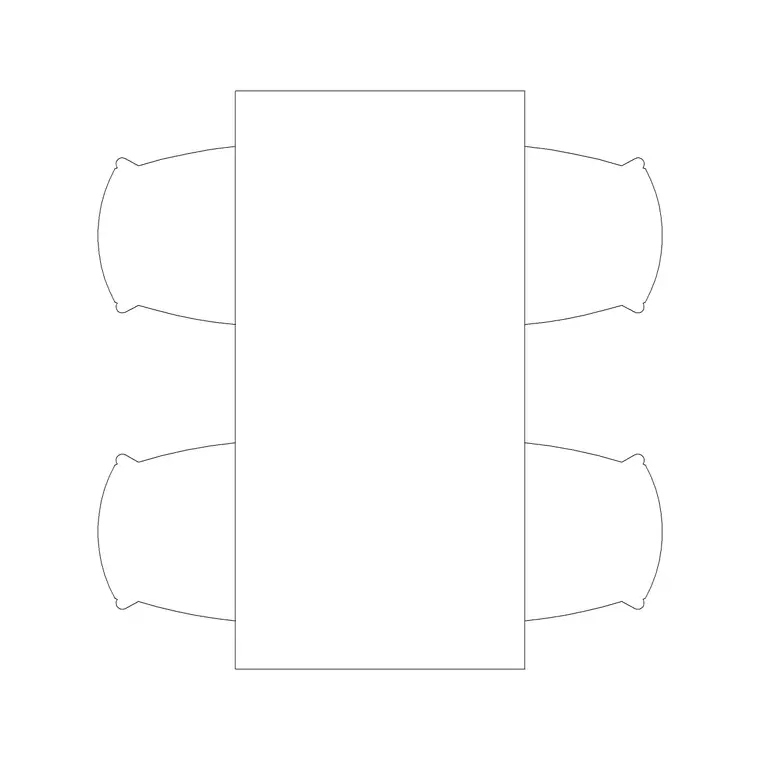
The blocks here are the dining kit — round and rectangular tables in a range of seat counts, dining chairs, a sideboard, and a chandelier or pendant over the table — drawn to true dimensions in DWG and DXF and free for personal and commercial use. Because the tables are scaled to real seat counts and the chairs to real footprints, you can prove a six-seater plus circulation genuinely fits the room before you place anything else.
The right way to design a dining room is to start from the table, ring it with the clearances it needs, and only then see what room is left for a sideboard, a serving zone or a route to the kitchen. Place the table block, draw the clearance ring, and the rest of the layout follows.
What the dining room is for
A dining room exists to seat people around a shared table for a meal — formally in a dedicated room, or casually in a dining zone of an open plan. Its function is simple but its geometry is exacting: every seat must be reachable, every diner must be able to push back and stand, and food must be able to reach the table from the kitchen without weaving through seated guests.
The people designing it range from homeowners furnishing a single room to architects setting a dining zone in an apartment and hospitality designers laying out restaurant covers. The constants are the same: table size drives seat count, seat count drives the room size, and circulation drives whether the room actually works. Scaled blocks turn all three into something you can see rather than estimate.
Choosing the table: shape and seat count
The table sets everything. Round tables seat people sociably with no head of the table and suit square rooms; a 1000 mm round seats four, a 1200 mm round seats six, and 1500–1800 mm rounds seat six to eight. Rectangular tables suit longer rooms and larger numbers, seating along both sides and the ends; a 1500 mm rectangular comfortably seats four to six, scaling up with length.
Match the table to the room shape and the seat count to the people. The blocks are labelled by diameter or length and by the number of place settings they are drawn for, so you pick the table that fits both the room and the gathering. Drop two candidate tables — say a round six and a rectangular six — into the same room outline and the better fit is obvious from the clearance left around each.
The clearances that decide the layout
This is where dining rooms are won or lost. A diner pulling a chair out and standing needs roughly 750–900 mm of clear floor behind the chair from the table edge. To walk behind a seated diner — the serving route around the table — you want closer to 900–1100 mm so a person carrying a dish can pass. Where there is no through-traffic, the lower end of each range works; where people circulate, take the higher.
That clearance ring is the real footprint of the dining set, not the table. A 1500 mm round table with a 900 mm ring needs a clear circle over three metres across. Draw that ring around the scaled table block and you instantly see whether the sideboard fits against the wall, whether the door swings clear, and whether two people can pass on the serving side. Most dining rooms that feel cramped have simply lost this ring to a wall or a cabinet.
Furnishing around the table
Once the table and its clearance ring are set, the supporting pieces find their place. Dining chairs ring the table — drawn tucked in for the plan footprint and pulled out for the clearance check. A sideboard or buffet sits against a wall for serving and storage, just outside the clearance ring so a person can stand at it while others sit. In an open plan, the dining zone borrows a wall or the back of an island for that serving surface.
Overhead, a chandelier or pendant centres on the table — not on the room — because it lights the table and visually fixes the dining zone. Drop the lighting block centred on the table block, typically hung so the bottom clears head height for a standing person but sits low enough to light the table. Bar or counter stools appear only where the dining zone meets a counter or island; the dining table itself takes chairs.
- Table: round or rectangular, sized to seat count - Seating: dining chairs ringing the table - Serving: sideboard or buffet against a wall - Lighting: chandelier or pendant centred on the table
Drawing the dining room in AutoCAD
Place the table block centred in the room or the dining zone first. Draw a circle or rectangle offset around it at your chosen clearance — say 900 mm — as a reference; this is the keep-clear ring. Array the chair blocks around the table, then check each against the ring. Set the sideboard against the longest clear wall, outside the ring.
Keep table, chairs, sideboard and lighting on separate layers so you can plot a clean furniture plan and an RCP showing the chandelier centred on the table. Centre the chandelier block on the table on the lighting layer. If the room is an open-plan diner, hatch the route from the kitchen to the table so it survives the rest of the furniture, and confirm a person carrying a tray can reach every seat without crossing the clearance ring of an occupied chair.
Common dining room mistakes
The first and most common mistake is a table too big for its room, so the end chairs back straight into a wall and can never be pulled out — the dining set on paper seats six but the room seats four. Draw the clearance ring and oversized tables expose themselves immediately. The second is a sideboard placed inside the ring, blocking the chairs on that side whenever someone stands at it.
The third is hanging the chandelier on the centre of the room rather than the centre of the table, so the light sits off to one side once the table is pushed against a wall or window. The fourth, in open plans, is routing the path from the kitchen straight across the pull-out zone of the end seats, so every served meal makes a diner shuffle in. Place the table, ring it, and route around it.
Free download
Browse the full library — DWG & DXF, no signup.
Questions
Frequently asked
How much space do I leave around a dining table?+
Allow roughly 750–900 mm of clear floor behind each chair so a diner can pull back and stand, and nearer 900–1100 mm on any side used as a serving route so a person carrying a dish can pass behind seated guests.
How many people does each table size seat?+
A 1000 mm round seats about four, a 1200 mm round about six, and 1500–1800 mm rounds six to eight. Rectangular tables seat along both sides and the ends, with a 1500 mm length comfortably taking four to six and scaling up with length.
Round or rectangular table for my room?+
Round tables suit square rooms and seat people sociably with no head of the table; rectangular tables suit longer rooms and larger numbers. Drop both into the same room outline and compare the clearance ring each leaves to pick the better fit.
Where should the chandelier go over a dining table?+
Centre the chandelier or pendant on the table, not on the room, so it lights the table even when the table is pushed toward a wall or window. Place the lighting block on a dedicated layer centred on the table block.
Are the dining room blocks free and what formats do they come in?+
They are free for personal and commercial use with no signup, and download in DWG and DXF that open in AutoCAD 2004 and later, plus any CAD tool that reads DXF.
Related downloads
Blocks for this guide
Related categories
Related guides
Room guide
Master Bedroom CAD Blocks & Layout — DWG
Free master bedroom CAD blocks in DWG — king and double beds, side tables, wardrobes, seating and lighting to lay out a master suite in AutoCAD.
Room guide
Kids Bedroom CAD Blocks & Plan — DWG
Free kids bedroom CAD blocks in DWG — single beds, wardrobes, desks and play space to plan a child's room in AutoCAD with real clearances.
Room guide
Guest Bedroom CAD Blocks & Layout — DWG
Free guest bedroom CAD blocks in DWG — double and single beds, compact wardrobes and seating to plan a flexible spare room in AutoCAD.