Room guide · hair salon layout cad blocks
Design a hair salon layout with free CAD blocks in 2026
By Sumana Kumar · Published 28 Sep 2024 · Updated 9 Mar 2026
A hair salon is a workflow space disguised as a pretty room. A client arrives, waits, is consulted, moves to a styling chair, often to a wash basin and back, and finally pays — and the floor plan has to make that loop smooth for both client and stylist while several clients are at different stages at once. Get the plan right and the salon feels calm and efficient; get it wrong and stylists collide and clients wait in the wrong place.
This guide covers laying out a hairdressing salon in AutoCAD from free CAD blocks. Each linked block downloads free in DWG and DXF at true millimetre scale for AutoCAD 2004 or later — no signup, no watermark, cleared for commercial fit-outs. Because the chairs, seating and reception are drawn full size, you can test the all-important space behind a styling chair the moment the blocks land.
It suits unisex and gents/ladies salons, blow-dry bars and combined hair-and-beauty spaces.
The salon workflow the plan must serve
A salon plan is organised around a sequence of stages, and the layout should let a client flow through them without backtracking: reception and waiting, consultation, styling station, wash basin, back to the station for finishing, then payment. Several clients run through this loop in parallel, so the plan needs enough stations and enough circulation that stylists are not stepping over each other.
The styling stations are the productive heart of the salon and usually line the walls in front of mirrors, with the wash basins grouped in a back-bar against the plumbing wall. Reception sits at the front by the door; waiting seating is near it. Think of the plan as a one-way loop with the wash zone as a side loop off the styling line.
Zoning: reception, styling, wash, back-of-house
Block the salon into clear zones. The front zone holds reception and a small retail display of products, plus comfortable waiting seating. The styling zone is the open central/wall area with the mirror stations. The wash zone groups the backwash basins against the plumbing wall, ideally tucked so reclining clients have some privacy. The back-of-house holds colour mixing, towels, staff and storage.
Grouping the wet services (wash basins, colour bar) against one wall keeps the plumbing run short and cheap, so let that drive where the wash zone sits. Mark each zone as a polyline on its own layer to balance the count of stations against the circulation.
Stations, seating and the CAD blocks you place
The salon-specific fixtures — styling chairs at mirrors and backwash units — you often draw or source as dedicated symbols, but the surrounding furniture comes straight from the free blocks below:
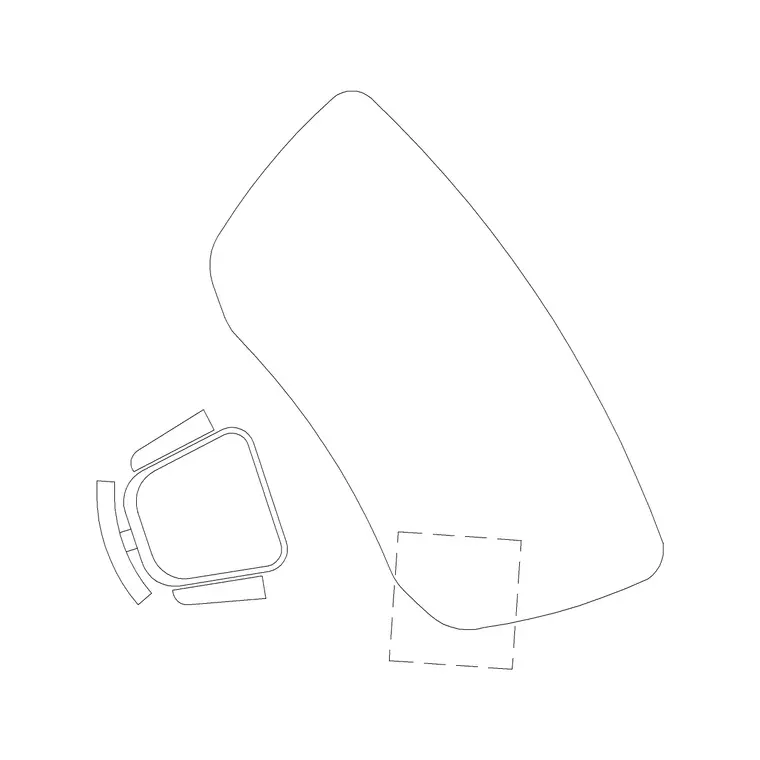
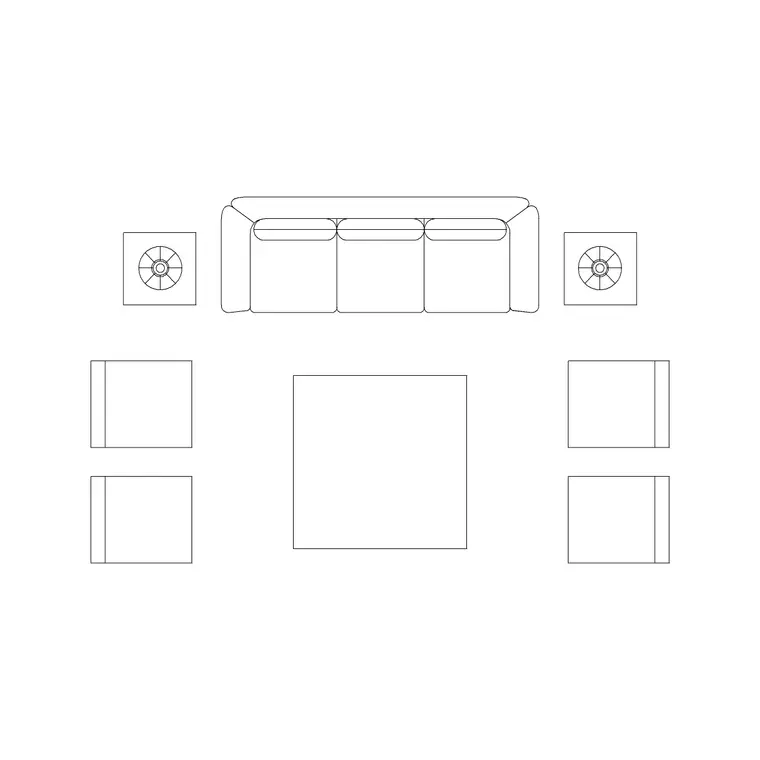
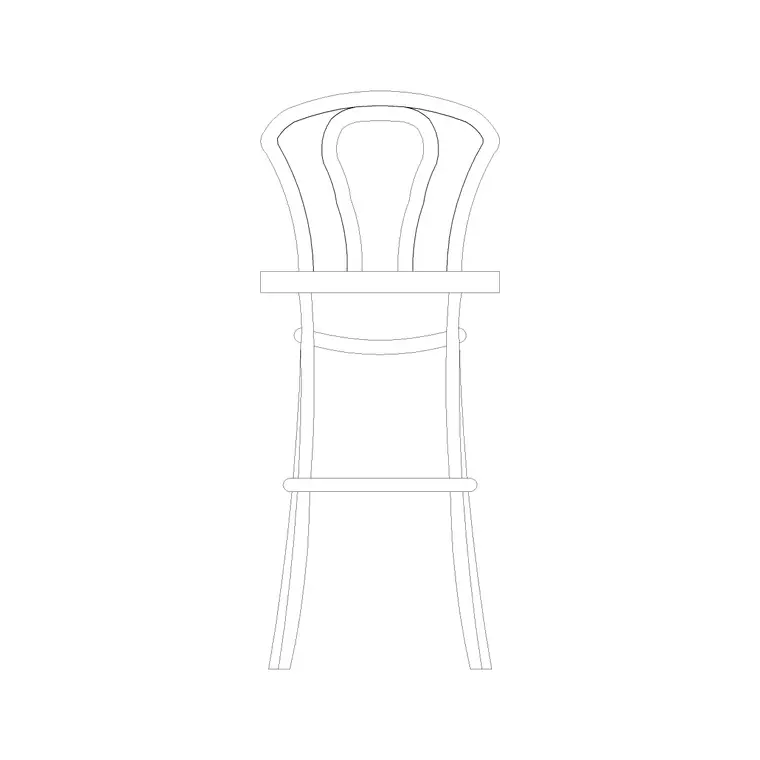
- A reception-table block is the front desk where clients book, pay and wait. - A sofa set and accent chairs furnish the waiting area; comfortable seating here sets the tone. - Round-back stools and bar stools serve as stylist seats and at the consultation/colour bar. - Mirrors aside, art frames and a wall clock dress the styling wall and help clients (and stylists) track time. - Indoor plants and a flower basket warm the space and photograph well for the salon's social media. - Wall lamps and a feature chandelier or ceiling lamp give the layered, flattering lighting a salon needs — harsh overhead light alone is unkind at the mirror.
Keep stations, seating, plumbing and lighting on separate layers so the electrician, plumber and joiner each get a clean plan.
Dimensions and clearances
The make-or-break dimension in a salon is the space behind a styling chair, because the stylist works a full circle around the client. Allow about 1500–1800 mm between the centres of adjacent styling stations, and at least 900 mm of clear working space behind each chair (more where it doubles as a walkway). The styling chair itself occupies roughly a 600–700 mm footprint, growing when reclined.
Backwash basins need about 900–1200 mm of clear floor in front for the stylist to stand and work. Reception desk: 600–750 mm deep with 900 mm behind. Waiting seating wants 700–900 mm of passing space in front. Keep a 1500 mm turning circle at the entrance and reception for accessibility. With the full-size blocks in place these gaps are visual, not arithmetic.
Building the salon plan
Draw the shell, the entrance and the plumbing wall first — the plumbing wall fixes the wash zone. Place the reception desk by the door and the waiting sofa and chairs beside it. Set out the styling stations along the mirror wall(s), spacing them at the station-centre figure above and confirming the working space behind each one.
Group the backwash basins against the plumbing wall with their working clearance. Add stylist stools, the consultation/colour bar with its stools, and the back-of-house. Drop in the lighting — wall lamps at the mirrors, a feature pendant over reception — on the lighting layer, and the plants and wall art to finish. Insert every block at scale 1 in a millimetre drawing. Walk a client through the loop on the plan to confirm no stage forces them to backtrack.
Common salon mistakes
The number-one mistake is cramming in stations to maximise chairs, leaving too little room behind each one for the stylist to circle the client — it slows every service and feels cramped. Another is putting the wash basins far from the plumbing wall, which balloons the fit-out cost. Reception placed away from the door leaves arriving clients unsure where to go, and a waiting area squeezed into a leftover corner makes the first impression poor.
In the drawing, watch for stations placed without checking the behind-chair clearance, and for mixing the wet services into the furniture layer so the plumber cannot read their plan. Keep the chairs and seating as block references so adjusting the station count is a quick re-array rather than a redraw.
Free download
Browse the full library — DWG & DXF, no signup.
Questions
Frequently asked
How much space goes between salon styling stations?+
Allow about 1500–1800 mm between station centres and at least 900 mm of clear working space behind each chair so the stylist can move around the client. The full-size chair blocks let you confirm this directly on the plan.
Where should the wash basins go in a salon?+
Group the backwash basins against the plumbing wall to keep the water run short and cheap, with about 900–1200 mm of clear floor in front for the stylist. Tuck them so reclining clients have a little privacy.
Which CAD blocks do I need for a salon fit-out?+
A reception desk, waiting-area sofa and chairs, stylist and consultation stools, plus lighting, wall art, a clock and plants. The styling chairs and backwash units are often drawn as dedicated symbols around these supporting blocks.
Are these salon CAD blocks free for commercial projects?+
Yes. They download free in DWG and DXF with no signup, watermark or attribution and are cleared for commercial salon fit-out work.
Related downloads
Blocks for this guide

Related categories
Related guides
Room guide
Free Living Room CAD Blocks — DWG Download
Free living room CAD blocks in DWG & DXF — sofa sets, coffee tables, lamps, plants and art drawn to scale for AutoCAD plans. No signup, commercial-use OK.
Room guide
Free Reading Nook CAD Blocks — DWG Download
Free reading nook CAD blocks in DWG & DXF — armchairs, side tables, reading lamps, plants and art for cosy reading corner plans in AutoCAD. No signup.
Room guide
Free Open-Plan Living Area CAD Blocks — DWG
Free open-plan living area CAD blocks in DWG & DXF — sofa sets, tables, plants and zoning lighting to define a great room in AutoCAD. No signup, free.