Block landing · cuckoo clock cad block
Free cuckoo clock CAD block in DWG and DXF
By Sumana Kumar · Published 30 Aug 2022 · Updated 7 Jun 2026
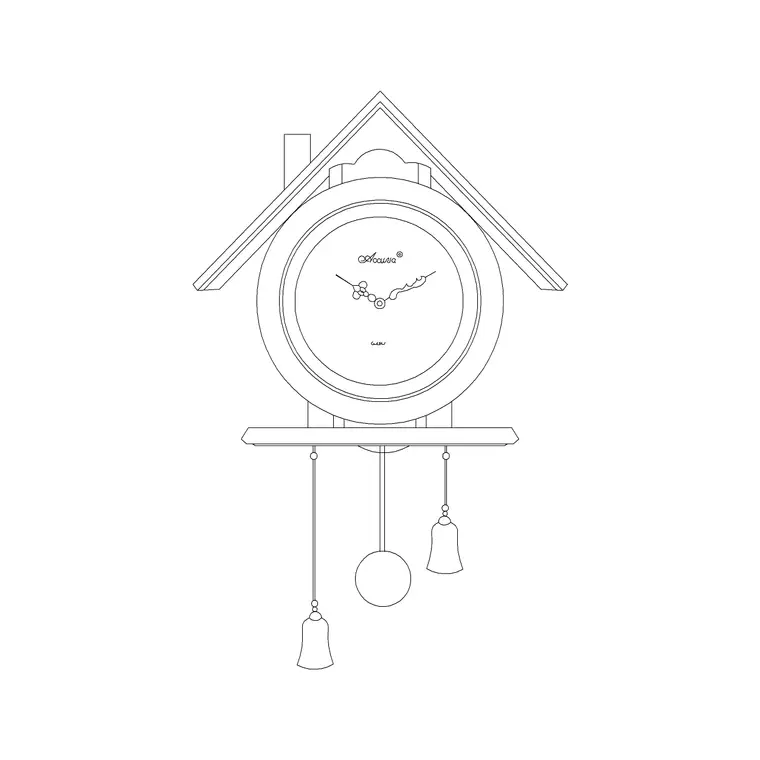
A cuckoo clock is a character piece — the carved, chalet-style wall clock with its pendulum, weights and little door — and a ready-made cuckoo clock CAD block lets you hang that decorative timepiece without drawing its ornate outline by hand. This page offers a free cuckoo clock CAD block in DWG and DXF, drawn as the distinctive house-shaped clock with its hanging weights so it reads instantly on a traditional or themed interior elevation. It is free for personal and commercial use, with no signup, watermark or attribution.
A cuckoo clock is set dressing with personality, used where a plain round clock would be too neutral — a country kitchen, an Alpine-themed restaurant, a heritage interior, a child's room. Because the block is drawn to scale, you can judge whether its ornate form suits the wall and hangs with enough room for the dangling weights and pendulum.
What makes a cuckoo clock block distinctive
Where a round clock is a simple disc, a cuckoo clock block is all silhouette: the gabled, chalet-style case with carved edges, a small dial set into the front, the little door above it, and the chains with hanging weights and a pendulum below. That elaborate outline, with the weights dropping beneath the case, is what makes the block read unmistakably as a cuckoo clock.
It is an elevation element, drawn as detailed single-layer linework. Because the form is ornate, the block is drawn cleanly enough that you can freeze or thin the fine carving for small-scale plots, and explode it if you need to simplify the case. As a single block reference it drops onto a wall in one move.
Why it is an elevation block
Like any wall clock, a cuckoo clock hangs flat against a wall, so it lives in elevation. You place it on interior elevations, themed restaurant or retail presentation drawings, and styling boards where the wall is shown face-on. In plan it would be just a line on the wall and is not a useful plan block.
The value of the block is its instant character: dropped onto a kitchen or themed-interior elevation it does more storytelling than a plain clock, signalling a traditional or Alpine mood. Pair it with timber furniture, a dresser or a fireplace block to complete the scene.
Typical cuckoo clock sizes
Use these as guide ranges. A traditional cuckoo clock case commonly sits in the 250–450 mm width and 350–550 mm height band for the case alone, with the chains, weights and pendulum hanging a further distance below — often a comparable length again, so the total drawn extent is noticeably taller than the case.
The figures that matter for placement are the overall drawn height including the weights, and the clear wall space beneath the case, because the dangling weights and pendulum need room and must not collide with furniture or a shelf below. Hang the case so the dial sits at a readable height while the weights still clear what is under it.
How to insert and scale the cuckoo clock
The block is drawn full size in millimetres. In a millimetre drawing, INSERT at scale 1 for real size; in a metre template insert at 0.001; in an imperial drawing set INSUNITS to millimetres so AutoCAD rescales it on insertion. That keeps the ornate proportions honest and avoids a miniature or giant case.
Pick a point at the top of the case as the insertion point so the clock hangs from the correct wall height, then check the weights clear the furniture below. Because the clock is a single block reference, it copies between elevations in one move, and editing the block definition lets you simplify the carving across every instance at once for a small-scale drawing.
Where cuckoo clock blocks are used
Cuckoo clocks suit country and farmhouse kitchens, Alpine and chalet-themed restaurants and bars, heritage and period interiors, children's rooms, and gift or souvenir retail fit-outs. Pair the cuckoo clock with the round and table clock blocks in the accessories category when you want to contrast clock styles, and with dresser, fireplace and timber-furniture blocks to build a traditional scene.
Because the file is free and licence-clear, it suits interior and set-design student projects, mood boards and themed concept elevations. The same block carries from a styling sketch to a finished presentation board without the ornate case being redrawn each time.
Handling the detail and the hanging weights
Two things deserve care with a cuckoo clock. First, the carving: at small plot scale the fine detail clogs, so keep it on a layer you can thin or freeze and reserve full detail for large-scale elevations. Second, the weights and pendulum: they need clear wall below the case, so place the clock where nothing collides with the chains, and remember the total drawn height is much greater than the case alone.
Keep the clock on a dedicated dressing layer so you can freeze it for a clean technical elevation and thaw it for the styled version. Because it is such a strong character piece, one is usually enough on a wall — let it be the focal accent rather than repeating it.
Free download
Browse the full library — DWG & DXF, no signup.
Questions
Frequently asked
Is the cuckoo clock CAD block free for commercial use?+
Yes. It downloads free in DWG and, where available, DXF, with no signup, watermark or attribution, and is cleared for paid client projects.
Does the block include the hanging weights and pendulum?+
Yes. The distinctive chains, weights and pendulum hanging below the case are part of what makes it read as a cuckoo clock, so the total drawn height is noticeably greater than the case alone.
How much wall space does a cuckoo clock need?+
Beyond the 250–450 mm wide case, allow clear wall beneath it for the dangling weights and pendulum — often a comparable drop again — so they do not collide with furniture or a shelf below.
Will the file open in older AutoCAD?+
Yes. The DWG targets AutoCAD 2004 and later, so it opens in AutoCAD, AutoCAD LT, BricsCAD, DraftSight and free DWG viewers.
Related downloads
Blocks for this guide

Related categories
Related guides
Block landing
Wine Rack CAD Block DWG — Free Download
Download a free wine rack CAD block in DWG and DXF — bottle storage drawn in plan and elevation for kitchens, bars and cellars. AutoCAD 2004+, no signup.
Block landing
Wine Glass CAD Block DWG — Free Download
Download a free wine glass CAD block in DWG and DXF — red and burgundy stemware in elevation and plan for bar and table settings. AutoCAD 2004+, no signup.
Block landing
Cement Planter Pot CAD Block DWG — Free
Download a free cement planter pot CAD block in DWG and DXF — concrete-finish planter drawn in plan and elevation for interiors and terraces. AutoCAD 2004+.