Room guide · courtyard cad blocks
Free courtyard CAD blocks for AutoCAD
By Saumyajit Maity · Published 14 Dec 2023 · Updated 9 Jan 2026
A courtyard is an outdoor room with walls on most or all sides — an enclosed void carved into a building or between wings. That enclosure changes everything about how you design it. Sightlines come from the surrounding rooms looking in, so the courtyard is read from above and from its edges as much as from within. Light is limited by the walls. And circulation often passes through it rather than ending in it. These free courtyard CAD blocks give you the paving, central planting, trees and seating to compose one properly at scale in AutoCAD, all in DWG.
Unlike a garden that opens to the horizon, a courtyard is a contained composition. The classic move is a strong centre — a specimen tree, a planted bed, a water feature or a paved focus — with the surrounding floor kept calm so the rooms around it borrow the green. Symmetry reads well here because the space is seen as a framed picture.
Everything is free for personal and commercial use, no signup, no watermark, and opens in AutoCAD 2004 or later. Draw the enclosing walls and the openings into the courtyard first; they are the frame that every other decision answers to.
The enclosed-room logic of a courtyard
A courtyard is an open-to-sky space enclosed by building on most or all sides, found in homes, hotels, offices, schools and traditional houses across many climates. Because it is surrounded, it is experienced as a framed view from the rooms around it, often from several storeys up. That makes its plan composition unusually important — there is no distant landscape to carry the eye, so the courtyard itself must be the whole picture.
Design follows from that. The plan reads best with a clear centre and a calm perimeter, the openings into the surrounding rooms set the main sightlines, and the planting is chosen for shade tolerance because the walls cut the light. Where the courtyard is also a route between wings, the path through it has to be resolved without destroying the composition.
Composing around a centre
The most reliable courtyard layout is centred. Place a feature on the main axis — a specimen tree, a square or round planted bed, or a paved medallion — and let the surrounding floor stay quiet. The pine plan block reads as a feature tree; the round iron-fenced flower bed and the rectangular bed make a built centrepiece; clustered potted plants soften the corners.
Keep the centre proportional to the void: a feature that fills the courtyard leaves no floor to stand on, while one too small floats. Aim to read the centre clearly from the main opening, and let the four corners take the supporting planting. Because the space is framed, modest symmetry — matched corner planters, a centred bed — pays off more here than in an open garden.
Paving and circulation through the void
Paving is the courtyard's dominant surface, so its pattern carries real weight. Lay a paver pattern that frames the centre — a banded border, a square-on-square or a path that crosses to the openings. The paving blocks give you several patterns to set that geometry.
If the courtyard is a route between rooms, draw the desire line first and let the paving acknowledge it: a clear crossing path with planting set back from it, rather than a centre feature marooned in the walking line. Keep crossing paths at least 900–1200 mm wide where they carry regular traffic. A courtyard that fights its own circulation never feels resolved on the ground.
Planting, trees and seating in shade
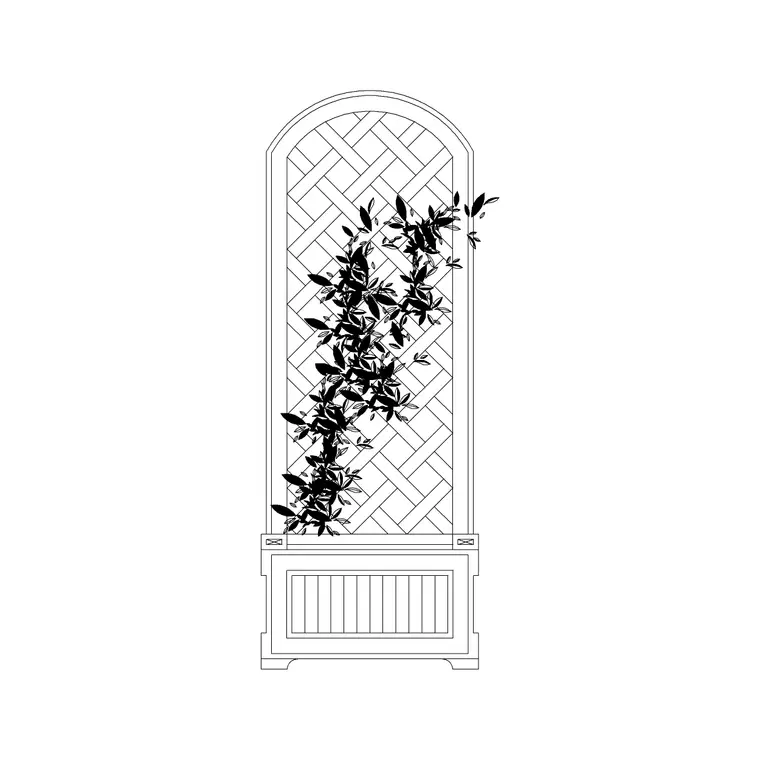
Walls steal light, so courtyard planting leans toward shade-tolerant species and containers that can be swapped as conditions reveal themselves. Use the potted plant blocks and low pots in the corners and along the walls, the flower-bed blocks for built planting, and a feature tree only where the void is tall enough to let it breathe.
Seating in a courtyard is usually intimate — a two-seat table, a bench against a wall, a small lounge cluster facing the centre. Set seating at the edges looking in, so people occupy the frame and contemplate the centre, and keep the middle for the feature. Orient at least one seat to catch whatever direct sun the walls allow through the day.
Building the courtyard plan
Sequence the drawing around the frame. First, draw the enclosing walls and every opening — doors, windows and route gaps — because these set the sightlines and entries. Second, fix the centre feature on the main axis. Third, if the courtyard is a through-route, draw the crossing path and pull planting clear of it. Fourth, place corner and wall planting to support the centre. Fifth, set seating at the edges facing in, then lay the paving pattern to tie it together.
Keep walls, paving, planting, furniture and any water feature on separate layers, and insert beds, trees and pots as named blocks. A north arrow earns its place here — it tells the reader which walls shade the courtyard and where the planting and seating should chase the light.
Courtyard design mistakes
- A weak centre: a courtyard with no focus reads as a leftover gap. Commit to a clear central feature. - Sun-loving planting in shade: walls cut the light, so species that need full sun will fail. Plan for shade tolerance. - Blocking the route: a centre feature dropped into the only crossing path forces detours and looks unresolved. - Over-filling the floor: paving plus planting plus furniture edge to edge leaves nowhere to stand. Keep calm space. - Ignoring the view from above: courtyards are seen from upper rooms, so a plan that only works at eye level misses half the audience.
Free download
Browse the full library — DWG & DXF, no signup.
Questions
Frequently asked
What makes a courtyard different to design than an open garden?+
A courtyard is enclosed by building on most sides, so it is read as a framed picture from the surrounding rooms and from above, with limited light. That pushes the design toward a strong centre, a calm perimeter and shade-tolerant planting.
Why centre the composition?+
Because a courtyard has no distant landscape, the eye needs a focus. A central feature — a specimen tree, a planted bed or a paved medallion — gives the framed view a subject, while the surrounding floor stays quiet and lets the rooms borrow the green.
How wide should a path crossing a courtyard be?+
Keep crossing paths at least 900–1200 mm where they carry regular traffic between wings. Draw the desire line first and set planting back from it, so the route and the composition coexist rather than fight.
What planting suits a shaded courtyard?+
Lean toward shade-tolerant species and containers you can move as the light reveals itself. Use the potted-plant and flower-bed blocks in corners and against walls, and reserve a feature tree for a tall enough void.
Are the courtyard blocks free for commercial work?+
Yes. Every block downloads as DWG free for personal and commercial projects, no signup or watermark, and opens in AutoCAD 2004 or later and most DWG-compatible CAD tools.
Related downloads
Blocks for this guide



Related categories
Related guides
Room guide
Free Balcony CAD Blocks — DWG Download
Free balcony CAD blocks in DWG — railings, compact seating, planters and pavers drawn to scale for AutoCAD apartment plans. No signup, commercial use OK.
Room guide
Terrace Garden CAD Blocks — Free DWG
Free terrace garden CAD blocks in DWG — raised planters, potted greenery, seating and paving to design a green roof terrace in AutoCAD. No signup.
Room guide
Rooftop Deck CAD Blocks — Free DWG
Free rooftop deck CAD blocks in DWG — lounge seating, railings, planters and decking pavers for roof terrace plans in AutoCAD. No signup, commercial OK.