Block landing · 6 person workstation cad block dwg
6 person workstation CAD block in DWG and DXF in 2026
By Saumyajit Maity · Published 10 Feb 2026 · Updated 5 Mar 2026
A six-person workstation is the long bench cluster that anchors high-density open-plan floors. Drawn as three-facing-three along a continuous spine, it lets a designer lay out whole teams in a single insertion rather than building a bench desk-by-desk. This 6 person workstation CAD block is drawn at true millimetre dimensions in plan view, ready for AutoCAD 2004 or later, and free for personal and commercial work with no signup and no watermark.
The six-seat unit is where the economics of a fit-out become visible. A long shared bench packs people efficiently and shares one cable spine across six desks, so it is the cluster planners reach for when the brief is to maximise seats per floor. Because the block already carries six work positions, the central spine and the chair clearances, you can repeat it across a bay and immediately read both the headcount and whether the aisles between benches still work.
What the six-person bench contains
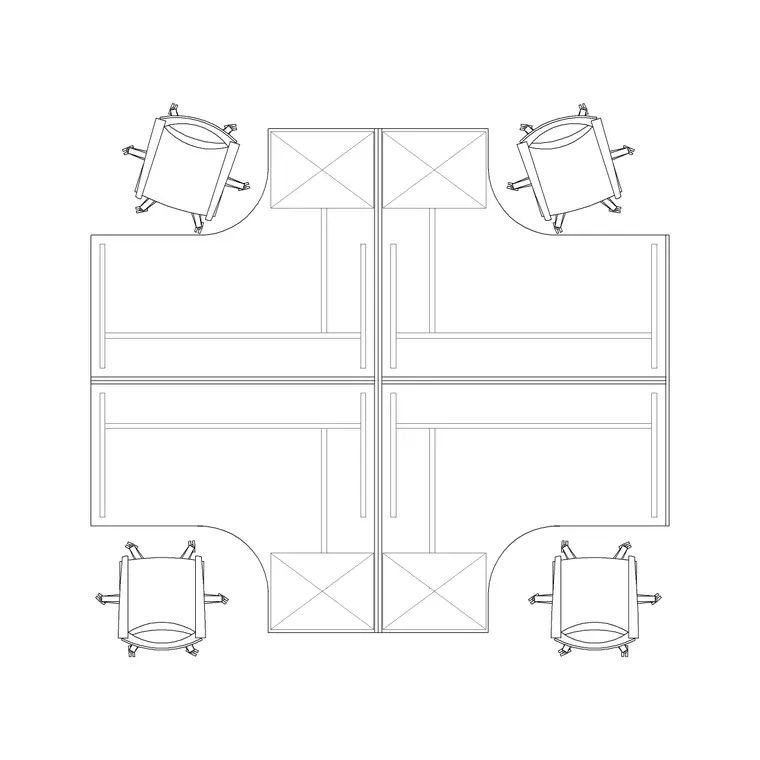
The plan view shows six desk surfaces in two rows of three, sharing a central spine that runs the length of the bench and carries power and data. The block includes the continuous worktop outlines, the dividing screen between the facing rows, and the six seat positions, kept on layers you can freeze or recolour independently.
A realistic six-seat bench also reflects where the cable tray and any shared storage sit along the spine, because that governs how two benches pack back-to-back. Inserting this block places a complete team cluster in one move, with the desk spacing already accounting for the room each person needs to roll back and stand, so you are reading a working bay rather than a row of bare rectangles.
Typical sizing to design around
Use these ranges to sense-check a layout. With single desk positions commonly drawn 1200 to 1600 mm wide and 700 to 800 mm deep, a three-facing-three bench typically runs around 3600 to 4800 mm long and roughly 1400 to 1650 mm across the two facing depths, before chair pull-out space. Allow for the seats and the full working envelope of the cluster often sits in the region of 4000 to 5200 mm long by 2800 to 3400 mm deep.
For circulation, plan around 900 to 1000 mm of clear floor behind each seated user and keep the aisles between benches wide enough to serve as walkways, often 1000 to 1200 mm or more for busy routes. These are typical planning ranges rather than fixed specs; the exact bench length depends on the desking system and how many desks you string together, so confirm against the manufacturer data before committing the bay.
How to insert and repeat the bench
The block is full size in millimetres. Insert at scale 1 in a millimetre drawing, 0.001 in a metre drawing, or set INSUNITS to millimetres on an imperial template so AutoCAD rescales on insertion and you sidestep a units mismatch. Run INSERT or drag the DWG from a tool palette, pick an insertion point, and rotate to suit the bay grid.
The bench comes in as a single block reference, so building a floor of benches is a rectangular ARRAY with the row and column spacing tuned until the aisles read correctly. Need a four- or eight-seat variant? Edit the block definition with BEDIT to add or remove desk positions, and every instance updates together — far quicker than editing each bench by hand. Where a run needs to bend around a core, copy and rotate the bench rather than stretching it out of proportion.
Where six-person benches are used
The long bench is the signature of high-density commercial floors: technology and finance offices, agencies, shared-service centres, newsrooms and large co-working spaces all run on six- and eight-seat benches. It suits team zones where a whole squad sits together, and it reads well in stack and test-fit plans where the goal is to prove the maximum sensible seat count.
Because the block is free and licence-clear, it carries from the leasing test-fit through to the construction set. Use it to show a landlord or tenant how many seats a floor yields, then keep the identical geometry as you coordinate power and data along the spine and produce the furniture schedule. One trustworthy bench does the work from pitch to handover.
Layers, attributes and schedules
Put the bench on a dedicated furniture layer and the chairs on a separate layer, so you can freeze furniture for a clean structural plan and thaw it for a furnished one, all from a single drawing. Distinct colours and lineweights for worktops, screens and seating keep a dense bench layout legible at small scale.
Give each bench a block attribute — a seat count or a team label — and you can extract a headcount and furniture schedule straight from the model, which is exactly what space planning and facilities teams want. Once a bay is approved, WBLOCK the furnished bench, with chairs and storage, as a single reusable assembly so the next high-density floor is laid out in minutes rather than hours.
Free download
Browse the full library — DWG & DXF, no signup.
Questions
Frequently asked
Is the 6 person workstation block free to use commercially?+
Yes. It downloads free in DWG, with DXF where available, and is cleared for commercial work with no signup, no watermark and no attribution required.
How long is a six-person bench desk?+
A three-facing-three bench commonly runs around 3600 to 4800 mm long and roughly 2800 to 3400 mm deep once chairs are included. Treat that as a planning range and confirm against the desking system you specify.
Can I extend the bench to eight or ten seats?+
Yes. Edit the block definition with BEDIT to add desk positions along the spine, or copy and join two benches end to end. Because desks sit on their own layer, extending or trimming the run is straightforward.
Which programs open the DWG?+
It targets AutoCAD 2004 and later, opening in current AutoCAD, AutoCAD LT, BricsCAD, DraftSight and free DWG viewers. DXF is supplied where available for other CAD applications.
Related downloads
Blocks for this guide
Related categories
Related guides
Block landing
Free Office Chair CAD Blocks — DWG Download
Download free office chair CAD blocks in DWG and DXF — task chairs, swivel chairs and executive seats drawn in plan and elevation, AutoCAD 2004+, no signup.
Block landing
Free Lighting Fixtures CAD Blocks — DWG Download
Download free lighting fixtures CAD blocks in DWG and DXF — chandeliers, wall lights, downlights and pendants in plan and elevation for AutoCAD.
Block landing
Free Office Desk CAD Blocks — DWG Download
Free office desk CAD blocks in DWG and DXF — straight desks and desk-with-chair units in plan and elevation for AutoCAD. No signup, commercial OK.