Block landing · 3 door wardrobe cad block
Free 3 door wardrobe CAD block in DWG in 2026
By Saumyajit Maity · Published 11 Jun 2025 · Updated 9 May 2026
A three-door wardrobe sits at the sweet spot between a compact two-door cupboard and a full wall-length run, and a properly scaled 3 door wardrobe CAD block makes it easy to test that middle size against a real room. This page offers a free three-door wardrobe block in DWG, drawn in plan view at true millimetre dimensions and ready to insert into AutoCAD 2004 or later. It is free for personal and commercial work, with no signup and no watermark.
Use this block when a single bay is too little but a four- or six-door run is too much for the wall. A three-door unit gives generous hanging space without dominating the room, which is why it is the default choice for many master and second bedrooms. Because the block is drawn to scale, the door swings and the carcass footprint let you check the layout the instant it lands.
What a 3 door wardrobe block shows
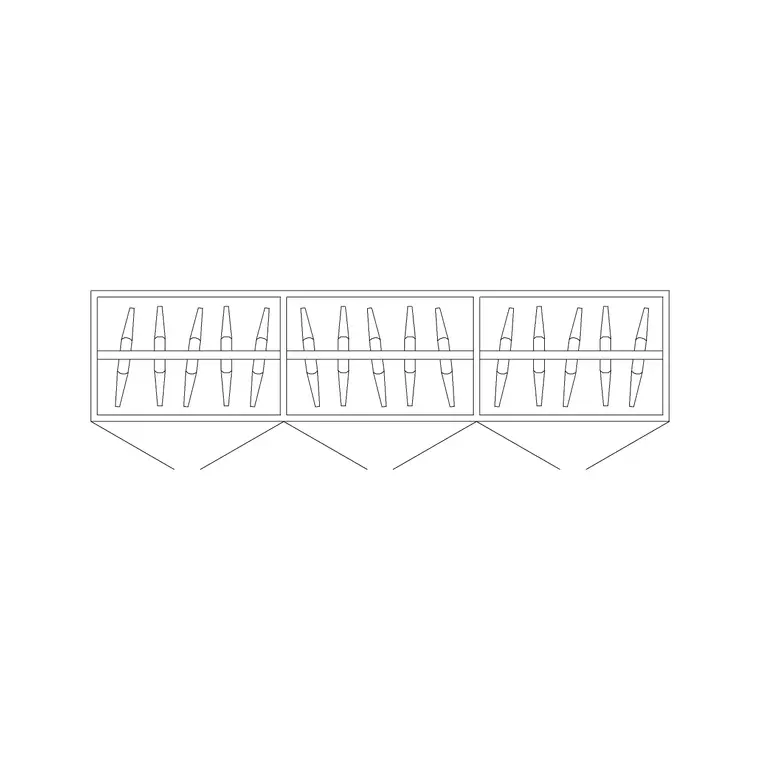
The block represents a three-bay cupboard from above: the carcass rectangle divided into three door leaves, with swing arcs or open-direction lines for each leaf. In plan, those three swing arcs are the working part of the drawing — they tell you how much floor in front of the unit must stay clear and which way the room reads best.
A three-door wardrobe is effectively one and a half times a two-door unit, so it occupies more wall but still behaves as a single storage object you can move, copy and rotate as one block reference. It is the natural step up when a room can spare a bit more wall but you do not want a full-length fitted run.
Views and what's included
The file ships in plan view, the view you use for bedroom and apartment layouts. The plan carries the outline, the three door leaves and their swing indication so you can place the unit, mirror it and check clearances against the bed, the door and the window reveal.
Keep the block on a furniture layer so it sits cleanly alongside the bed, nightstands and dressing table. If a joinery or interior-elevation drawing needs the cupboard face-on, draw that elevation separately on its own layer — this plan block is intended for setting out the room, not for the cabinet schedule.
Typical 3 door wardrobe sizing
Treat these as planning ranges, not fixed dimensions. A three-door hinged wardrobe is often around 1350–1650 mm wide, since three comfortable leaves of roughly 450–550 mm each add up to that span. Depth is commonly 550–650 mm to clear a front-to-back hanging rail. Height tracks the ceiling and does not appear in plan.
Leave clear floor in front for the doors. Hinged leaves typically need 450–600 mm of swing clearance, so keep that strip free of the bed and any walkway. With the scaled block in place, you can read those clearances straight off the swing arcs instead of calculating them.
How to insert and place the block
The block is drawn full size in millimetres. Insert at scale 1 in a millimetre drawing, 0.001 in a metre template, or set INSUNITS to millimetres so AutoCAD rescales on insertion. Use INSERT or drag the DWG from a tool palette, snap the insertion point to a back corner so the cupboard sits flush to the wall, and rotate to suit the room.
Move the placed block onto a furniture layer for clean freezing later. If the leaves swing into the bed, mirror the block about its centreline to reverse the swing. To fit a non-standard wall length, you can stretch the carcass slightly, but keep the leaf widths sensible so the doors still read as usable.
Where three-door wardrobes are used
Three-door units suit master bedrooms in apartments, well-proportioned second bedrooms, guest suites, serviced apartments and mid-range hotel rooms. They give a single person or a couple enough hanging and shelf space without the cost or bulk of a full fitted wall, which is why they recur across residential and hospitality drawing sets.
Pair the block with the bed, bedside-table and dressing-table blocks in the furniture category to build a complete room. Where a wall can take more storage, swap to a four-, five- or six-door run from the same family; where the wall is shorter, drop back to the two-door unit. Keeping the whole run from one block family keeps the plan consistent.
Layering and reuse
Put the wardrobe on a dedicated furniture layer rather than layer 0 so you can toggle storage on and off independently of the architecture. A distinct colour and lineweight for furniture lets you issue a clean shell plan and a furnished plan from one drawing, and you can dim the swing arcs on a lighter sub-layer for presentation sheets.
Tag the cupboard as a block with a type attribute and you can pull a furniture schedule from the drawing, which is handy when a fit-out count is needed per room. Once a standard bedroom is set out, WBLOCK the bed-and-wardrobe arrangement as a single unit so you can repeat the room across a multi-unit scheme without redrawing the storage each time.
Three doors versus sliding alternatives
A three-door hinged unit is not the only way to fill a 1350–1650 mm wall. The same span can be closed with two or three sliding leaves, which trade a little internal access for zero swing clearance. If the bed sits close to the wardrobe wall, that swing-versus-slide decision is worth making on the plan: the hinged block shows three swing arcs eating into the room, while a sliding equivalent shows overlapping leaves and frees that strip of floor.
Keep the choice readable in the drawing. Where you place a hinged three-door unit, the arcs do the communicating; where you switch to sliding, the overlap notation does. Either way the carcass footprint and the 550–650 mm depth stay the same, so you can swap door types late in the design without re-planning the position. That makes the three-door size a flexible default — you commit to the bay arrangement first and resolve hinged or sliding once the bed position is final.
Free download
Browse the full library — DWG & DXF, no signup.
Questions
Frequently asked
Is the 3 door wardrobe CAD block free to use commercially?+
Yes. It downloads free in DWG with no signup, no watermark and no attribution requirement, and it is cleared for commercial as well as personal project use.
What is a typical three-door wardrobe width?+
Often around 1350–1650 mm, since three comfortable hinged leaves add up to roughly that span. Use the figure as a planning range and stretch or scale the block to match your real unit.
Which view does the download include?+
Plan view — the cupboard seen from above with three door leaves and their swing indication. That is the view used for bedroom and apartment layouts.
Can I fit it to a slightly different wall length?+
Yes. Stretch the carcass with grips or the STRETCH command, keeping each leaf a sensible width so the doors still read as usable. For a big change, step up or down to a different door-count unit instead.
Related downloads
Blocks for this guide
Related categories
Related guides
Block landing
Free Office Chair CAD Blocks — DWG Download
Download free office chair CAD blocks in DWG and DXF — task chairs, swivel chairs and executive seats drawn in plan and elevation, AutoCAD 2004+, no signup.
Block landing
Free Bar Table CAD Blocks — DWG Download
Download free bar table CAD blocks in DWG and DXF — round, square and rectangular high bar tables in plan and elevation for AutoCAD. No signup, commercial-use OK.
Block landing
Free Restaurant Table CAD Blocks — DWG Download
Download free restaurant table CAD blocks in DWG and DXF — 2, 4 and 6 cover tables with chairs drawn in plan and elevation for AutoCAD. No signup, commercial-use OK.