Curated pack · 20 free wardrobe cad blocks dwg
Twenty free wardrobe CAD blocks for AutoCAD in 2026
By Sumana Kumar · Published 26 Mar 2026 · Updated 20 Apr 2026
A wardrobe sets the rhythm of a bedroom plan: it defines a whole wall, governs the door swings around it and dictates how much floor is left for the bed and circulation. This pack collects 20 free wardrobe CAD blocks in DWG — hinged-door wardrobes, sliding-door runs, corner units and walk-in layouts — drawn to scale for AutoCAD 2004 and later. Every file is free for personal and commercial use, with no signup and no watermark.
Twenty styles cover the situations that come up across residential work: the standalone two- or three-door wardrobe, the floor-to-ceiling sliding run along a feature wall, the angled corner unit and the walk-in dressing room. You get plan blocks for the bedroom layout and elevation blocks for joinery drawings and interior elevations.
Wardrobes are dimensionally demanding because they sit on standard module depths and because their doors need room to open. A hinged door needs swing clearance; a sliding door needs none but eats internal depth. Drawing the wardrobe at its true depth and showing the door operation lets you settle the bedroom layout — and avoid a wardrobe door that fouls the bed — straight on the plan.
The 20 wardrobe types in the pack
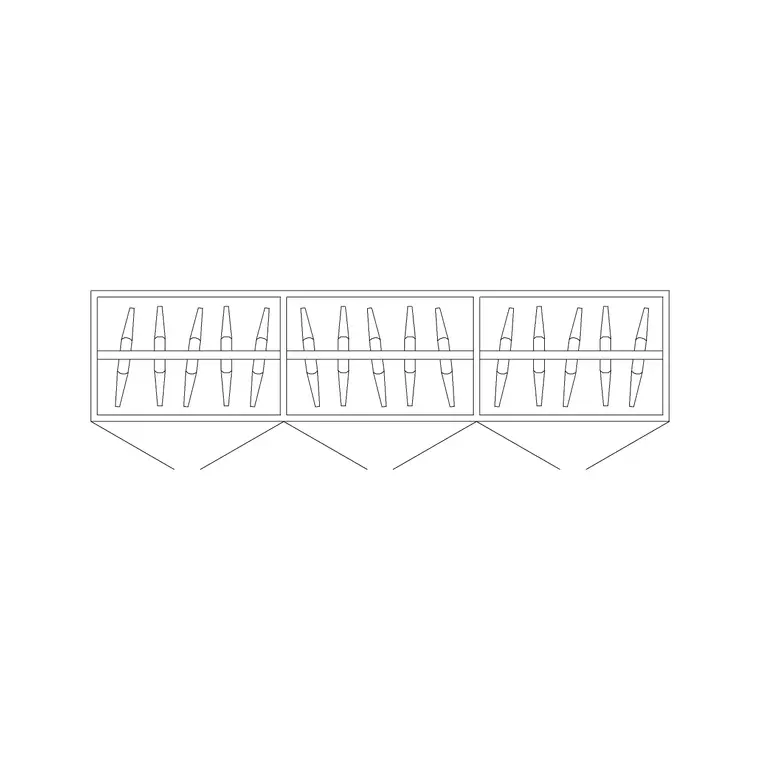
The set spans the main configurations. Hinged-door wardrobes in two-, three- and four-door widths, with the door swing drawn so you can check clearance. Sliding-door runs that need no swing space, ideal for tight rooms and feature walls. Corner wardrobes that turn an awkward corner into storage. And walk-in layouts with hanging rails and shelving drawn to plan. There are freestanding-style blocks and fitted, built-in runs you can stretch to the wall length.
Having the range in one pack means a project can stay consistent across bedrooms or vary by room size — a sliding run in the small room, a walk-in off the master. Each block is drawn on sensible layers so the carcass, doors and internal fittings can be handled separately.
Wardrobe dimensions to design around
Use these as planning ranges and confirm against the units you specify. Wardrobe depth commonly sits around 600 mm so a garment can hang across a rail without crushing, though slimmer 500-550 mm units exist for tight rooms. Per-door widths typically fall around 450-600 mm, so a three-door wardrobe lands roughly in the 1350-1800 mm range. Standard heights run from around 2000 mm up to full floor-to-ceiling.
The figure that catches people out is hinged-door swing: a 500 mm door needs 500 mm of clear floor in front to open, which must not overlap the bed or a walkway. Sliding doors trade that swing space for a little lost internal depth. Drawing both correctly in plan turns the bedroom layout into a set of visual clearance checks.
Plan block and elevation block
The plan block is the workhorse for laying out a bedroom: it shows the wardrobe footprint against the wall, the internal hanging and shelf layout, and — for hinged units — the door swing arcs. This is what you push against a wall and check against the bed, the door into the room and the circulation route. Keep it on a furniture or joinery layer so the bedroom plan stays legible.
The elevation block shows the wardrobe face-on: the door divisions, handle lines, drawer fronts and any open shelving. Use it for joinery and interior elevations, where the door pattern and proportions matter, and for presentation drawings. Many blocks ship both views in one DWG so the plan and the joinery elevation come from a single download.
Fitting a wardrobe into the bedroom layout
Start by deciding which wall the wardrobe owns — usually the one without a window and clear of the bedroom door swing — then push the unit against it. Check the door operation immediately: a hinged run wants clear floor in front, so if the bed or the room door competes for that space, switch to a sliding block, which needs none.
Leave room to use the wardrobe. Allow enough clear floor in front for a person to stand and pull a garment out, and keep the swing or slide clear of the bed corner. Because each wardrobe is a block reference, you can try a hinged unit, swap it for a sliding run if the swing clashes, and stretch a fitted run to close the wall, all without redrawing the bedroom.
Layers, joinery and reuse
Put wardrobes on a furniture or joinery layer, separate from the architecture, so you can freeze them for a clean base plan and produce a furnished plan from the same drawing. Drawing the carcass, doors and internal fittings on their own sub-layers or with their own lineweights keeps a joinery elevation legible.
For a built-in run, tag the wardrobe with a width or unit code so a data extraction can summarise the joinery for costing. When a bedroom layout is finalised, WBLOCK the wardrobe with the surrounding wall as a reusable unit and the next similar room starts half-drawn. Because the blocks are references, swapping a hinged unit for a sliding one across several bedrooms is a redefine, not a redraw.
Where wardrobe blocks are used
Wardrobe blocks belong in any drawing with bedrooms: houses and apartments, hotel guest rooms, student accommodation, serviced apartments and care-home rooms. They pair with the bed, bedside-table and dressing-table blocks in the furniture category to build a complete bedroom layer, and with the door and window blocks to test how the room works as a whole.
Because the set is free and licence-clear, it suits student residential schemes, fit-out concepts and presentation plans where storage has to be shown believably. Twenty styles give enough range to fit out a whole development of varied rooms without the same wardrobe appearing in every bedroom.
Free download
Browse the full library — DWG & DXF, no signup.
Questions
Frequently asked
Are these 20 wardrobe CAD blocks free for commercial projects?+
Yes. All twenty download free in DWG with no signup, no watermark and no attribution requirement, and they are cleared for commercial use.
What depth should a wardrobe block be drawn at?+
Commonly around 600 mm so garments hang freely on a rail, with slimmer 500-550 mm units for tight rooms. Confirm against the units you are specifying, and remember sliding doors lose a little internal depth.
Do the wardrobe blocks show door swings?+
The hinged-door plan blocks include the door swing arcs so you can check clearance against the bed and circulation. Sliding-door blocks need no swing space, which the plan reflects.
Do the files include plan and elevation views?+
Many do. The plan block shows the footprint and door swing; the elevation block shows the door pattern and proportions for joinery drawings. Where both ship, they are in the same DWG.
Related downloads
Blocks for this guide
Popular blocks to download
Related categories
Related guides
Curated pack
Free Office CAD Block Pack — DWG & DXF
Free office CAD block pack in DWG and DXF — desks, workstations, conference tables and reception furniture in plan view. No signup, commercial-use OK.
Curated pack
Free Reception Area CAD Block Pack — DWG
Free reception area CAD block pack in DWG and DXF — reception desks, waiting seating and scale figures for lobby layouts. No signup, commercial-use OK.
Curated pack
Free Restaurant CAD Block Pack — DWG & DXF
Free restaurant CAD block pack in DWG and DXF — dining tables, chairs, bar stools and high chairs for cafe and restaurant layouts. No signup, commercial OK.