Curated pack · free toilet cad blocks
15 free toilet and WC CAD blocks for AutoCAD in 2026
By Saumyajit Maity · Published 8 Sep 2024 · Updated 19 Jan 2026
The WC is the fixture that anchors almost every bathroom layout, because its position is fixed by the soil stack rather than by taste — so a folder of clean, correctly-scaled toilet CAD blocks is one of the first things worth keeping in a project library. This collection brings together 15 free toilet and WC CAD blocks in DWG and DXF: close-coupled pans, wall-hung suites on concealed cisterns, back-to-wall units, low-level and high-level cisterns, bidets that share the WC footprint, and squat-pan blocks for regions where they are standard. Every file downloads free for personal and commercial work, with no signup, no watermark and no attribution.
The set is drawn so you can do the thing a WC drawing actually exists to do: prove the activity space in front of the pan, the side clearance to a wall or basin, and the door swing, all the moment the block lands. Because the porcelain is drawn to standard sanitaryware envelopes, you are designing against real dimensions from the first click rather than nudging a rough rectangle later.
Use the pack across en-suites, family bathrooms, cloakrooms, accessible WCs and public washroom ranges. Mix the plan blocks for setting-out and the elevation blocks for tiling and sanitary elevations, and you cover the whole drawing set from one download.
What's in the 15-block WC set
The pack is built to cover the WC types you actually specify, not fifteen near-identical pans. It runs from the everyday close-coupled toilet (cistern bolted directly to the pan) through wall-hung units that hang off a concealed frame, back-to-wall pans that hide the cistern in a duct, and the traditional low-level and high-level cistern arrangements you still meet in heritage and budget work. Two squat-pan blocks are included for projects in regions where they are the norm, and a bidet block rounds out the suite since it shares the WC's plan footprint and sits next to it.
Each block ships in plan as the primary view, with elevation views included on the suites where the cistern height and seat line matter for tiling drawings. The geometry is split sensibly onto layers — porcelain outline, centreline, and the seat — so you can freeze the seat for a setting-out plan or recolour the outline without touching the rest.
Standard WC dimensions to design around
Reach for these figures when you check a layout. A pan is typically 350–400 mm wide and 600–700 mm deep from the wall, with the seat at roughly 400–430 mm above the finished floor. A close-coupled cistern adds 150–200 mm of depth at the back. The pan centreline normally sits a minimum of 200 mm from any side wall, and you want around 600 mm of clear activity space in front of the bowl for someone to use and clean it.
Accessible WCs change the numbers entirely: an ambulant-disabled cubicle and a wheelchair-accessible WC need a clear transfer space beside the pan and a turning circle of roughly 1500 mm, with the pan centreline set further off the side wall. Because the blocks are drawn full size, you draw those zones straight around the inserted pan rather than guessing — which is exactly where a scaled block beats a sketched box.
Plan blocks for setting-out, elevation for tiling
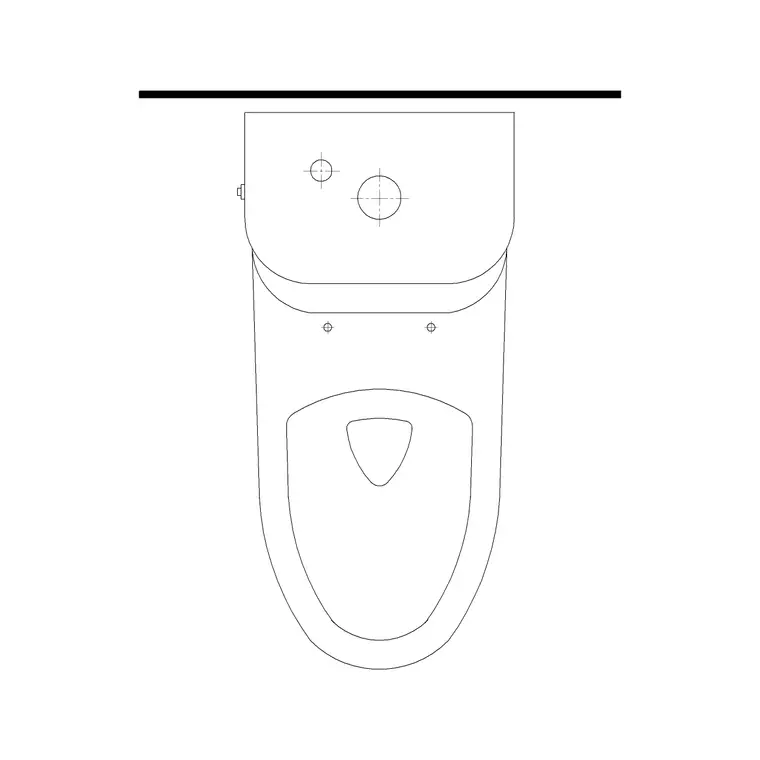
For the bathroom layout you work in plan: pans seen from above, set against the soil-stack wall with their activity zones drawn in. The plan blocks are what you mirror to flip an en-suite, or array down a wall to lay out a row of WC cubicles in a public washroom.
For sanitary elevations, tiling setting-out and client presentations you switch to elevation, where the pan, seat line and cistern are drawn face-on at their real heights. This is where wall-hung versus close-coupled really diverges on the drawing — a wall-hung pan floats clear of the floor on its frame, which the elevation block shows, while a close-coupled suite reads as a continuous mass to the floor. Pick the block whose elevation matches the suite you are specifying.
How to use the set in a bathroom layout
Start from the drainage. Identify the wall carrying the soil stack and place the WC block against it first, because a long horizontal run of large-bore waste with a shallow fall is the thing every bathroom layout tries to avoid. Snap a centreline through the pan and dimension it off the finished wall — that single setting-out dimension is what the installer works to.
With the WC fixed, bring in the basin within easy reach, then the bath or shower along the longest wall, checking the 600 mm activity zone in front of each fixture and the door swing as you go. Keep the WCs on a dedicated sanitary layer so you can produce a clean architectural plan and a dimensioned setting-out plan from the same drawing, and tag each pan with an attribute if you want to extract a sanitaryware schedule later.
Per-item notes: close-coupled, wall-hung, back-to-wall and squat
The close-coupled blocks are the safe default for residential work — they read clearly in plan, the cistern depth is built in, and they suit budget and mid-market jobs. The wall-hung blocks are the ones to reach for in contemporary schemes and where floor cleaning matters: remember the concealed cistern needs a 150–200 mm service void behind the pan, which the plan block accounts for, so don't push it tight against a structural wall.
The back-to-wall pans sit in a tiled or boxed duct, so pair them with a duct line in your plan rather than a bare wall. The low- and high-level cistern blocks carry a visible flush pipe in elevation, which is the detail that makes a heritage or industrial bathroom read correctly. The squat-pan blocks are floor-set with the footprint recessed; use them where the brief and plumbing standards call for them, and check the local activity-space requirements, which differ from a seated WC.
Who uses these toilet blocks
Architects and interior designers use the WC set to fit out residential and hospitality bathrooms at speed and to coordinate the pan position with the soil stack early. Plumbing and public-health engineers use them to lay out cubicle ranges in offices, schools and leisure buildings, where the repeat-and-mirror workflow of scaled plan blocks saves real time. Students reach for them on studio and portfolio projects where licence-clear, correctly-sized fixtures matter.
Pair the toilet pack with the wash basin, bathtub and shower blocks in the bathroom category to fit out an entire sanitary suite from one consistent, free library — and with the sinks-and-faucets category when you move on to the kitchen and utility wet zones.
Free download
Browse the full library — DWG & DXF, no signup.
Questions
Frequently asked
What types of toilet are in the 15-block pack?+
Close-coupled and wall-hung WCs, back-to-wall pans, low-level and high-level cistern suites, two squat pans and a bidet — drawn in plan, with elevation views on the suites where the cistern and seat heights matter.
What clearance should I leave in front of a WC?+
Allow around 600 mm of clear activity space in front of the pan for everyday use, and keep the pan centreline at least 200 mm off a side wall. Accessible WCs need far more — a 1500 mm turning circle and transfer space beside the pan.
Are the toilet CAD blocks free for commercial projects?+
Yes. Every block downloads free in DWG and, where available, DXF, with no signup, no watermark and no attribution requirement, and they are cleared for commercial use.
What scale are the WC blocks drawn at?+
Full size in millimetres. Insert at scale 1 in a millimetre drawing, or set INSUNITS to millimetres so AutoCAD rescales automatically if your template uses different insertion units.
Related downloads
Blocks for this guide
Popular blocks to download
Related categories
Related guides
Curated pack
Free Kitchen CAD Block Pack — DWG & DXF
A free kitchen CAD block pack in DWG and DXF — cookers, hobs, ovens, sinks, hoods and cabinets drawn in plan and elevation for AutoCAD. No signup, commercial-use OK.
Curated pack
Free Plumbing Fixtures CAD Block Pack — DWG
Free plumbing fixtures CAD block pack in DWG and DXF — WCs, basins, sinks, valves, gullies and pipework symbols for AutoCAD layouts. No signup.
Curated pack
Free Accessibility / Part M CAD Block Pack — DWG
Free accessibility / Part M CAD block pack in DWG — wheelchair symbols, turning circles, accessible WCs and clearances for AutoCAD inclusive-design plans.