Curated pack · free stove cad blocks
15 free stove and cooktop CAD blocks for AutoCAD in 2026
By Sumana Kumar · Published 24 Mar 2024 · Updated 21 Mar 2026
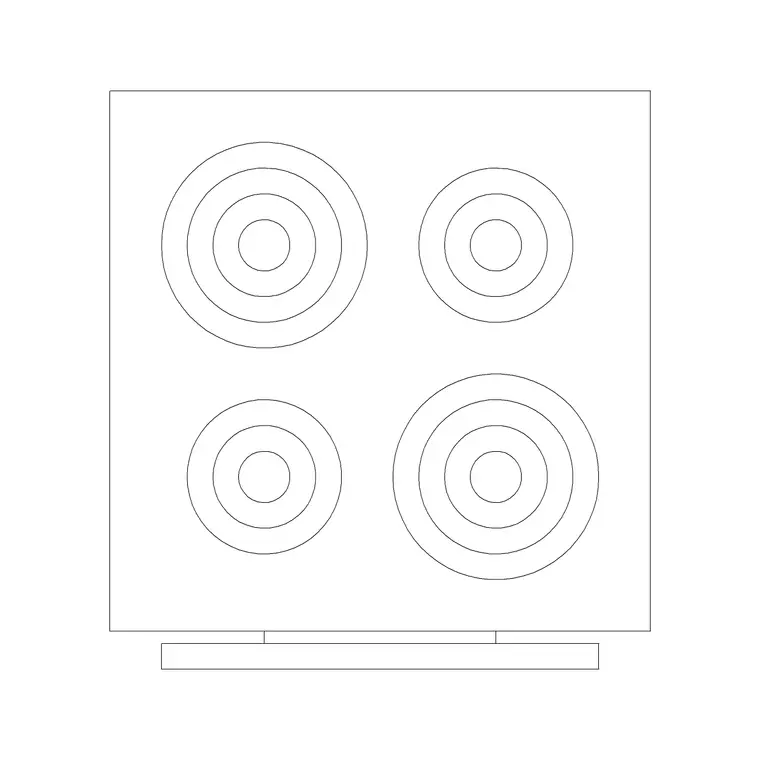
The cooktop is the heat point of the kitchen work triangle and the fixture with the strictest clearances, because anything above and beside it has to deal with flame, heat and an extractor — so laying it out from a scaled block, not a guessed rectangle, is the safe way to draw. This collection brings together 15 free stove and cooktop CAD blocks in DWG and DXF: 4-burner and 5-burner gas hobs, ceramic and induction cooktops, domino (modular) hobs, freestanding cookers and full range cookers, plus a couple of built-in versions sized to drop into a worktop run. Everything downloads free for personal and commercial work, with no signup and no watermark.
Cooktops sit on the standard 600 mm cabinet module, but unlike most appliances they bring a safety zone with them: a clearance to combustible surfaces beside the hob and an extractor or hood centred above. Drawing from scaled blocks lets you place the hob in the run and immediately check those gaps and the hood line, so the layout is right before the joinery is ordered.
Use the pack across residential kitchens, apartment kitchenettes, utility and outdoor kitchens, and small commercial prep lines. The plan blocks are the working view — hobs are laid out in plan along the run — and they snap onto the same 600 mm grid as the sinks and cabinets.
What's in the 15-cooktop collection
The pack covers the heat sources you actually specify and the formats they come in. Built-in hobs dominate: 4-burner and 5-burner gas hobs with their pan-support outlines, ceramic and induction cooktops drawn with the standard zone rings, and slimline domino hobs you pair side by side for a custom run. Freestanding cookers (a single oven under a 4-burner top) and full range cookers (a wide top over a double oven) are included for kitchens that want a statement cooker rather than a built-in hob. A compact two-burner block rounds out the set for kitchenettes and utility rooms.
Every block is drawn full size in plan, with the cooking surface, the burner or zone positions, the pan supports and a centreline on sensible layers — so you can centre the hood above the hob, dimension the worktop cut-out, or recolour the outline without touching the rest of the kitchen drawing.
Standard cooktop dimensions to design around
Keep these figures close. A 4-burner hob sits in a 600 mm cabinet and is around 580–600 mm wide; a 5-burner hob spans roughly 700–750 mm and needs a wider base unit. Range cookers come in big formats — commonly 900 mm, 1000 mm and 1100 mm wide — so they claim their own gap in the run. The hob surface sits flush in the 900 mm worktop, with the extractor or hood typically hung 650–750 mm above the cooking surface for a gas hob (sometimes lower for induction).
The critical clearances are sideways and above. Keep a margin of worktop — often around 300 mm or more — between the hob edge and any tall combustible surface or the end of the run, and centre the hood on the hob both ways. Because the blocks are drawn full size, you can draw the hood footprint over the hob and check the side gaps the moment the cooktop lands.
Placing the hob in the work triangle and under the hood
The cooktop is the heat point of the work triangle, so place it to form a sensible triangle with the sink and fridge — and never directly under a window, where reaching across a flame to open it is a hazard. Drop the hob block into the run, snap a centreline, and dimension it off the run ends so the joiner can cut the worktop.
Then bring the extractor or hood in directly above, centred on the hob in both directions, and check its height above the surface against the block's surface line. Keep the hood on its own layer above the worktop layer so you can produce a clean cabinet plan and a separate ventilation plan from the same drawing. Leave landing worktop on at least one side of the hob — somewhere to set a hot pan down — which the scaled blocks make easy to confirm.
Gas, electric and induction: what changes on the drawing
The fuel type changes more than the symbol. A gas hob block shows distinct burners and cast pan supports, needs a gas supply run to the cabinet, and usually wants the hood hung a little higher to clear the flame and heat plume. A ceramic or induction cooktop block reads as flat zones — concentric rings rather than burners — needs a dedicated electrical supply (induction especially draws a heavy load, so flag the circuit), and tolerates a slightly lower hood.
For the layout itself the footprints are similar because both sit in the 600 mm module, but the services differ, so note the supply on the relevant block and coordinate the gas or the electrical circuit early. Domino hobs let you mix fuels — a gas pair beside an induction pair — by butting the slimline blocks together, which is handy for a bespoke run. Pick the block whose symbol matches the fuel so the plan reads correctly to the installer.
Per-item notes: 4-burner, 5-burner, range and domino
The 4-burner blocks are the default for most kitchens — they fit a 600 mm base, leave room for landing worktop, and suit the common gas, ceramic and induction formats. The 5-burner blocks add a central wok or fish burner but need a wider base unit and eat more of the run, so check the cabinetry takes them. The freestanding cooker and range cooker blocks claim their own slot between cabinets (900–1100 mm), bring their oven with them, and often want a deeper or chimney hood — flag that gap and the ventilation early.
The domino blocks are the flexible specialists: each is a slim two-zone module you butt together to build a custom mixed-fuel run, which suits enthusiast kitchens. The compact two-burner block is the answer for a kitchenette, utility room or outdoor kitchen where a full hob won't fit — small footprint, modest clearances, but still keep the side margin and the extractor in mind.
Who uses these stove and cooktop blocks
Kitchen designers use the cooktop set to fix the heat point of the work triangle and to prove the side clearances and the hood line before the joinery is ordered. Architects use the plan blocks to populate residential and apartment kitchens with correctly-sized, module-matched hobs. Mechanical and services engineers use them to position the extraction and coordinate the gas or heavy electrical supply. Students use them on studio kitchens where a hob with believable clearances keeps the layout safe and credible.
Pair the cooktop pack with the kitchen sink blocks and the refrigerator blocks to complete the work triangle, and with the cabinetry and the broader kitchen category to fit out the whole room from one consistent, free block library.
Free download
Browse the full library — DWG & DXF, no signup.
Questions
Frequently asked
What size cabinet does a hob need?+
A 4-burner hob fits a 600 mm cabinet and is around 580–600 mm wide; a 5-burner hob spans 700–750 mm and needs a wider base unit. Range cookers come in 900 mm, 1000 mm and 1100 mm formats and claim their own gap in the run.
How high above the hob should the extractor go?+
An extractor or hood is typically hung 650–750 mm above the cooking surface, usually higher for a gas hob to clear the heat plume and sometimes lower for induction. Centre it on the hob in both directions — the scaled blocks let you draw the hood footprint over the hob to check.
Do gas and induction cooktops have different footprints?+
Their footprints are similar because both sit on the 600 mm module, but the symbols differ — gas shows burners and pan supports, induction shows flat zone rings — and the services differ, with gas needing a supply run and induction a heavy dedicated circuit.
Are the cooktop CAD blocks free for commercial use?+
Yes. Every stove and cooktop downloads free in DWG and, where available, DXF, with no signup, no watermark and no attribution requirement, and they are cleared for commercial project use.
Related downloads
Blocks for this guide
Popular blocks to download
Related categories
Related guides
Curated pack
Free Kitchen CAD Block Pack — DWG & DXF
A free kitchen CAD block pack in DWG and DXF — cookers, hobs, ovens, sinks, hoods and cabinets drawn in plan and elevation for AutoCAD. No signup, commercial-use OK.
Curated pack
15 Free Kitchen Sink CAD Blocks — DWG & DXF in 2026
Download 15 free kitchen sink CAD blocks in DWG and DXF — single, double, 1.5-bowl, Belfast and corner sinks with drainers in plan. No signup needed.
Curated pack
12 Free Refrigerator CAD Blocks — DWG & DXF in 2026
Download 12 free refrigerator CAD blocks in DWG/DXF — freestanding, integrated, American-style and under-counter fridges and freezers in plan. No signup.