Curated pack · free refrigerator cad blocks
12 free refrigerator CAD blocks for AutoCAD in 2026
By Saumyajit Maity · Published 11 Mar 2024 · Updated 10 May 2026
The fridge is the cold point of the kitchen work triangle and the appliance most likely to break a clean cabinet line, because it is taller and often deeper than the units around it and its door needs room to swing wide. A set of scaled refrigerator blocks lets you place it honestly, with the door swing and the standing-back clearance drawn in, rather than dropped in as a flat box. This collection brings together 12 free refrigerator CAD blocks in DWG and DXF: freestanding fridge-freezers, slim and standard larders, integrated (cabinet-fronted) fridges, wide American-style side-by-side and French-door units, under-counter fridges and freezers, and a chest freezer for utility rooms and garages. Everything downloads free for personal and commercial work, with no signup and no watermark.
Fridges sit on the kitchen module like everything else, but they come in a wider spread of footprints than any other appliance, so checking the real depth and the door arc against the run matters. Drop a scaled block in and you can see whether it projects past the worktop, whether the door clears the adjacent cabinet, and how it lands in the work triangle.
Use the pack across residential kitchens, apartments, utility rooms and small commercial kitchenettes. The plan blocks lay out the run and the door swing; the elevation blocks place the fridge against the tall-unit line for the cabinet drawing.
What's in the 12-fridge collection
The pack is organised by format, because a fridge's footprint and door behaviour vary far more than its function. There are freestanding fridge-freezers (the everyday tall unit), slim and full-width larder fridges, integrated fridges drawn within a cabinet-front footprint so they read flush in the run, and the wide statement units: American-style side-by-side fridge-freezers and French-door (bottom-freezer) models that need real width and door space. Under-counter fridges and freezers are included for utility runs and small kitchens, and a chest freezer covers the garage and utility-room case.
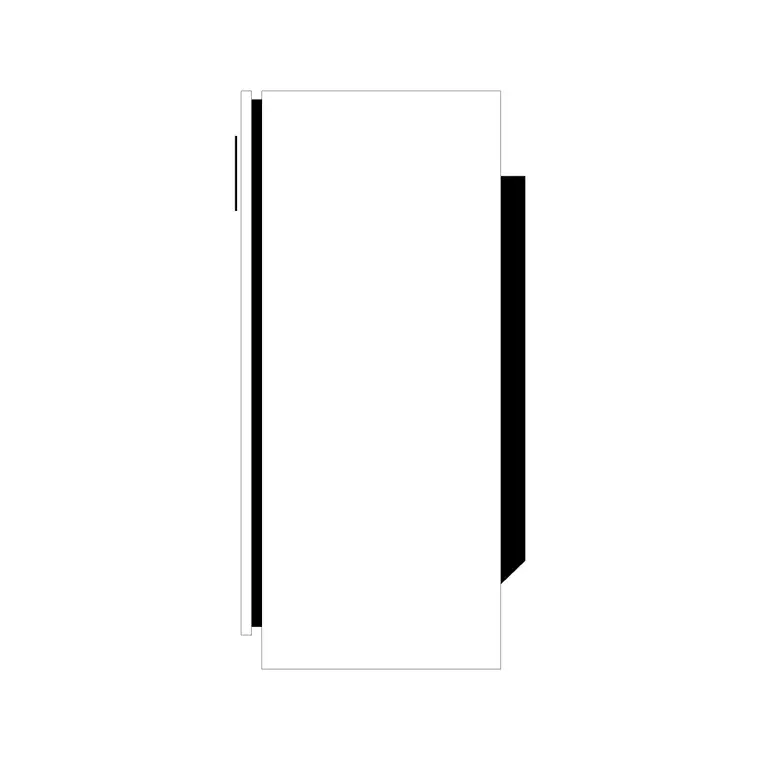
Every block is drawn full size in plan, with the body outline, the door swing arc and a centreline on sensible layers, plus elevation views on the tall units where the height against the cabinet line matters. That lets you draw the door arc on its own layer, freeze it for a clean cabinet plan, or recolour the outline without disturbing the rest of the kitchen.
Standard refrigerator dimensions to design around
Keep these reference figures close. A standard freestanding fridge or fridge-freezer is around 600 mm wide, 600–700 mm deep and 1700–2000 mm tall — note the depth often runs a little past the 600 mm worktop, so it projects slightly. Slim larders narrow to around 550 mm; integrated units fit a 600 mm cabinet aperture. American-style side-by-side and French-door fridges are wide, commonly 900–1100 mm, and deep, so they claim a big slot and a generous door arc. Under-counter fridges and freezers sit in a 600 mm base unit at roughly 850 mm tall.
For access, allow the full door swing clear of adjacent cabinets and the worktop return, plus standing-back room of around 1000 mm in front so someone can load and unload. The scaled blocks carry the door arc, so you can confirm the door clears the run the moment the fridge lands.
Placing the fridge in the work triangle
The fridge is the cold point of the work triangle, so place it to form a workable triangle with the sink and hob — but keep it at the end of a run or against a wall where its height won't interrupt the worktop, and where its door can open without blocking a walkway or another appliance. Drop the plan block, snap a centreline, and dimension it off the run end.
Then draw the door swing arc and check it clears the adjacent cabinet, the worktop return and any walkway — a fridge door that fouls the run is a classic layout error the door-arc block exists to catch. Avoid putting the fridge right beside the hob, since the heat works against it. Keep the fridge and its door arc on a layer with the appliances so you can produce a clean cabinet plan and a separate appliance-and-services plan from the same drawing.
Integrated vs freestanding: what changes on the drawing
An integrated fridge hides behind a cabinet door and reads flush with the run, so on the plan it sits within the 600 mm cabinet line and the elevation shows a continuous cabinet face — the integrated blocks are drawn to that aperture. Use them where the brief wants a seamless kitchen and the units are bespoke, and note that the cabinet door adds its own swing on top of the appliance.
A freestanding fridge stands proud, usually a touch deeper than the cabinets, with a visible finished body — the freestanding blocks show that projection, which matters at the end of a run where it can stick out past the worktop. The wide American and French-door units are always freestanding statements: give them their slot, draw the twin or wide door arcs, and check the deep body against the walkway. Pick the block — integrated or freestanding — that matches the kitchen so the cabinet line and the projection read correctly.
Per-item notes: freestanding, integrated, American and under-counter
The freestanding fridge-freezer blocks are the default — 600 mm wide, tall, and easy to slot at the end of a run, but remember the slight depth projection past the worktop. The larder blocks (slim and full) are all-fridge, no freezer, for kitchens that keep the freezer elsewhere; the slim version rescues a narrow gap. The integrated blocks read flush and suit bespoke, seamless kitchens, but allow for the cabinet door swing on top of the appliance.
The American side-by-side and French-door blocks are the wide statements: 900–1100 mm of width, a deep body and big door arcs, so they need a genuine slot and clear standing-back room — don't squeeze them into a galley. The under-counter fridge and freezer blocks tuck into a 600 mm base for small kitchens, utility runs and second-fridge duty. The chest freezer block is the utility-room and garage specialist: a low, wide box whose lid lifts up, so leave headroom above rather than door swing to the side.
Who uses these refrigerator blocks
Kitchen designers use the fridge set to place the cold point of the work triangle and to prove the door swing clears the run before the cabinetry is built. Architects use the plan and elevation blocks to populate residential and apartment kitchens with correctly-sized fridges that sit on the module and read against the tall-unit line. Services designers use them to confirm the appliance position and the standing-back clearance. Students use them on studio kitchens where a fridge with a real door arc keeps the layout believable.
Pair the refrigerator pack with the kitchen sink blocks and the stove and cooktop blocks to complete the work triangle, and with the cabinetry and the broader kitchen category to fit out the whole room from one consistent, free block library.
Free download
Browse the full library — DWG & DXF, no signup.
Questions
Frequently asked
What size is a standard refrigerator block?+
A standard freestanding fridge or fridge-freezer is around 600 mm wide, 600–700 mm deep and 1700–2000 mm tall. American side-by-side and French-door units are wider — commonly 900–1100 mm — and deeper, so they need a larger slot and door space.
Do the fridge blocks show the door swing?+
Yes. The plan blocks carry the door swing arc on its own layer so you can check the door clears adjacent cabinets, the worktop return and any walkway — a fridge door fouling the run is a common layout error the door-arc block catches.
What's the difference between an integrated and a freestanding fridge block?+
An integrated fridge sits within the 600 mm cabinet line behind a cabinet door and reads flush in the run; a freestanding fridge stands proud, usually a little deeper than the cabinets, with a visible finished body that can project past the worktop.
Are the refrigerator CAD blocks free for commercial use?+
Yes. Every fridge downloads free in DWG and, where available, DXF, with no signup, no watermark and no attribution requirement, and they are cleared for commercial project use.
Related downloads
Blocks for this guide
Popular blocks to download
Related categories
Related guides
Curated pack
Free Kitchen CAD Block Pack — DWG & DXF
A free kitchen CAD block pack in DWG and DXF — cookers, hobs, ovens, sinks, hoods and cabinets drawn in plan and elevation for AutoCAD. No signup, commercial-use OK.
Curated pack
15 Free Kitchen Sink CAD Blocks — DWG & DXF in 2026
Download 15 free kitchen sink CAD blocks in DWG and DXF — single, double, 1.5-bowl, Belfast and corner sinks with drainers in plan. No signup needed.
Curated pack
15 Free Stove & Cooktop CAD Blocks — DWG/DXF in 2026
Download 15 free stove & cooktop CAD blocks in DWG/DXF — gas, electric and induction hobs, 4 and 5-burner cooktops and range cookers in plan. No signup.