Curated pack · free palm tree cad blocks
15 free palm tree CAD blocks for AutoCAD in 2026
By Saumyajit Maity · Published 11 Dec 2025 · Updated 7 Apr 2026
Palms behave differently from broadleaf trees on a drawing, and a generic tree symbol won't pass for one. A palm reads narrow and vertical, governed by frond spread rather than a broad rounded canopy, so it needs its own family of blocks. This round-up gathers 15 free palm tree CAD blocks in DWG and DXF — date palms, coconut palms, fan palms and potted ornamental palms — in both plan and elevation, drawn to scale and free for commercial use with no signup.
These are the blocks you want for resort masterplans, coastal promenades, hotel forecourts, courtyard gardens and any scheme with a Mediterranean, tropical or Middle Eastern character. A row of date palms down a boulevard does a lot of design work in a single move, and a clean plan symbol — the distinctive star of fronds seen from above — signals 'palm' instantly to anyone reading the drawing.
Below we walk through what the 15 blocks cover, how the plan and elevation views differ for palms specifically, how to scale them by trunk height rather than canopy width, and where palm blocks earn their place in a landscape or architectural drawing set.
The 15 palms in the set
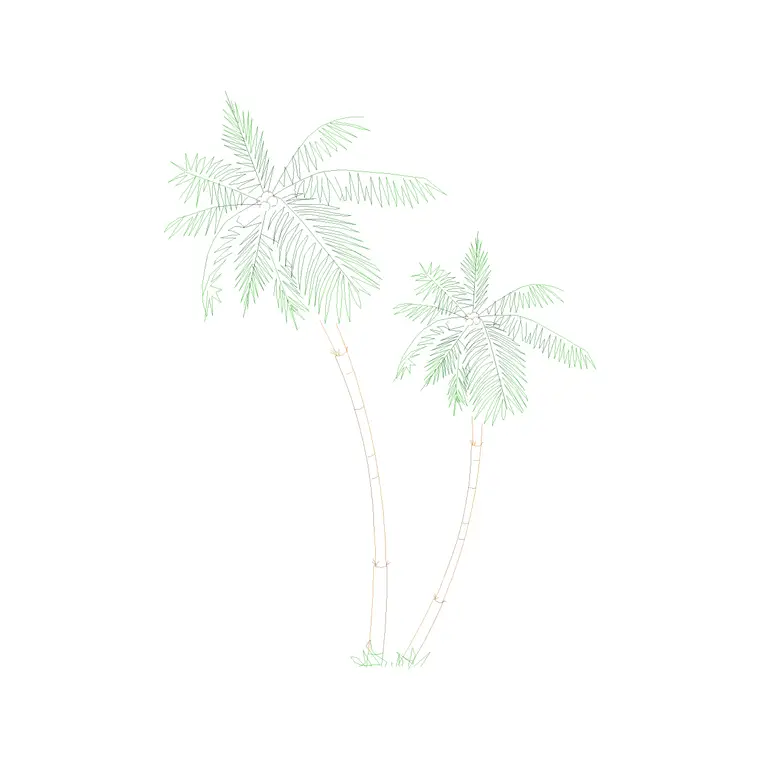
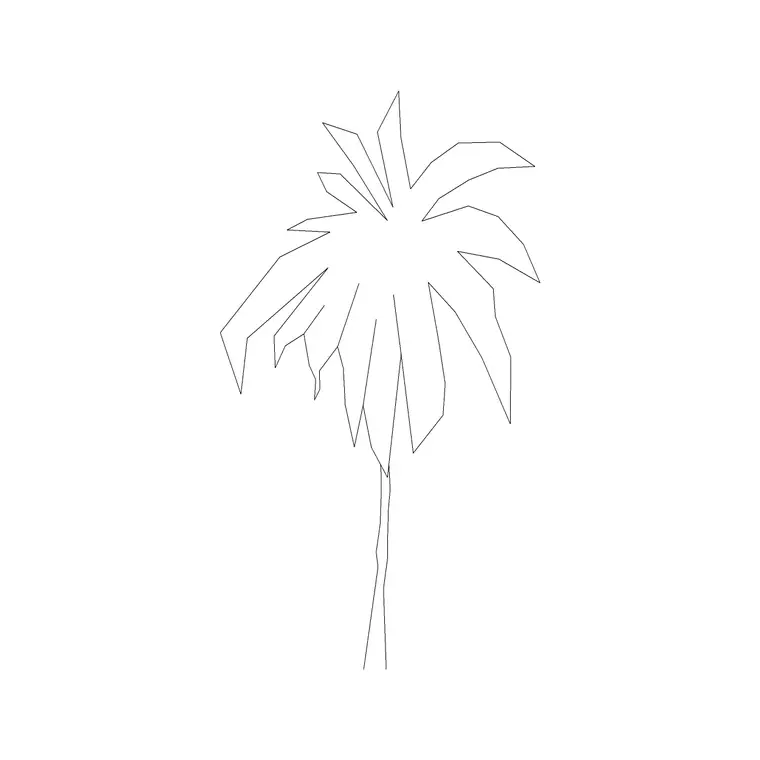
The collection spans the palm types you actually specify. Tall, slender palms — date and coconut types — with a clear trunk and a crown of fronds, drawn for boulevards, avenues and resort entrances. Fan palms, broader and lower, for courtyards and feature planting. Multi-stem and clustering palms for informal groups. And potted or planter palms for terraces, lobbies and interior landscaping where the palm sits in a container rather than the ground.
In plan, a palm reads as a radial star of fronds rather than a filled canopy, so it stands out clearly against broadleaf trees on the same drawing. In elevation, the tall clear trunk and the crown silhouette are unmistakable — which is exactly why palms are such effective elevation trees for coastal and tropical schemes.
Plan and elevation: why palms need both
For the site plan you use the plan symbols: the frond-star seen from above, positioned and arrayed like any other tree. Because palms are often planted in formal rows — entrance avenues, promenade edges, car-park dividers — the plan blocks get a lot of path-array use along centrelines.
Elevation palms matter more for palms than for most trees, because the palm silhouette is a signature element of the buildings and streetscapes they belong to. A coastal section, a resort elevation or a hotel approach drawing leans on the elevation palm to set the scene. Several blocks in this set ship both views together, so one download gives you the plan symbol and the matching elevation.
Scaling palms by trunk height, not canopy width
Palms break the usual tree-scaling rule. With broadleaf trees you scale to canopy spread; with palms, trunk height is the governing dimension and the frond crown is comparatively modest. Reference heights to design around: ornamental fan palms 2–4 m, mature date palms 8–15 m of clear trunk, tall coconut palms 10–20 m and up. The frond spread typically sits in the 4–8 m range regardless, so it is the trunk that changes most between a courtyard palm and a boulevard specimen.
When you scale an elevation palm, lock the height to the design intent first, then check the crown looks proportionate. For plan symbols, scale to the frond spread. Vary the height a little between palms in an informal group so they don't look identical, but keep a formal avenue uniform.
Where palm blocks belong
Palm blocks suit a recognisable set of project types: beach resorts and hotels, coastal promenades and corniches, Middle Eastern and Mediterranean civic schemes, themed retail and leisure, and any residential development reaching for a tropical or holiday character. Interior designers also use the potted-palm blocks to dress atriums, lobbies and double-height spaces.
They pair naturally with paving blocks for promenade and forecourt surfaces, with pool and water-feature geometry, and with people and vehicle blocks to give the scene scale. On a resort masterplan, a few palm species used consistently across the site read as far more intentional than a scatter of mismatched symbols.
Keeping palms on the planting layer
As with any tree blocks, drop the palms onto a dedicated planting layer so you can freeze them for a clean structural plan and thaw them for the full landscape drawing. If a scheme mixes palms with broadleaf trees, it can help to give palms their own sub-layer so you can isolate, recolour or count them separately — useful when a client wants to know exactly how many date palms the entrance avenue needs.
Because the blocks are licence-clear, you can build a small reusable palm palette for a project, save it into your template, and carry it across every drawing in the set — plan, section and elevation alike — without redrawing a single frond. Tagging each palm with a simple type attribute also lets you extract a planting schedule straight from the drawing, so the contractor knows precisely how many of each palm to supply and where.
Mistakes to avoid with palm blocks
A few habits separate a convincing palm drawing from an unconvincing one. The most common error is reaching for a generic broadleaf tree symbol and calling it a palm — the rounded canopy reads wrong in plan and ruins the tropical character the scheme is trying to convey, so always use a true palm block with its radial frond pattern. The second is scaling by canopy rather than trunk height, which leaves a boulevard of stunted-looking palms because the trunk was never stretched to its proper height.
Two more catch people out. In elevation, lining up a row of identical palms at exactly the same height reads as artificial; vary the trunk heights slightly in an informal group, but keep a formal avenue uniform on purpose. And on a units mismatch a palm can arrive microscopic or enormous — the fix is almost always INSUNITS set to millimetres, not manual scaling. Get those four things right and the palms carry the scene instead of undermining it.
Free download
Browse the full library — DWG & DXF, no signup.
Questions
Frequently asked
What palm types are included in the 15 blocks?+
Tall date and coconut-type palms, broader fan palms, multi-stem clustering palms, and potted ornamental palms for terraces and interiors — drawn in plan and, in many cases, elevation.
How do palm blocks differ from regular tree blocks?+
Palms read narrow and vertical. In plan they show as a radial star of fronds rather than a filled canopy, and in elevation they have a tall clear trunk with a crown on top — so they need their own family rather than a generic tree symbol.
Should I scale palms by height or canopy?+
By trunk height. For palms the trunk is the governing dimension — anything from 2–4 m for ornamental fan palms up to 10–20 m for tall coconut palms — while the frond crown stays comparatively modest at roughly 4–8 m.
Are the palm CAD blocks free for commercial projects?+
Yes. Every palm block downloads free in DWG and DXF with no signup, no watermark and no attribution requirement, and all are cleared for commercial use.
Related downloads
Blocks for this guide
Popular blocks to download
Related categories
Related guides
Curated pack
Free Landscape & Tree DWG Pack — Plan & Elevation
A free landscape and tree DWG pack — trees, palms, shrubs and potted plants in plan and elevation for AutoCAD site plans. DWG and DXF, no signup, commercial-use OK.
Curated pack
Free Landscape CAD Block Pack — DWG & DXF
A free landscape CAD block pack in DWG and DXF — trees, shrubs, fences, paving, lighting and figures for AutoCAD landscape plans. No signup, commercial-use OK.
Curated pack
Free Garden CAD Block Pack — DWG Download
A free garden CAD block pack in DWG and DXF — trees, shrubs, fences, a swing, a BBQ and paving for residential garden plans. No signup, commercial OK.