Curated pack · free office desk cad blocks
12 free office desk CAD blocks for AutoCAD in 2026
By Sumana Kumar · Published 12 Oct 2024 · Updated 13 May 2026
The desk is the unit an office plan is built from — repeat it cleanly and a whole floor lays out fast — so a set of correctly-scaled desk and workstation blocks is the backbone of any office drawing. This pack gathers 12 free office desk CAD blocks in DWG and DXF: single desks, L-shaped and corner desks, two-person and bench workstations, executive desks and small meeting tables, each drawn at true millimetre dimensions and ready to insert into AutoCAD 2004 or later. Everything is free for personal and commercial work, with no signup and no watermark.
Desks are a plan-view block. You array them across a floor plate, check the circulation between rows, and confirm each workstation has room for a chair to pull out and a person to pass behind. Because the blocks are scaled, the density of a layout — how many desks fit while keeping the gangways legal and comfortable — is something the drawing shows you directly.
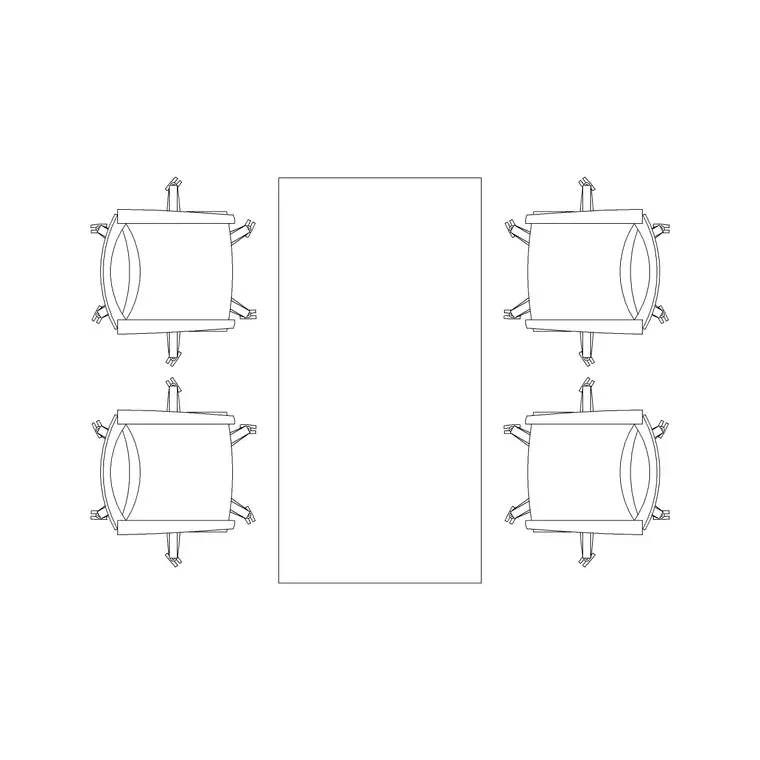
The pack includes a four-person rectangular meeting table, so you can set out both the workstations and the small collaboration tables an office floor needs.
What the office-desk pack covers
The selection spans the desk types an office floor needs. Single rectangular desks are the basic unit. L-shaped and corner desks suit private offices and roles needing a return for a second monitor or paperwork. Two-person and four-person bench workstations are the staple of open-plan floors, where desks share a continuous run. Executive desks anchor private offices. Small meeting and breakout tables — like the four-person rectangular table here — handle informal collaboration.
The blocks are drawn in plan with the desktop outline and, where relevant, the return and any pedestal. Most are designed to share edges cleanly so bench runs join without gaps, and so you can array a row of identical workstations down a floor in one operation.
Typical desk and workstation dimensions
Design around these figures. A single office desk is commonly 1200-1600 mm wide and 700-800 mm deep, at a worktop height of about 720-750 mm. An L-shaped or corner desk adds a return of roughly 800-1200 mm. Bench workstations allocate around 1400-1600 mm of width per person along the run. A four-person meeting table is typically around 1800-2400 mm long.
The critical clearance is behind the desk: allow at least 900 mm for the chair to pull out and a person to sit, and 1200 mm or more where that space is also a circulation route. These ranges let you set the desk size and the row spacing so the floor is dense enough to be efficient but still comfortable and compliant.
Laying out an open-plan floor
Start by drawing the floor outline and the primary circulation spine. Insert one workstation, align it to the structural grid, then array it to build rows and banks of desks down the floor. Bench desks array along their length; back-to-back rows form a typical open-plan bank. Keep the gangways between banks clear at the figures above so people can reach their seats and pass behind.
Keep desks on a dedicated furniture layer so you can produce a clean architectural plan and a furnished layout from the same drawing. Once a workstation — desk plus chair — works, WBLOCK it as a single unit and array that unit, so you place fully-furnished positions rather than desks and chairs separately.
Desks plus chairs: the furnished workstation
A desk on its own does not prove a layout — the chair pull-out is what governs the spacing. Pair each desk with an office chair block from the office category and place it in its working position, then check the clearance behind it against the gangway. A chair drawn at its real base diameter, roughly 600-700 mm, is what keeps the row spacing honest.
The efficient move is to build one furnished workstation — desk, chair, and any screen or pedestal — as a single block, then array that across the floor. Every position lands complete and identically spaced, the count is trivial to extract, and a later change to the workstation definition updates every desk at once. That is the same block-reuse logic the rest of this library is built on.
Where office-desk blocks are used
Desk blocks populate open-plan office floors, private and executive offices, co-working spaces, home-office studies, call centres, classrooms and training rooms, and back-of-house areas in almost every building type. Architects and workplace designers use them to test density and circulation; FF&E teams use them to count workstations and order furniture.
Use the office-desk pack with the office chair, conference-table and the stool and chair blocks in this furniture series to fit out a complete workplace from one consistent, free library. Scaled and licence-clear, the same desk carries from a test-fit space plan to a coordinated FF&E drawing.
Single desks vs bench systems
How you furnish a floor depends on the working style. Individual desks — separate rectangular or L-shaped pieces — suit cellular offices, assigned seating and roles needing their own defined space. They are simple to place and rearrange, but waste a little floor compared with shared runs. Bench systems share a continuous worktop and structure between users, packing more people onto a floor plate and reading as a clean, modern open-plan environment.
The pack carries both so you can test a floor each way. Lay it out with single desks to gauge a more generous, cellular density, then swap to bench runs to see how many more positions the same floor holds. Because both are scaled blocks that share edges cleanly, switching between the two is a matter of re-arraying rather than redrawing, and the clearances stay honest throughout.
Free download
Browse the full library — DWG & DXF, no signup.
Questions
Frequently asked
What desk types are in the pack?+
Single rectangular desks, L-shaped and corner desks, two and four-person bench workstations, executive desks and small meeting tables, including a four-person rectangular table. All are drawn full size in millimetres.
How wide is a standard office desk block?+
Commonly 1200-1600 mm wide and 700-800 mm deep, at a worktop height of about 720-750 mm. Bench workstations allocate roughly 1400-1600 mm of width per person along the run.
How much space do I leave behind a desk?+
Allow at least 900 mm for the chair to pull out and a person to sit, and 1200 mm or more where that space is also a circulation route. The scaled blocks make these gangway checks straightforward.
Are the office desk blocks free for commercial use?+
Yes. Every block downloads free in DWG and DXF with no signup, no watermark and no attribution requirement, and they are cleared for commercial project use.
Related downloads
Blocks for this guide
Related categories
Related guides
Curated pack
Free Office CAD Block Pack — DWG & DXF
Free office CAD block pack in DWG and DXF — desks, workstations, conference tables and reception furniture in plan view. No signup, commercial-use OK.
Curated pack
Free Reception Area CAD Block Pack — DWG
Free reception area CAD block pack in DWG and DXF — reception desks, waiting seating and scale figures for lobby layouts. No signup, commercial-use OK.
Curated pack
Free Restaurant CAD Block Pack — DWG & DXF
Free restaurant CAD block pack in DWG and DXF — dining tables, chairs, bar stools and high chairs for cafe and restaurant layouts. No signup, commercial OK.