Plan, elevation and section explained
Plan, elevation and section are the three core views every architectural drawing relies on. Here is what each one shows, when to use it, and how to pick the right block view for your drawing.
Saumyajit MaityUpdated 22 June 20267 min read
Three views, one object
Any object can be drawn from several directions, and architecture standardises on three core views: plan, elevation and section. Each answers a different question. Plan asks 'what is the layout?', elevation asks 'what does the face look like?', and section asks 'what is happening inside?'. Together they describe a three-dimensional building through a set of two-dimensional drawings that a builder can actually read and construct from.
Understanding which view you need is also how you pick the right CAD block. A chair has a plan symbol (seen from above) and an elevation symbol (seen from the front), and the two look completely different. Using the wrong one in the wrong drawing — an elevation chair dropped into a plan — is a common beginner mistake that immediately signals inexperience to anyone trained. Getting the view right is half the battle of placing a block well.
Plan — the view from above
A plan is a horizontal slice, looking straight down, conventionally cut about 1.2 metres above the floor so the cut passes through doors and windows and shows them. It is the workhorse of layout drawings: walls, room sizes, door swings, furniture arrangement and circulation all live here, which is why most projects begin with the plan.
When you furnish a floor plan you use plan-view blocks — the top-down outline of a sofa, the rectangle-and-pillows of a bed, the circle-or-rectangle of a table. Most furniture and fixture blocks in any library default to this view because it is by far the most-used. If you only ever learn to read one architectural view fluently, make it the plan, because it is the one you will spend the most time creating and the one clients understand most readily.
Elevation — the view straight on
An elevation is the view of a vertical face, drawn as if you stood directly in front of it with no perspective and no foreshortening. Exterior elevations show façades — windows, doors, materials and the heights of things; interior elevations show a single wall of a room, which is invaluable for kitchens, bathrooms and joinery where the vertical arrangement is the whole point.
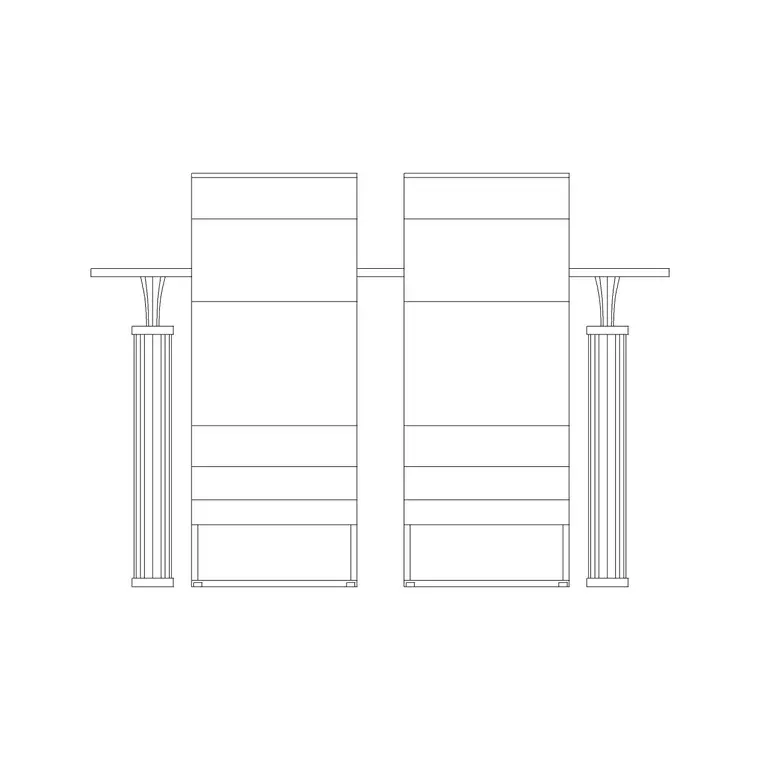
Elevation blocks show the front profile of an object: a tree's canopy and trunk in silhouette, a door with its panels and handle, a person standing at full height. You use them to add height, scale and realism to a face-on drawing. A street elevation populated with elevation trees and figures reads as a real place; the same elevation with plan-view symbols accidentally dropped in reads as a mistake, which is why matching the block view to the drawing is essential.
Section — the view through a cut
A section is a vertical slice taken straight through the building, revealing what plan and elevation both hide: floor build-ups, ceiling heights, stair geometry and how spaces stack vertically on top of one another. The position and direction of the cut are shown on the plan with a section line and arrows pointing the way you are looking.
Section blocks — a staircase drawn in section, a bathtub cut through to show its profile — are essential for construction-level drawings where you need to communicate real dimensions and how things assemble, not merely how they appear. Sections are often the view that separates a presentation drawing from a buildable one, because they force you to resolve the vertical reality of the design: the rise and going of every step, the headroom under a stair, the depth of a floor zone.
Picking the right block view
The rule is simple: match the block view to the drawing. In a plan, use plan-view blocks; in an elevation, use elevation blocks; in a section, section blocks. It sounds obvious, but mixing them is one of the most frequent errors in student and junior work.
Many of our blocks are labelled by view — plan, elevation, side view, section — for exactly this reason. A tree, for example, might have both a plan circle (for the site plan) and an elevation silhouette (for the street view), and you choose whichever the current drawing calls for. Mixing them — dropping an elevation tree into a plan, or a plan chair into an elevation — instantly reads as wrong to anyone trained, so it always pays to confirm the view before you place. Check the label, place the right one, and your drawings will read correctly to professionals and clients alike.
Questions
Frequently asked
What is the difference between a plan and a section?+
A plan is a horizontal cut viewed from above, showing layout. A section is a vertical cut viewed from the side, showing internal heights, floor build-ups and how spaces stack.
At what height is a floor plan cut?+
Conventionally about 1.2 metres above the floor, so the cut passes through doors and windows and shows them on the plan.
How do I know which view a CAD block is?+
On CADBlockDWG, blocks are labelled by view — plan, elevation, side view or section — so you can match the block to the drawing you are working in.
Free CAD block library
Download the blocks from this article — free, no signup