Explainer · what is the base point of a block
What is the base point of a block, explained
By Sumana Kumar · Published 7 Sep 2023 · Updated 9 Mar 2026
Every AutoCAD block has one special coordinate that AutoCAD treats as the handle for the whole object: the base point. When you insert the block, the base point is the spot that lands under your cursor. When you scale or rotate the block, the base point is the pivot everything moves around. Get it right and a door snaps neatly onto its frame; get it wrong and the geometry jumps off into space every time you place it.
This page explains what the base point actually is, how it differs from the insertion point you click on screen, where AutoCAD stores it, and how to set or change it without redrawing the block. The same idea applies whether you are placing a 1000 mm wide door, a four-seat table or any other library block, so it is worth understanding once and reusing forever.
The base point is the block's origin
When you run BLOCK and define geometry as a block, AutoCAD asks you to pick a base point. That point becomes the local origin (0,0) of the block definition. All of the block's geometry is stored relative to it. So if a door panel sits 40 mm to the right of the base point in the definition, it will always sit 40 mm to the right of wherever you later insert the block.
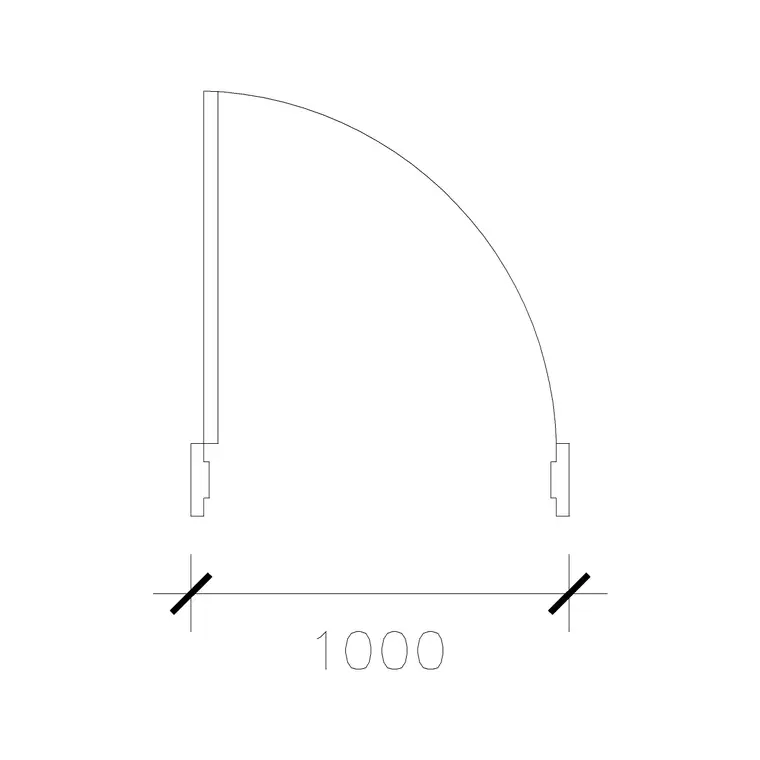
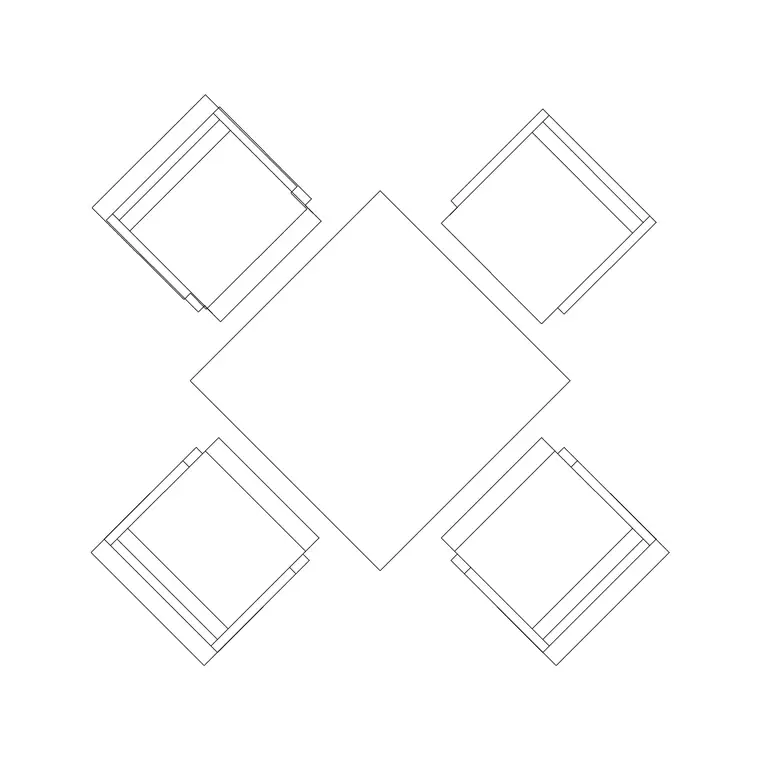
Think of it as the grab handle. You are telling AutoCAD: 'when someone places this block, hold it by exactly this spot.' For a door, the natural grab handle is the hinge corner where the frame meets the wall, because that is the point a drafter wants to snap to the opening. For a table, the centre of the top is usually the most useful handle so the block rotates cleanly around its middle.
Base point vs insertion point
These two terms get used loosely, so it helps to separate them. The base point is part of the block definition — a fixed property baked into the block when it was made. The insertion point is the on-screen coordinate you pick when you run INSERT and drop the block into a drawing. AutoCAD aligns the block's base point to your chosen insertion point.
In other words, the base point lives inside the block; the insertion point lives in the host drawing. If you insert the same door fifty times, you pick fifty different insertion points, but the door is grabbed by the same base point every single time. That consistency is exactly what lets you snap a library block to an OSNAP endpoint with confidence.
Why the base point governs scale and rotation
Scale and rotation in AutoCAD always happen about a point. For a block reference, that point is the base point unless you override it. If a door's base point is at the hinge, rotating the block 90 degrees swings the door panel around the hinge — which is exactly the behaviour you want. If the base point were accidentally placed in empty space a metre away, the same rotation would fling the door across the room.
The same logic applies to mirroring with dynamic-block flip actions and to non-uniform scaling. A well-chosen base point makes the block behave intuitively under every transform. A badly chosen one makes the block feel like it has a mind of its own.
Where AutoCAD stores the base point
For a standard block, the base point is stored in the block definition in the drawing's block table. You set it once at creation time. For the current drawing itself, AutoCAD also tracks a separate value through the BASE command — that defines the base point used when the whole drawing is inserted into another drawing as a block, and it defaults to the WCS origin (0,0,0).
That distinction trips people up. BASE sets the insertion base point of the entire file; the base point you pick during BLOCK sets the origin of one named block inside the file. Most library DWGs you download are drawn so that the relevant block already has a sensible base point, so you rarely need to touch BASE.
How to set or change a block's base point
When you create a block with the BLOCK command, the 'Pick point' button under Base point lets you click the exact coordinate you want as the handle. Always use an object snap here — pick the true hinge corner or the precise centre, not an eyeballed location near it.
To change the base point of an existing block, the cleanest route in modern AutoCAD is the Block Editor: open the block with BEDIT, then move the geometry so the desired handle sits on the editor's 0,0, or add a Base Point parameter from the dynamic-block palette and place it where you want the new grab point. Alternatively, explode the block, redefine it with BLOCK using a fresh base point of the same name, and choose to redefine all instances. Both approaches update every existing reference at once.
Practical base-point choices for common blocks
Choose the base point by asking 'what will the drafter snap this to?' For a single door, the hinge side of the frame is ideal because doors are positioned against the latch or hinge jamb. For a double door, the centreline of the opening is often better so the leaves grow symmetrically.
For furniture the centre of the footprint usually wins, because tables and chairs get rotated to face a room and you want them spinning around their own middle. For a column or grid bubble, the geometric centre is the obvious handle. There is no single correct answer — the right base point is the one that makes the block snap where a human would naturally want it, with the fewest extra moves.
Free download
Browse the full library — DWG & DXF, no signup.
Questions
Frequently asked
Is the base point the same as the insertion point?+
Not quite. The base point is a fixed property stored in the block definition; the insertion point is the on-screen coordinate you pick when you insert the block. AutoCAD lines the base point up to your chosen insertion point.
Can I change a block's base point without redrawing it?+
Yes. Open the block with BEDIT and either move the geometry relative to the editor origin or add a Base Point parameter, then save. You can also redefine the block of the same name with a new base point, which updates all instances.
What does the BASE command do?+
BASE sets the insertion base point of the whole current drawing, used when that file is later inserted into another drawing as a block. It defaults to the WCS origin and is separate from the base point of individual named blocks.
Why does my block rotate around the wrong spot?+
Because its base point is not where you expect. Rotation pivots about the base point, so if the handle was placed away from the geometry the block swings out wide. Edit the block to move its base point to the natural pivot.
Related downloads
Blocks for this guide
Popular blocks to download
Related categories
Related guides
Explainer
Dynamic Blocks Explained — AutoCAD Guide in 2026
Dynamic blocks explained simply — what they are, how parameters, actions and grips let one AutoCAD block flex into many sizes, and when to use them over plain blocks.
Explainer
Static vs Dynamic Blocks in AutoCAD Compared
Static vs dynamic blocks in AutoCAD — the real difference, the pros and cons of each, when to choose which, and how to convert a static block into a dynamic one.
Explainer
What Are Block Attributes in AutoCAD?
What are block attributes in AutoCAD? Learn how attributes attach editable text and data to a block, how to define them with ATTDEF, and how to extract schedules.