Explainer · dynamic blocks explained
Dynamic blocks explained: one block, many shapes in 2026
By Sumana Kumar · Published 29 Aug 2024 · Updated 8 Jan 2026
A dynamic block is an AutoCAD block that can change shape, size or configuration after you insert it, without you having to redraw it or swap in a different file. Instead of keeping a separate block for every door width, you keep one door that you stretch with a grip; instead of ten desk sizes, you keep one desk with a size list. The flexibility comes from extra rules — called parameters and actions — that you bake into the block definition in the Block Editor.
For most people the easiest way to picture a dynamic block is a normal block with handles. You still insert it, copy it and rotate it like any block reference, but it sprouts a few blue grips and maybe a small drop-down menu. Pull a grip and the block lengthens; pick a menu item and it switches variant. The geometry obeys whatever logic the author built in, so the block stays correct as it changes rather than turning into a mess of stretched lines.
This page explains what dynamic blocks actually are under the hood, how the parameter-and-action system works, the common behaviours you will meet in the wild, and — importantly — when a dynamic block is worth the effort and when a plain static block is the smarter choice.
What makes a block 'dynamic'
Every block in AutoCAD is a named definition stored in the drawing. A static block definition is fixed geometry: insert it and the only things you can change are position, rotation and overall scale. A dynamic block definition adds a layer of intelligence on top of that geometry — a set of authored rules that let specific parts of the block move, stretch, flip, rotate, array or switch independently.
You can usually spot a dynamic block on the canvas by its grips. Alongside the normal blue square insertion grip, a dynamic block shows extra custom grips: arrows for stretching, a lookup triangle for choosing a preset, a circular grip for rotating one element, a flip arrow for mirroring. Hovering or clicking a grip reveals what that part of the block is allowed to do. Nothing about insertion changes — it is still one block reference — but it now carries its own editing controls.
Parameters and actions: the two halves
Dynamic behaviour is built from two cooperating pieces, defined in the Block Editor (BEDIT). A parameter describes a property that can vary — a linear distance, an angle, a flip state, a visibility set, an XY point. Think of it as the dimension or switch the block exposes. An action is attached to a parameter and tells specific geometry how to respond when that parameter changes — stretch these lines, move that object, rotate this group, scale the lot.
The classic pairing is a Linear parameter plus a Stretch action: the parameter measures a width, and the action stretches the chosen objects to match when you drag the grip. A Flip parameter plus a Flip action mirrors a door swing. A Rotation parameter plus a Rotation action spins a single element about a point. Newer 'parametric' constraint tools (Block Editor constraints) can do similar jobs with geometric and dimensional constraints, but the parameter-plus-action model is what most existing dynamic blocks rely on.
Common dynamic behaviours you'll meet
A handful of behaviours cover the vast majority of real dynamic blocks. Stretch: drag a grip to lengthen a desk, widen a door or extend a wall symbol. Visibility states: one block holds several variants and a drop-down shows or hides geometry — a window block that switches between casement, sliding and fixed, for example. Lookup tables: pick a size from a list and several parameters snap to preset values at once, so a door jumps to a true 600, 700, 800 or 900 mm leaf rather than any random width.
Others include Flip (mirror a swing or a handed fixture), Rotation (spin a chair or a north arrow element), Array (repeat a tread up a stair or a baluster along a rail at a set spacing), and Alignment (so the block auto-rotates to sit flush against the line or wall you snap it to). Most production dynamic blocks combine two or three of these — a door that stretches to standard widths via a lookup and flips its hinge with one grip is a textbook example.
A worked example: a stretching, flipping door
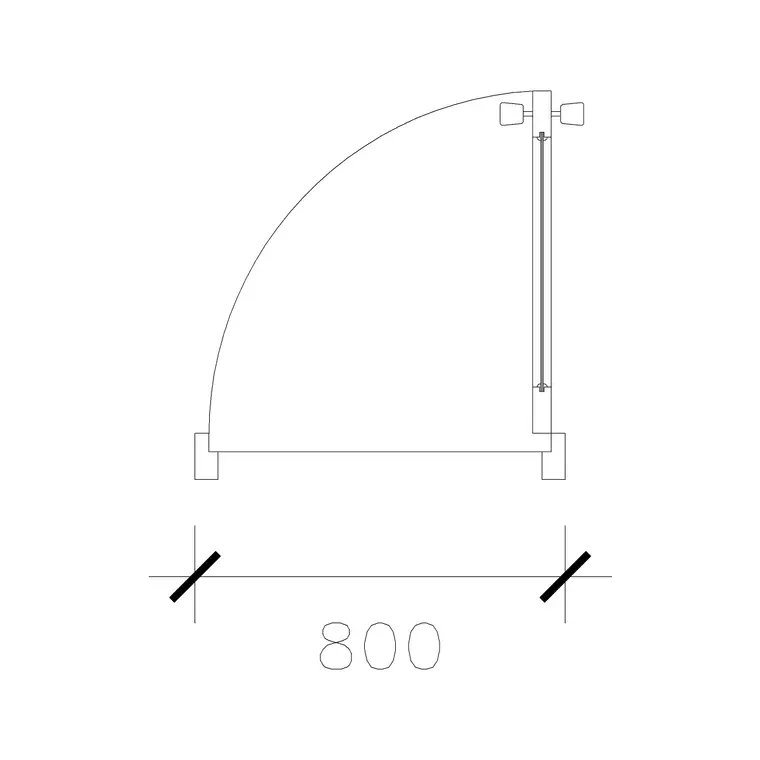
Picture the single most useful dynamic block in architecture: a hinged door. You draw one door leaf and frame at, say, 800 mm. You add a Linear parameter across the opening and a Stretch action so dragging the right-hand grip widens both the leaf and the swing arc together. You add a Lookup parameter holding 600, 700, 800, 900 and 1000 mm so a click snaps to a real standard width instead of an arbitrary number. Finally you add a Flip parameter and action so one grip mirrors the swing left-to-right and another flips it in-to-out.
The result is a single block that replaces a dozen separate door files. On a plan you insert it once, snap it into the opening (alignment can auto-rotate it to the wall), then pick the width from the list and click the flip arrows to set the handing. Edit the leaf detail once in BEDIT and every door in the project — every width, every handing — updates together. That is the whole appeal: fewer files, faster placement, and one place to make a change.
When a dynamic block is worth it
Dynamic blocks pay off for symbols you place constantly in slightly different sizes or configurations: doors, windows, desks, beds, vehicles you stretch to length, title-blocks that switch sheet sizes, valves and fittings that come in handed pairs. The break-even is roughly: if you would otherwise keep three or more near-identical static blocks, a single dynamic block usually wins — fewer files to manage, a smaller library, and consistent edits.
They cost more to build, though, and that cost is real. Authoring parameters and actions takes time and a bit of practice, badly-built dynamic blocks can behave unpredictably when stretched, and very complex ones are harder for a colleague to understand or repair. For one-off symbols, fixed-size appliances, logos and north arrows, a plain static block is simpler, more predictable and more portable. A pragmatic library mixes both: static for the fixed kit, dynamic for the handful of symbols whose whole value is that they flex.
Compatibility and downloads
Dynamic blocks were introduced in AutoCAD 2006, so the dynamic behaviour only survives in AutoCAD 2006 and later. Open a dynamic block in an older release, or in some lightweight or non-Autodesk viewers, and you may see the block as plain static geometry at whatever state it was last saved — the grips and lists simply do not appear. AutoCAD LT can insert and use dynamic blocks but historically could not author them in the Block Editor.
Many freely downloadable blocks — including the ones across this site — are deliberately supplied as clean static blocks targeting the widely-compatible AutoCAD 2004 format. That keeps them simple, predictable and openable in everything from full AutoCAD to free DWG viewers and other CAD programs. If you want dynamic behaviour, the usual route is to download a tidy static block and then add your own parameters and actions in the Block Editor to suit your standards — you get a clean starting point and full control over how it flexes.
Free download
Browse the full library — DWG & DXF, no signup.
Questions
Frequently asked
What is a dynamic block in AutoCAD?+
A dynamic block is a block whose definition includes parameters and actions, so one inserted block can stretch, flip, rotate, array or switch between variants using custom grips — instead of you keeping a separate block for every size.
How do I edit a dynamic block's behaviour?+
Open it in the Block Editor (BEDIT), where you add or change parameters (linear, flip, rotation, visibility, lookup) and the actions attached to them. Save and close, and every instance of that block updates to match.
Do dynamic blocks work in older AutoCAD or free viewers?+
Dynamic behaviour needs AutoCAD 2006 or later. Older releases and some non-Autodesk viewers show the block as plain static geometry at its last-saved state, without the grips or drop-down lists.
Should I use a dynamic block or several static blocks?+
If you would otherwise keep three or more near-identical blocks that differ only in size or handing, a single dynamic block usually wins. For fixed-size or one-off symbols, a simple static block is more predictable and more portable.
Related downloads
Blocks for this guide
Popular blocks to download
Related categories
Related guides
Explainer
Static vs Dynamic Blocks in AutoCAD Compared
Static vs dynamic blocks in AutoCAD — the real difference, the pros and cons of each, when to choose which, and how to convert a static block into a dynamic one.
Explainer
What Are Block Attributes in AutoCAD?
What are block attributes in AutoCAD? Learn how attributes attach editable text and data to a block, how to define them with ATTDEF, and how to extract schedules.
Explainer
Block vs Group in AutoCAD — The Difference
Block vs group in AutoCAD explained — how a block's single shared definition differs from a group's loose collection, with clear rules for when to use each.