Explainer · what is a parameter in a dynamic block
What is a parameter in a dynamic block, explained
By Saumyajit Maity · Published 23 Dec 2023 · Updated 22 Feb 2026
In a dynamic block, a parameter defines what is allowed to vary — a distance, an angle, a position, a yes/no flip, or a choice from a list. It is the dimension of freedom you are giving the block. On its own a parameter does nothing visible; it simply declares 'this aspect of the block can change' and usually adds a grip the user can drag or a value they can edit in the Properties palette.
This page explains the main parameter types you find on the Block Editor's Parameters panel, how a parameter differs from the action that actually moves geometry, and how the pairing of the two is what gives a downloaded block its stretch, rotate and flip behaviour. If you have ever dragged a blue grip to resize a door, you have used a parameter without knowing its name.
A parameter declares a degree of freedom
Think of a parameter as a labelled slot for something that can change. A Linear parameter says 'there is a distance here that can vary' and stores a current value such as 1000. A Rotation parameter says 'there is an angle here that can vary.' A Visibility parameter says 'there is a set of named states, and one is shown at a time.'
The parameter itself holds the value and exposes the control — typically a grip plus an entry in the Properties palette. What it does not do is move any lines. That job belongs to the action. The parameter is the steering wheel; the action is the linkage that turns the wheels.
The core parameter types
AutoCAD offers several parameter types, each suited to a kind of change. Point gives a draggable XY location. Linear constrains movement to a distance along a defined direction — the workhorse for resizing. Polar combines a distance and an angle. XY allows independent horizontal and vertical change. Rotation drives an angle. Alignment lets the whole block snap its orientation to nearby geometry. Flip provides a mirror state. Visibility switches between named display states. Lookup maps input values to outputs through a table. Base Point relocates the block's grab handle.
Each parameter type adds its own style of grip — a triangular arrow for linear stretch, a circular grip for rotation, a flip arrow for mirroring, a lookup grip (a small down-arrow) for picking from a list. Recognising the grip shape on an inserted block tells you what kind of parameter is driving it.
Parameter versus action
This is the distinction that confuses newcomers most. A parameter defines what can change and how the user controls it; an action defines what geometry responds and how. A Linear parameter named Width, paired with a Stretch action, produces a block whose width grip drags the frame wider. Swap the Stretch for an Array action on the same parameter and dragging the grip instead repeats objects along that distance.
So the parameter is necessary but not sufficient. Add a parameter with no action and you get a grip that moves but no geometry follows — a common 'why isn't my block doing anything?' moment in the Block Editor. Almost every parameter (Visibility, Alignment and Base Point are the exceptions) needs at least one action attached to have any effect.
Value sets: limiting what a parameter can be
By default a Linear or Polar parameter can take any value, which is rarely what you want for real components. A value set restricts the parameter to a list or an increment. Set a Linear parameter's value set to a list of 700, 800, 900 and 1000 and the resize grip snaps only to those leaf widths. Set it to an increment of 50 between a minimum and maximum and it steps in 50 mm jumps.
Value sets are what turn a vaguely stretchy block into a properly engineered one. They stop a 1000 mm door from ever being dragged to a meaningless 963 mm and make the grip feel deliberate, clicking into the standard sizes a real specification would use.
How parameters appear to the person inserting the block
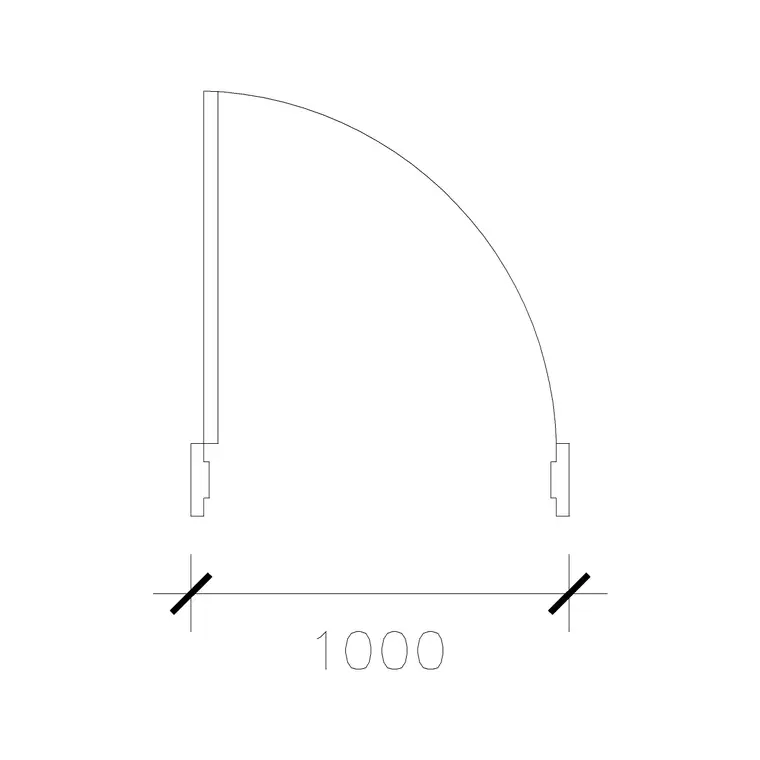
When you insert a dynamic block, the parameters surface in two places. First as custom grips on the geometry — drag the arrow to stretch, the circle to rotate, the flip arrow to mirror. Second in the Properties palette under a 'Custom' section, where each parameter's current value is listed and can be typed in directly. A door with a Linear parameter named Width will show 'Width 1000' there, editable to 900 with a keystroke.
This dual exposure is why dynamic blocks feel so flexible. You can work visually by dragging grips, or precisely by typing values, and either way you are setting the same underlying parameters the author defined in the Block Editor.
Adding a parameter in the Block Editor
Open the block with BEDIT, go to the Parameters panel of the Block Authoring Palettes, and click the parameter type you want. For a Linear parameter you pick a start point and an endpoint to define the distance and direction, then position the label. AutoCAD flags the new parameter with a small yellow alert icon until you attach an action — its way of reminding you the steering wheel still has no linkage.
Name the parameter clearly (Width, Height, FlipState) because that name shows in the Properties palette. Then add the matching action, optionally attach a value set, and test by exiting the editor and dragging the grip. Clear names and sensible value sets are what separate a professional dynamic block from a fiddly one.
Free download
Browse the full library — DWG & DXF, no signup.
Questions
Frequently asked
What is a parameter in a dynamic block in simple terms?+
It is a declared degree of freedom — a distance, angle, flip or choice that the block is allowed to change. It holds the value and usually adds a grip, but it does not move geometry by itself.
Why does my parameter not do anything?+
Because it has no action attached. Most parameters need a paired action — a Linear parameter needs a Stretch or Array action, for example. The yellow alert icon in the Block Editor flags parameters that still lack an action.
What are value sets used for?+
They limit a parameter to a list of allowed values or a fixed increment, so a resize grip snaps to standard sizes instead of any arbitrary number — for example forcing a door width to 700, 800, 900 or 1000 mm.
Which parameters work without an action?+
Visibility, Alignment and Base Point parameters function on their own. Linear, Polar, XY, Rotation, Flip and Lookup parameters need at least one paired action to affect geometry.
Related downloads
Blocks for this guide
Popular blocks to download
Related categories
Related guides
Explainer
Dynamic Blocks Explained — AutoCAD Guide in 2026
Dynamic blocks explained simply — what they are, how parameters, actions and grips let one AutoCAD block flex into many sizes, and when to use them over plain blocks.
Explainer
Static vs Dynamic Blocks in AutoCAD Compared
Static vs dynamic blocks in AutoCAD — the real difference, the pros and cons of each, when to choose which, and how to convert a static block into a dynamic one.
Explainer
What Are Block Attributes in AutoCAD?
What are block attributes in AutoCAD? Learn how attributes attach editable text and data to a block, how to define them with ATTDEF, and how to extract schedules.