Block landing · taraxacum lamp cad block
Free Taraxacum lamp CAD block in DWG and DXF
By Saumyajit Maity · Published 4 Sep 2024 · Updated 25 Jun 2026
The Taraxacum is one of the most recognisable designer pendant lights — a near-spherical cluster of slender arms radiating from a central hub, each ending in a small lamp, named for the dandelion seed-head it resembles. This page offers a free Taraxacum lamp CAD block in DWG and DXF, drawn in plan and elevation at true millimetre size so its bold spherical form reads correctly in an interior drawing. It is free for commercial work with no signup, watermark or attribution.
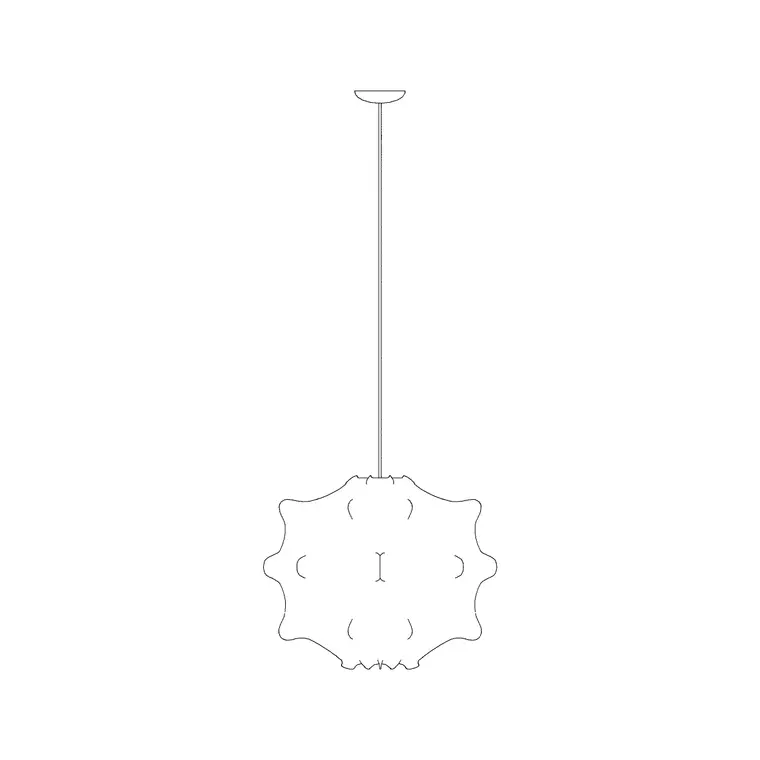
A fitting like the Taraxacum is a centrepiece, not a background light, so getting it onto the drawing accurately matters: it anchors a dining room, a stairwell void or a hotel lobby and sets the scale of the space around it. Because the form is a sphere of many arms, both the plan footprint and the elevation diameter are worth showing, and this block carries both so you can place it, size it and coordinate it with confidence.
What the Taraxacum form needs on the drawing
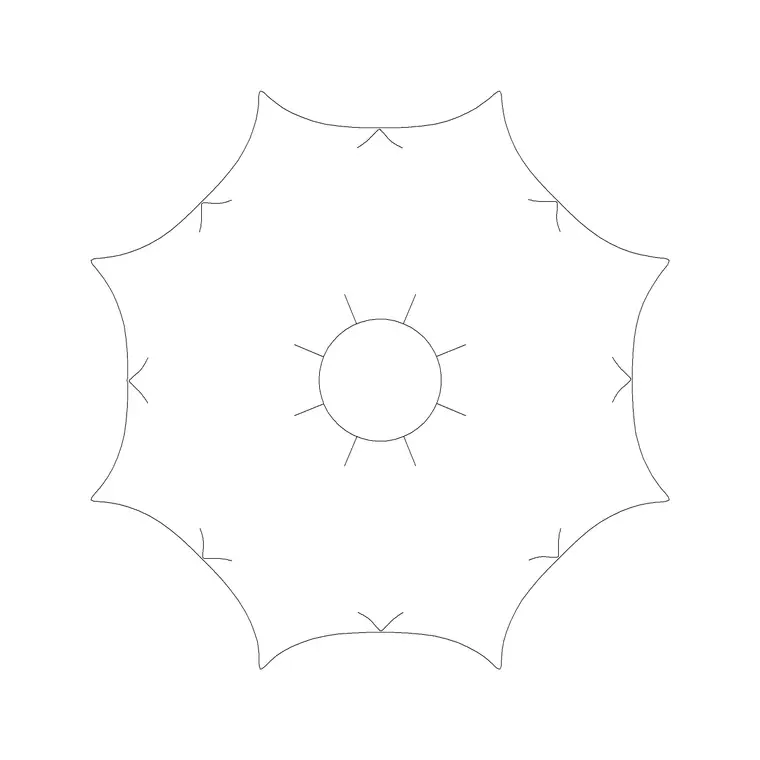
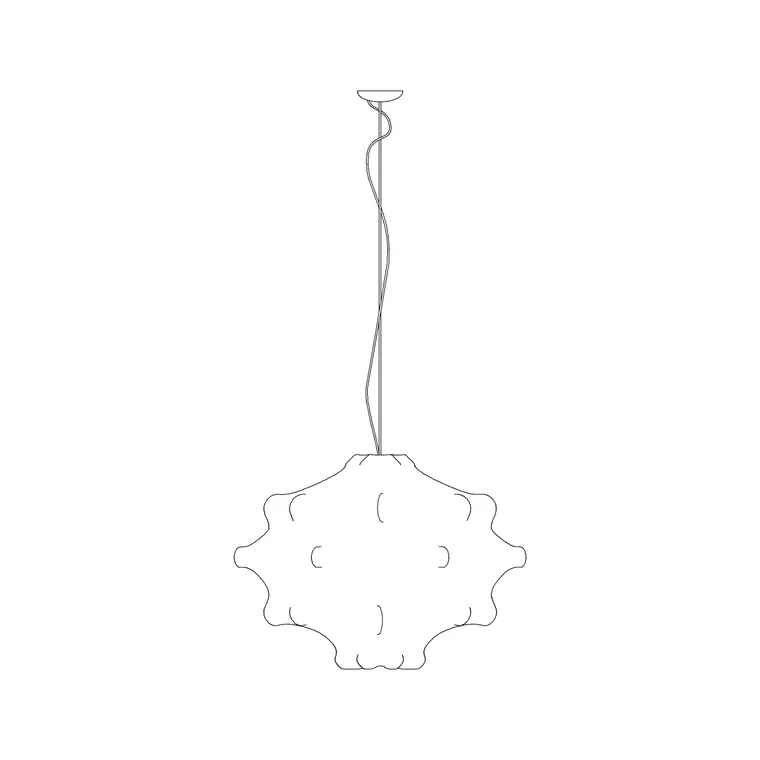
The Taraxacum reads as a globe of fine radiating arms, so the two views tell different parts of the story. The elevation shows the overall sphere — its diameter and the height it hangs at — which is what governs head clearance below it and how it relates to a table or a stair. The plan shows the circular footprint it casts on the ceiling and the space below, useful when you are centring it over a dining table or within a void.
This block ships both plan and elevation so you can use whichever the sheet needs. It is drawn as clean geometry on tidy layers, prints sharply at interior scales, and as a true block reference updates everywhere when the definition is edited once. Because the radiating arms are intricate, drawing it as a block keeps the geometry consistent every time it appears.
Diameter and drop to design around
Treat these as ranges and confirm against the actual variant, since the Taraxacum is made in more than one size. The spherical body commonly falls in the 500–900 mm diameter range, with larger statement versions bigger again. The drop — how far the fitting hangs below the ceiling — depends entirely on the room: over a dining table the bottom of the sphere typically sits a comfortable distance above the table top so it lights the surface without blocking the view across it.
Because the block is full size, dimension the diameter and set the drop straight off the elevation to suit your ceiling height and the furniture below. In a tall void or stairwell the same fitting can hang lower to fill the volume, which the drawing should show clearly.
How to insert and centre the fitting
The DWG is drawn in millimetres. Insert at scale 1 in a millimetre drawing, 0.001 in a metre drawing, or set INSUNITS to millimetres so an imperial template rescales it. Run INSERT or drag from a palette and pick the insertion point at the centre of the sphere so it centres and rotates cleanly.
For a plan, snap the block to the centre of the table, void or room it crowns. For an elevation or section, set the vertical position so the bottom of the sphere sits at the chosen drop above the table or floor. Keep the fitting on its own lighting layer so this feature piece can be shown or hidden independently, and rotate as needed to suit the view.
Where the Taraxacum is used
As a statement chandelier, the Taraxacum belongs where a room wants a focal point: dining rooms, double-height living spaces, stair voids, hotel lobbies and reception areas, restaurant and bar interiors, and high-end residential schemes. It is exactly the kind of fitting an interior designer puts on a presentation elevation to signal a considered, high-specification scheme.
The same block drops into a section through a double-height space to show the chandelier filling the void, and into furniture-and-finishes boards alongside the dining table or seating it crowns. Free and licence-clear, it suits student and competition work as readily as a coordinated interiors package, and it crosslinks with the other designer pendants in the lighting category.
Coordinating a statement pendant
A feature pendant like the Taraxacum has to be coordinated, not just dropped in: it needs a structural fixing, it must clear head height below, and it has to sit clear of any other ceiling services. So keep it on its own lighting layer with a distinct colour, and use the full-size block to check the clearances on the section before the ceiling is set out.
Because the geometry is intricate, treat the block as the single source of truth — edit the definition once and every appearance updates, rather than redrawing the arms each time. Pair it with the Skygarden, Frisbi and other designer pendant blocks in the lighting category when you are presenting a range of feature lighting options to a client.
Weight, fixing and access for a statement chandelier
A spherical multi-arm chandelier like the Taraxacum is a heavy, intricate fitting, so beyond where it hangs the drawing has to flag how it is fixed and how it is reached. A statement piece of this size usually needs a proper structural fixing back to the slab or to a noggin rather than a standard ceiling rose, and the section is where you confirm the ceiling build-up can take it. Drawing the fitting full size keeps everyone honest about the load hanging in the void.
Access for cleaning and lamp changes is the other consideration a focal chandelier raises, especially in a stairwell or a double-height space where it may hang well out of normal reach. The section should show how the fitting is reached — from a landing, by a tower, or on a lowering device — so the maintenance route is designed in rather than discovered later. Capturing the chandelier to scale in the void, with its fixing and access shown, turns a beautiful symbol into a fitting the building can actually carry and maintain.
Free download
Browse the full library — DWG & DXF, no signup.
Questions
Frequently asked
What is a Taraxacum lamp?+
A designer pendant light shaped like a near-spherical cluster of slender arms radiating from a central hub, each ending in a small lamp — named after the dandelion seed-head it resembles. It is used as a statement chandelier.
Does the block include plan and elevation?+
Yes. This block ships both the plan footprint and the elevation of the spherical fitting, so you can centre it on a table in plan and set its drop and diameter in elevation or section.
How big is a Taraxacum and how low should it hang?+
The spherical body commonly falls in the 500–900 mm diameter range, with larger statement versions bigger. The drop depends on the room; over a dining table the bottom typically sits a comfortable distance above the table top. The block is full size, so set both off the elevation.
Will the DWG open in free CAD software?+
Yes. It targets AutoCAD 2004 and later and opens in AutoCAD, AutoCAD LT, BricsCAD, DraftSight and free DWG viewers including Autodesk's online viewer.
Related downloads
Blocks for this guide
Related categories
Related guides
Block landing
Free Lighting Fixtures CAD Blocks — DWG Download
Download free lighting fixtures CAD blocks in DWG and DXF — chandeliers, wall lights, downlights and pendants in plan and elevation for AutoCAD.
Block landing
Free Table Lamp CAD Blocks — DWG Download
Download free table lamp CAD blocks in DWG and DXF — classical and decorative table lamps in plan and elevation for AutoCAD 2004+. No signup, commercial-use OK.
Block landing
Free Floor Lamp CAD Blocks — DWG Download
Download free floor lamp CAD blocks in DWG and DXF — straight and arc floor lamps in plan and elevation for AutoCAD 2004+. No signup, free for commercial use.