Explainer · standard parking space dimensions
Standard parking space dimensions for site plans
By Saumyajit Maity · Published 13 Mar 2024 · Updated 15 Jun 2026
Laying out a car park looks like drawing rectangles until you realise how many dimensions interact: the bay itself, the aisle a car turns out of, the angle the bays sit at, and the extra width an accessible bay needs. Get one of those wrong and the layout either wastes land or traps cars in spaces they cannot reverse out of. The numbers are not arbitrary — they come from the size of a car and the geometry of manoeuvring it.
This explainer covers the typical ranges for parking bays and aisles, how the parking angle changes everything, what accessible bays add, and how dropping a scaled car block into the plan turns a fit-check into a glance.
What sets parking dimensions
Parking bay sizes are derived from a design vehicle — a representative car — plus the room to open doors and the swept path needed to drive in and out. A bay must hold the car with clearance to its neighbours, and the aisle in front must be wide enough for the car to turn into and out of the bay without a multi-point shuffle. Those two demands, the static fit and the dynamic manoeuvre, set the figures.
Because cars vary, layouts are designed around a standard vehicle envelope rather than any one model. That envelope, plus door-opening and turning allowances, is what the published bay and aisle dimensions encode. Understanding that is why the numbers come in ranges and why they shift with the parking angle.
Typical bay sizes
A standard perpendicular car bay generally falls in a width band around the mid-2000s of millimetres and a length in the high-4000s to around 5000 mm, sized to hold the design car with door-opening clearance. End bays next to walls or columns are often a little wider because a door cannot open into the obstruction. Bays for larger vehicles or family use run wider again.
These are typical ranges to sketch a layout against, not fixed specifications — the controlling figures come from the local parking standard and the design vehicle chosen for the scheme. The practical point is that a bay is roughly car-plus-doors, and squeezing below that makes the spaces uncomfortable or unusable in practice.
Aisle width and manoeuvring
The aisle is the drive lane cars use to reach and leave the bays, and its width is governed by the turn a car must make to enter a bay at the chosen angle. For perpendicular bays, where a car turns through ninety degrees, the aisle is at its widest — commonly around the 6000 mm region for two-way flow — because the manoeuvre needs the most room.
Get the aisle too narrow and cars cannot swing into the bays cleanly, forcing repeated forward-and-back moves that snarl the whole layout. The aisle and the bay angle are a pair: change one and you must re-check the other. This is exactly the kind of geometry a swept-path check, or simply a scaled car turning on the drawing, makes visible.
How parking angle changes the layout
Bays do not have to sit perpendicular to the aisle. Angled bays — at, say, forty-five or sixty degrees — let cars drive in with a gentler turn, so the aisle can be narrower, which suits one-way flow and tight sites. The trade-off is that angled bays use the depth less efficiently and usually work in one direction only.
Perpendicular bays pack the most cars per area and allow two-way circulation, but demand the widest aisle. Parallel bays, lined up along the kerb, suit street-edge parking and need a long slot for the car to reverse into. Choosing the angle is a balance between site shape, traffic direction and how many bays you must fit — and each angle carries its own bay and aisle dimensions.
Accessible parking bays
Accessible bays are wider than standard bays, and crucially they include a marked transfer zone — a striped access aisle alongside, and sometimes behind, the bay — so a wheelchair user can deploy and use a ramp or transfer beside the vehicle. That access aisle is part of the bay's footprint and must stay clear, not be parked across.
Accessible bays are also located close to the accessible entrance with a step-free route, and the number required scales with the size of the car park under the local standard. When you lay them out, draw the bay and its access aisle together as one protected zone, and place them where the route to the building is shortest and level.
Checking the layout with a scaled car
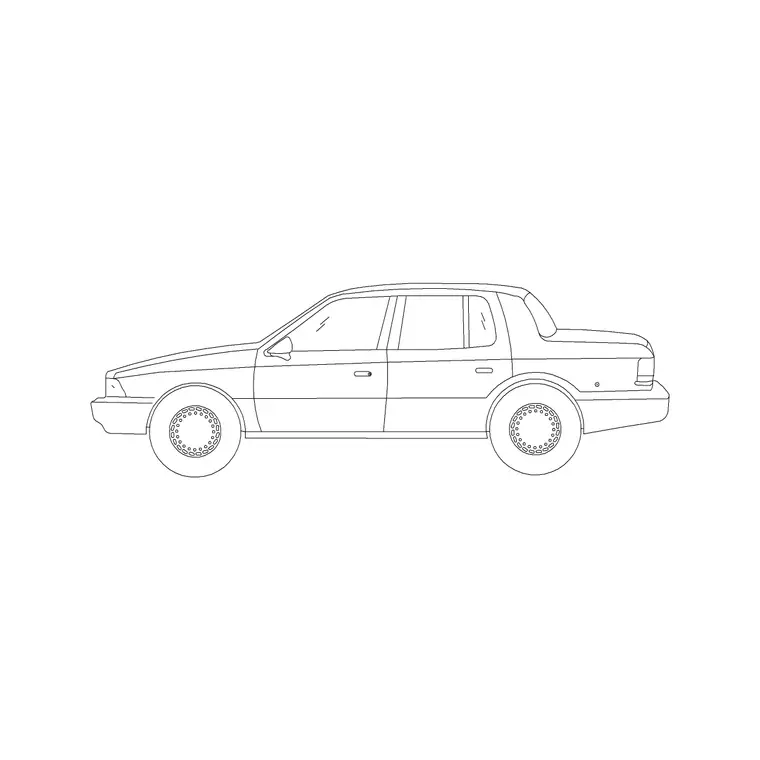
The honest way to test a parking layout is to put a scaled car into it. Drop a sedan block sized to the design vehicle into a bay and you can see at once whether the bay holds it with door clearance and whether the aisle gives room to swing in. Rotate a copy through the entry path to trace the manoeuvre and confirm the aisle is wide enough.
Keep bays, aisles, markings and the test car on separate layers so you can produce a clean marking plan and a manoeuvring-check plan from the same drawing. Because the car block is drawn to true size, the check needs no calculation — the vehicle either parks and exits cleanly within the drawn geometry or it shows you exactly where the layout is too tight.
Free download
Browse the full library — DWG & DXF, no signup.
Questions
Frequently asked
What is a standard parking space size?+
A standard perpendicular bay is roughly the mid-2000s of millimetres wide and high-4000s to around 5000 mm long, sized to hold the design car with door-opening clearance. End bays beside walls are often a little wider. Treat these as ranges; the controlling figures come from the local parking standard.
How wide does a parking aisle need to be?+
It depends on the bay angle. Perpendicular bays need the widest aisle — often around 6000 mm for two-way flow — because cars turn through ninety degrees to enter. Angled bays allow a narrower aisle but usually one-way flow. The aisle and bay angle must be checked together.
How do angled parking bays differ from perpendicular ones?+
Angled bays let cars enter with a gentler turn, so the aisle can be narrower and they suit one-way flow and tight sites, but they use depth less efficiently. Perpendicular bays pack the most cars and allow two-way circulation but need the widest aisle. The angle is a site-shape and traffic trade-off.
What makes an accessible parking bay different?+
It is wider than a standard bay and includes a marked access aisle alongside — and sometimes behind — so a wheelchair user can deploy a ramp or transfer beside the car. It sits close to the accessible entrance on a step-free route, and the number required scales with the car park size under the local standard.
How can I check a parking layout in CAD?+
Insert a scaled car block sized to the design vehicle into a bay to confirm it fits with door clearance, then rotate a copy through the entry path to test the aisle width. Keep bays, aisles and the test car on separate layers so the manoeuvring check and the marking plan come from one drawing.
Related downloads
Blocks for this guide
Popular blocks to download
Related categories
Related guides
Explainer
What Are CAD Blocks? A Beginner's Guide in 2026
What are CAD blocks? A beginner's guide to AutoCAD blocks — what they are, why drafters use them, how blocks, attributes and libraries work, and where to download free DWG blocks.
Curated pack
Free Landscape CAD Block Pack — DWG & DXF
A free landscape CAD block pack in DWG and DXF — trees, shrubs, fences, paving, lighting and figures for AutoCAD landscape plans. No signup, commercial-use OK.
Curated pack
Free Street Furniture CAD Block Pack — DWG
A free street furniture CAD block pack in DWG and DXF — street lights, fences, gates, paving and figures for public realm plans. No signup, commercial OK.