Block landing · pine tree plan cad block dwg
Free pine tree plan view CAD block in DWG
By Sumana Kumar · Published 6 Sep 2022 · Updated 30 Mar 2026
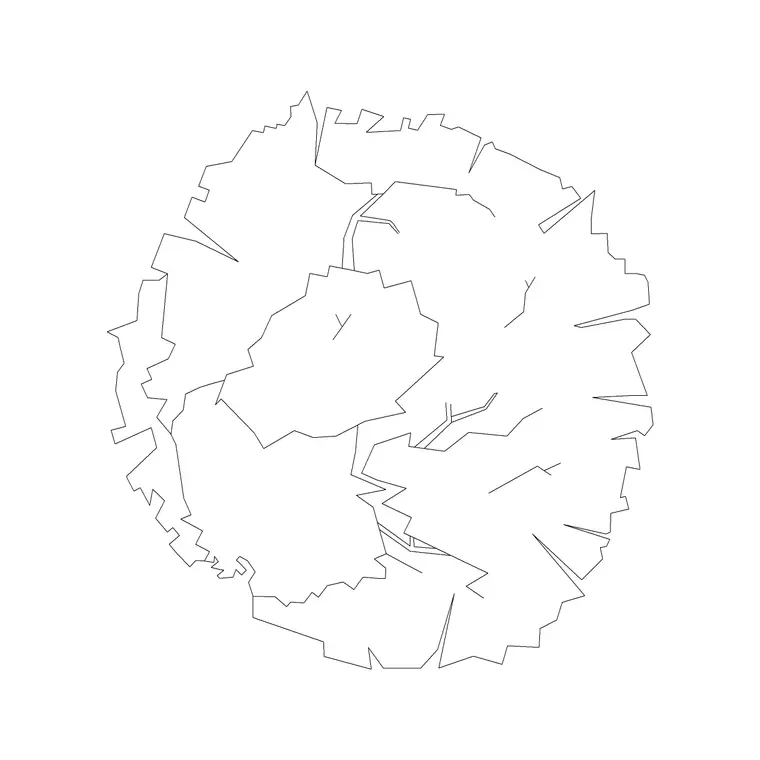
Download a free pine tree plan CAD block in DWG — the top-down canopy symbol you array across a site plan, landscape masterplan or planting drawing. Unlike a soft broadleaf circle, a pine reads in plan as a tighter, more textured ring with a radial needle pattern, so it labels itself as a conifer without a leader line. The block is free for personal and commercial work, no signup and no watermark.
What the plan symbol looks like
In plan you are looking straight down on the canopy, so a pine becomes a roughly circular outline with a finer, more radial texture than a deciduous tree. A small centre mark or trunk dot fixes the planting point. The radial needle linework distinguishes it from the smooth or cloud-edged circles used for broadleaf trees, which is genuinely useful on a mixed planting plan where the species need to be told apart at a glance.
The canopy outline and the inner texture sit on separate sub-elements so you can simplify the symbol for a busy masterplan or keep the full detail for a feature planting sheet.
Typical canopy spread to scale to
Plan symbols are all about footprint, so scale the block to the canopy spread the species actually reaches. Pines stay narrow for their height — a young specimen might read as a 2-4 m circle in plan, while a mature pine canopy can spread into the 6-10 m range depending on species and conditions. Treat these as ranges to scale against, not fixed values.
Getting the spread right is what lets the plan do real work: correct circles let you check spacing between trees, clearance from buildings and overhang across boundaries the moment the symbols land.
Inserting and arraying across the site
The block is drawn full size in millimetres. INSERT at scale 1 in a millimetre drawing, 0.001 in metres, or set INSUNITS so AutoCAD rescales on insertion. Place the centre dot on your planting point.
For an avenue or shelterbelt of pines, use a path ARRAY along the road or boundary centreline; for a grid like a plantation, use a rectangular array. Vary the scale and rotation a little between copies so the planting reads as natural rather than mechanical. Keep everything on a planting layer such as L-PLANT so you can freeze it for a clean base plan.
Where pine plan symbols are used
Pine plan blocks appear in landscape masterplans, planting schedules, shelterbelt and screening layouts, campus and parkland plans, and any site where evergreen structure matters through the winter. Because a pine holds its canopy year-round, it is the symbol of choice when you are showing a permanent visual screen or a windbreak.
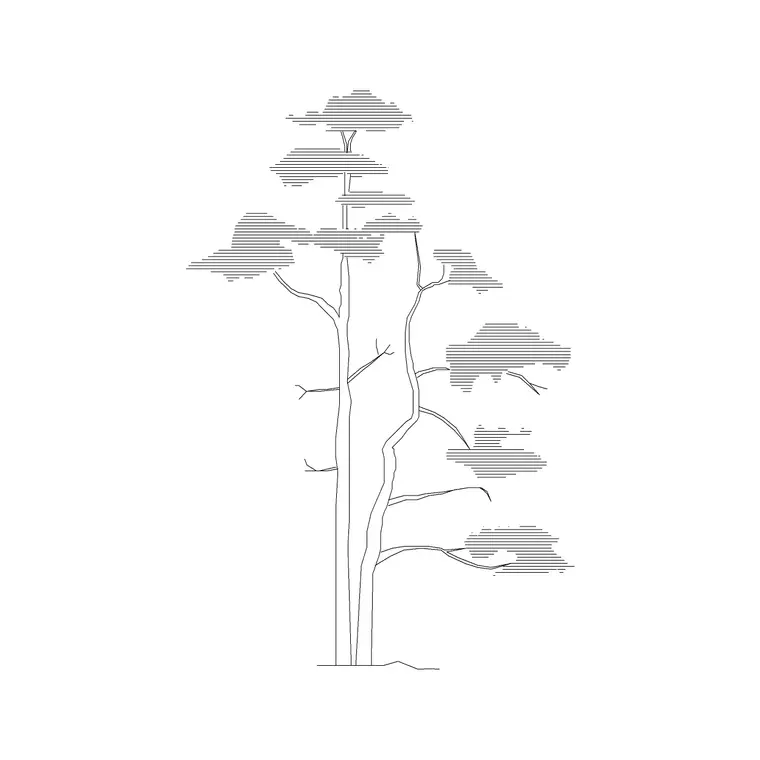
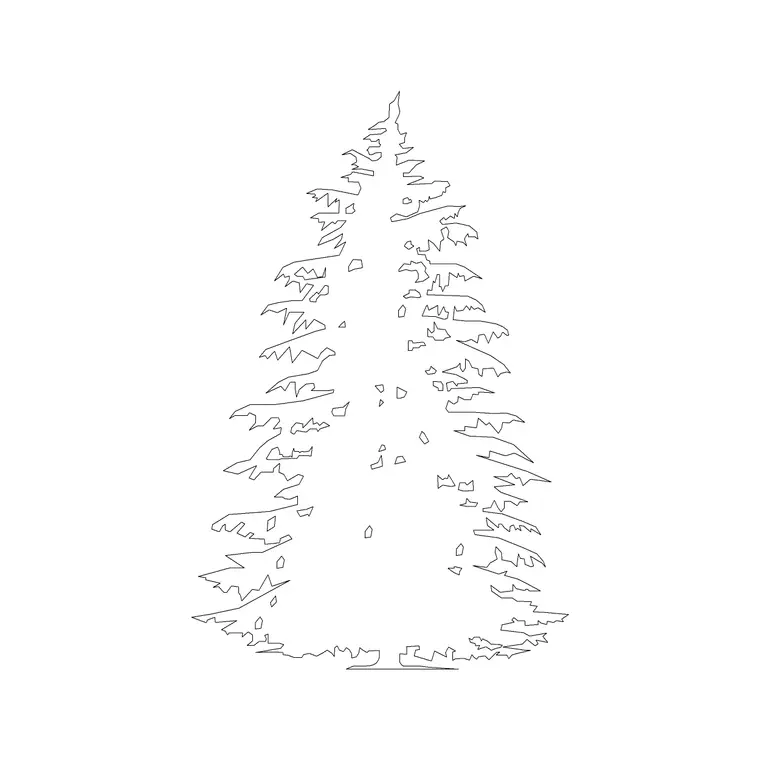
Pair the plan symbol with the matching pine elevation block so the same species appears correctly in both your site plan and your section/elevation sheets — a small consistency that makes a drawing set look properly coordinated.
Reading a mixed-species planting plan
On a planting plan you rarely have just one species. Using a distinct radial pine symbol alongside cloud-edged deciduous circles and tighter shrub symbols means a contractor can read the species mix without constantly cross-referencing the schedule. That visual shorthand is exactly why landscape plans use different canopy textures rather than identical circles.
If your office runs a planting schedule, tag each tree block with a simple species attribute. You can then extract a count of each species straight from the drawing, turning the plan into the data a procurement or planting list needs.
Keeping symbols lightweight
Detailed canopy texture is lovely on a feature sheet but can clog a large masterplan. Keep two versions in your library: the full-texture pine for close-up planting plans and a simplified ring for the overall masterplan. Both go on the same planting layer so layer control stays simple.
When a layout is finalised, WBLOCK a representative cluster of pines as a single grove block. Dropping that one reference in populates a wooded area in seconds, and editing the definition reshapes every grove at once.
Using the plan symbol for shadow and root checks
A correctly-scaled pine plan symbol does more than decorate the page. Because the circle represents the real canopy spread, you can use it to check where shade will fall across a building, a terrace or a solar array at different times of day, and to flag where a canopy will eventually overhang a boundary or a roof.
The trunk dot at the centre also marks where the root system originates, which matters for keeping trees clear of drains, foundations and underground services. Designers often draw a separate root-protection circle around the trunk on its own layer; having the canopy symbol already centred on the trunk makes adding that constraint circle quick and accurate. Because a pine canopy stays fairly narrow, the gap between its constraint circle and its canopy circle tends to be smaller than for a broad-crowned tree, which is useful to know when you are squeezing planting onto a tight urban site.
Free download
Browse the full library — DWG & DXF, no signup.
Questions
Frequently asked
What is the difference between the pine plan and elevation blocks?+
The plan block is the top-down canopy symbol you array across a site plan; the elevation block is the front-on profile for sections and facades. Use the plan for layout and the elevation for vertical drawings.
How do I tell a pine plan symbol from a deciduous one?+
The pine symbol uses a finer radial needle texture in a tighter circle, whereas a broadleaf tree is usually a smooth or cloud-edged circle. That contrast lets you read a mixed planting plan at a glance.
Is the pine plan block free to use commercially?+
Yes. It downloads free in DWG with no signup, no watermark and no attribution required, cleared for personal and commercial work.
Can I array these along a road for an avenue?+
Yes. Use a path ARRAY along the road centreline, then vary the scale and rotation of individual copies slightly so the avenue looks natural rather than stamped.
Can I use the plan symbol to check canopy overhang?+
Yes. Because the circle is the real canopy spread, you can see directly where a tree will overhang a boundary, roof or terrace, and adjust spacing before there is a problem.
Related downloads
Blocks for this guide
Related categories
Related guides
Block landing
Free Flower Plant CAD Blocks — DWG Download
Free flower plant CAD blocks in DWG and DXF — flowering annuals and perennials in plan and elevation for AutoCAD landscape plans. No signup, commercial OK.
Block landing
Free Flowering Shrub CAD Blocks — DWG Download
Free flowering shrub CAD blocks in DWG and DXF — ornamental shrubs in plan and elevation for AutoCAD planting and site plans. No signup, commercial OK.
Block landing
Free Herb Plant CAD Blocks — DWG Download
Free herb plant CAD blocks in DWG and DXF — herbs for kitchen gardens, raised beds and planters, in plan and elevation for AutoCAD. No signup, commercial OK.