Block landing · large indoor plant cad block
Large indoor plant CAD block in DWG
By Saumyajit Maity · Published 27 May 2022 · Updated 23 Mar 2026
A large indoor plant is a deliberate design move, not just dressing: it anchors a double-height lobby, screens a stair, or gives a tall glazed wall something to push against. Because it carries so much visual weight, it has to be drawn at the right height to be believable, which is exactly what this free large indoor plant CAD block delivers. It is supplied in DWG, drawn in elevation for AutoCAD 2004 or later, free for personal and commercial work, with no signup, no watermark and no credit required.
This is the block to reach for when a medium pot would look lost — atriums, hotel lobbies, showroom corners and tall residential voids where a feature specimen reads from across the room. The foliage mass is generous and the planter is sized to carry it, so the plant holds its own against large-scale architecture instead of disappearing into the floor line.
What the large indoor plant block shows
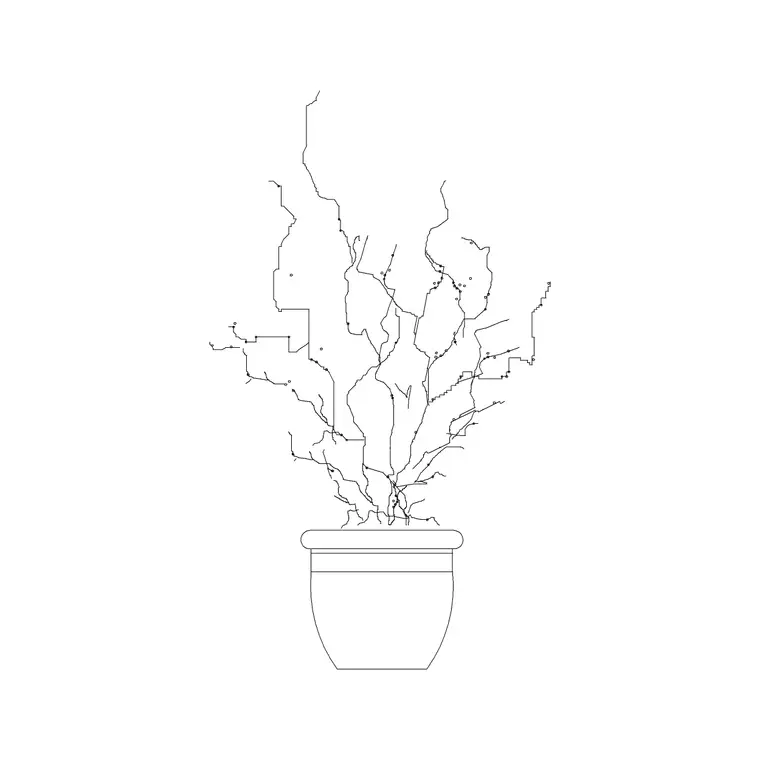
The block draws a tall specimen — a substantial planter supporting a full, branching foliage mass that rises well above seated and standing furniture. The leaves are drawn as a clean, layered silhouette rather than rendered in botanical detail, which keeps the symbol legible at the scales you use for big interior elevations and sections.
The planter is generous because a tall plant needs a stable, visually convincing base; a feature specimen on a tiny pot looks wrong even in a line drawing. The stem or trunk line runs centred up through the canopy so the whole thing balances on the pot, and the outline is built to be screened back, hatched or recoloured to suit a presentation board.
Views and what's included
This is an elevation block: the plant seen face-on, ready for interior elevations, building sections and presentation drawings where you are looking at a wall or a tall space straight on. It is the right view for lobby elevations and atrium sections rather than top-down planting plans.
The geometry is organised so you can treat the pot and the foliage as separable elements — keep the container crisp while you screen the leaves back, or change the pot to match a stone or metal finish on your material board. It inserts as one block reference, so you can place, mirror and copy the whole specimen as a unit and explode it only when you need to edit the internal linework.
Typical sizing to design around
Think of a large indoor plant as well above standing height overall, with the foliage doing most of that work and the planter providing a broad, stable base. As a design range, the height sits clearly above a person while the pot diameter lands in the large-planter band so the proportions read as a real feature specimen rather than an overgrown desk plant. Use the floor line as your datum and check the canopy top against door heads, mezzanine edges or window transoms in the same elevation.
These are envelopes to design within, not exact figures stamped on the block. A real ficus, palm or fiddle-leaf will vary, so scale the block to your specimen — and because it inserts as a single reference, you can adjust X and Y independently to make the canopy narrower for a tight corner or broader for an open atrium.
How to insert and scale it
The DWG is drawn in millimetres. Insert at scale 1 in a millimetre drawing, 0.001 in a metre template, and set INSUNITS to millimetres in an imperial setup so AutoCAD rescales the block automatically — the surest way to avoid a plant arriving the wrong size.
Use INSERT or drag the file in, pick the base of the planter as the insertion point and snap it to the floor line. Because a large plant often needs height-tuning to suit a specific void, scale it about the pot base so the container stays on the floor while the foliage grows upward. Set the finished specimen on a planting or FF&E layer so it can be frozen for a clean coordination elevation and thawed for the dressed presentation view.
Where large indoor plants are used
Large indoor plant blocks belong in the big interior moments: hotel and office lobbies, atriums and double-height voids, showroom and retail anchor points, restaurant entrances, and generous residential living rooms with tall glazing. They give scale to spaces that would otherwise feel empty and help a presentation elevation communicate ambition.
They also do real work in sections, where a feature plant beside a stair or against a glazed wall explains how the volume is meant to feel. Combine the large specimen with medium pots, furniture and lighting blocks from the trees-and-plants and interior libraries to dress a whole lobby elevation, then mirror or copy the plant to balance a symmetrical entrance.
Layer and library habits that save time
Keep your feature plants on a dedicated planting layer with their own colour and lineweight. That single habit lets you toggle the greenery off for a technical or coordination drawing and back on for the client-facing elevation, all from the same file without redrawing anything.
If the same large specimen recurs through a scheme, leave it as a named block so editing the definition once updates every placement. When you have a tall plant you are happy with, WBLOCK it into your office library so the next lobby or atrium starts from a proven, correctly-proportioned block rather than a blank canvas.
Free download
Browse the full library — DWG & DXF, no signup.
Questions
Frequently asked
How tall is this large indoor plant block meant to be?+
It is drawn as a feature specimen that rises well above standing height, with a broad planter to match. Treat the height as a design range and scale the block to your real plant, checking the canopy top against door heads or transoms in the same elevation.
Is the block really free for commercial drawings?+
Yes. It is free to download in DWG with no signup, no watermark and no attribution, and it is cleared for commercial, personal and student project use alike.
What view is the file drawn in?+
Elevation — the plant seen face-on for interior elevations and sections. It suits lobbies, atriums and presentation views rather than top-down planting plans, where you would want a plan-view block instead.
Can I make the canopy narrower to fit a tight corner?+
Yes. Insert the block and give it a smaller X scale than Y, which slims the foliage width while keeping the height. Scaling about the pot base keeps the planter sitting cleanly on the floor line as you do it.
Related downloads
Blocks for this guide
Related categories
Related guides
Block landing
Free Flower Plant CAD Blocks — DWG Download
Free flower plant CAD blocks in DWG and DXF — flowering annuals and perennials in plan and elevation for AutoCAD landscape plans. No signup, commercial OK.
Block landing
Free Flowering Shrub CAD Blocks — DWG Download
Free flowering shrub CAD blocks in DWG and DXF — ornamental shrubs in plan and elevation for AutoCAD planting and site plans. No signup, commercial OK.
Block landing
Free Herb Plant CAD Blocks — DWG Download
Free herb plant CAD blocks in DWG and DXF — herbs for kitchen gardens, raised beds and planters, in plan and elevation for AutoCAD. No signup, commercial OK.