How-to guide · how to scale a door block to a custom width
How to scale a door block to a custom width in AutoCAD
By Sumana Kumar · Published 7 Jan 2025 · Updated 13 Apr 2026
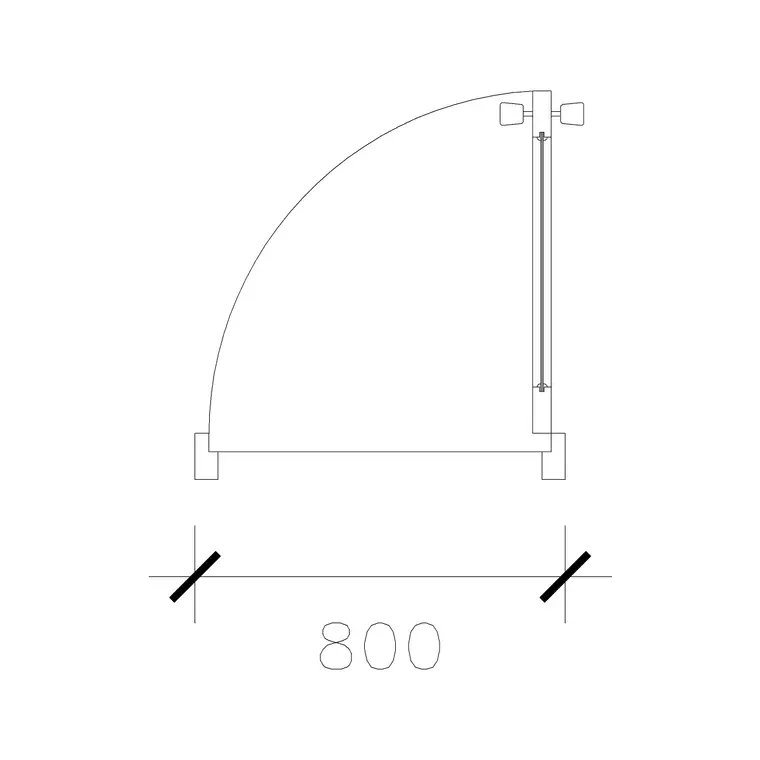
Doors are a special case for scaling because a door block has two parts that must stay in sync: the leaf and its swing arc. Stretch one without the other and the open door no longer matches the arc it sweeps. So when you scale a door to a custom width — fitting a 762 mm leaf to its opening, or widening a standard door to 900 mm for accessibility — the trick is to scale the whole block uniformly so the arc grows with the leaf.
This guide shows how to scale a door block to an exact opening width using the reference method, why uniform scaling keeps the swing correct, and how to size doors to the common widths you'll specify in real drawings.
Common door widths to scale toward
Internal and external doors come in standard leaf widths, and which you choose depends on the room and the regulations. Common internal door widths to design around: roughly 610, 686, 762 and 838 mm (the classic 2'0", 2'3", 2'6" and 2'9" sizes still widely used), and metric 800 and 900 mm leaves. Accessible doorways often need a clear opening around 800 mm minimum, which usually means a 900 mm or larger leaf once you account for the frame and the door thickness in the opening.
The block typically represents the leaf plus the 90-degree swing arc. Your target is the leaf width — get that right and the opening it serves follows.
Step 1 — Measure the door leaf, not the arc
Insert the door block and measure the leaf with DIST: pick the hinge point and the latch edge of the leaf along its length. That's the current leaf width. Don't measure the arc radius by mistake — on a 90-degree door the arc radius equals the leaf length, so they're the same number here, but measuring the leaf itself keeps you clear about what you're scaling to.
Note the hinge point as you go, because that's the natural base point for scaling — a door grows from its hinge, just as a real door is fixed at the hinge and swings the latch edge.
Step 2 — Scale by reference from the hinge
Select the whole door block — leaf and arc together — type SCALE, and pick the hinge point as the base point. Type R for Reference, click the hinge then the latch edge as the reference length (the current leaf width), and enter the custom target, for example 900. AutoCAD scales the entire block uniformly so the leaf becomes 900 mm and the swing arc grows to a matching 900 mm radius automatically.
Because you scaled from the hinge, the hinge stays fixed exactly where the door is fitted in the wall, and the leaf and arc both swing out to the new width from that point — which is precisely how the real door behaves.
Step 3 — Fit the scaled door to the wall opening
Now drop the hinge of the scaled door onto the hinge side of the structural opening. The leaf should span the clear opening, and the arc should show the door swinging into the room without fouling adjacent walls, fixtures or another door's swing. This swing check is the main reason a door is drawn to true width at all: a 900 mm door needs more room to open than a 762 mm one, and the arc makes any clash obvious.
If the leaf doesn't match the opening, scale again to the opening's clear width, or adjust the opening — the drawing is telling you the door and the structure disagree, which is exactly what you want to catch on paper.
Why uniform scaling is essential for doors
It's tempting to make a door wider by stretching only the leaf, but that's the one thing you must not do, because the swing arc won't follow. You'd end up with a 900 mm leaf sweeping an 800 mm arc — geometry that's simply wrong and misleads anyone checking clearances. Uniform SCALE (one factor for X and Y) keeps the leaf and arc locked together so the drawing stays truthful.
If you genuinely need to change only the leaf — say, to model a door thicker or a different style — edit the block definition in BEDIT rather than non-uniformly scaling the instance. For width, always scale the whole block uniformly.
Pitfalls when scaling door blocks
The headline pitfall is non-uniform scaling that desyncs the leaf and arc — avoid different X/Y factors on a door at all costs. The second is scaling from the latch edge or the door head instead of the hinge, which shifts the hinge off the opening; always base the scale at the hinge. Third, watch the door swing direction after scaling: scaling doesn't flip a door, but if you also mirror it to change handing, check the arc still reads correctly into the room.
Finally, the familiar units caveat applies. If a door inserts comically large or tiny, that's INSUNITS, not a scaling problem — set your insertion units to millimetres to match the block, then scale to the custom leaf width you actually need.
Free download
Browse the full library — DWG & DXF, no signup.
Questions
Frequently asked
How do I scale a door to exactly 900 mm wide?+
Select the whole door block, run SCALE, pick the hinge as the base point, type R for Reference, click the hinge then the latch edge as the reference length, and type 900. AutoCAD scales the leaf and the swing arc together so both reach the 900 mm width from the fixed hinge.
Can I widen just the door leaf without the arc?+
No — that desyncs the geometry and gives a false swing. The arc radius must match the leaf width on a 90-degree door, so always scale the whole block uniformly. If you need to change only the leaf detail, edit the block definition in BEDIT instead of stretching the instance.
What are the standard door leaf widths?+
Common widths include roughly 610, 686, 762 and 838 mm (imperial 2'0" to 2'9"), plus metric 800 and 900 mm leaves. Accessible doorways usually need a clear opening around 800 mm, which typically means a 900 mm or wider leaf once the frame is accounted for.
Where should I put the base point when scaling a door?+
On the hinge. A real door is fixed at the hinge and swings the latch edge, so scaling from the hinge keeps it locked to the opening while the leaf and arc grow to the new width. Scaling from the latch edge or door head shifts the hinge off the wall opening.
Related downloads
Blocks for this guide
Related guides
How-to guide
How to Insert a Tree CAD Block in AutoCAD
Step-by-step guide to inserting a tree CAD block in AutoCAD — download the DWG, set units, use INSERT, scale and place it, then array trees across a site plan.
How-to guide
How to Create a Block in AutoCAD (BLOCK & WBLOCK)
Learn how to create a block in AutoCAD with the BLOCK and WBLOCK commands — pick a base point, choose objects, set units, and save a reusable DWG block library.
How-to guide
How to Array Trees Along a Path in AutoCAD
Use ARRAYPATH to line trees along a road, footpath or curve in AutoCAD — set spacing, align to the path, vary the look, and keep planting on its own layer.