How-to guide · how to import a dxf into solidworks
How to import a DXF into SolidWorks
By Saumyajit Maity · Published 16 Dec 2022 · Updated 20 Apr 2026
SolidWorks treats an imported DXF as 2D sketch geometry inside a part, which is exactly what you want when a downloaded block is the starting point for a 3D model. The DXF/DWG import wizard walks you through placing that geometry on a sketch plane and choosing units, and once the curves are clean you extrude them into a solid. DXF is the preferred exchange format here because it is a plain-text vector format that SolidWorks reads reliably.
This guide imports a DXF block into SolidWorks and prepares it for modelling. We will run the import wizard, get the units and scale correct, repair the small gaps that DXF files carry, and extrude the profiles. The same process applies to a DWG — SolidWorks reads both — but DXF tends to import with fewer surprises.
Step 1 — Start the DXF/DWG import wizard
Use File > Open and change the file type filter to DXF/DWG, then select the file. SolidWorks launches its import wizard rather than opening the file blindly. On the first page choose 'Import to a new part' (as a 2D sketch) so the geometry lands on a sketch you can model from, instead of importing it as a drawing sheet.
This choice matters: importing as a part gives you live sketch curves, while importing as a drawing gives you a flat reference you cannot extrude. For turning a block into 3D, always pick the part route.
Step 2 — Set units during import
The wizard asks what units the source file uses. Tell it millimetres for the metric blocks here so the geometry converts to true size in your part. SolidWorks parts carry their own document units, but as long as the import declares the source correctly, a 600 mm element comes in as 600 mm regardless of whether your part template is metric or imperial.
Get this right at the wizard and you skip a manual scale later. If you are unsure of the source units, import once and measure a known dimension to confirm before committing to the model.
Step 3 — Place the geometry on a sketch plane
The wizard lets you pick which plane the 2D geometry lands on — Front, Top or Right. For a plan-view block, the Top plane keeps it lying flat like a floor plan, ready to extrude upward. You can also nudge the origin so the geometry sits where you want relative to the part's coordinate system.
Finish the wizard and SolidWorks drops the curves onto the chosen plane as an editable sketch. Every line and arc is now a real sketch entity you can dimension, constrain and trim, which is what makes the imported block a true modelling base.
Step 4 — Repair gaps and clean the sketch
DXF and DWG exports frequently contain endpoints that are a hair apart, leaving open contours that block extrusion. SolidWorks offers a 'repair sketch' tool (Tools > Sketch Tools > Repair Sketch) that finds and closes tiny gaps and removes duplicate overlapping entities automatically. Run it first.
After the automatic pass, check any remaining open loops by hand: zoom to suspect corners and add a coincident relation or trim the overshoot. The aim is a set of closed contours, because only closed contours can be extruded into solid material.
Step 5 — Extrude the profiles into a solid
With clean closed contours, use Features > Extruded Boss/Base. Select the outline you want, set a depth, and SolidWorks builds the body. For a block with several parts — a seat, arms and a base, for instance — extrude each closed region to its own height to recreate the form in 3D.
From there the part behaves like any native SolidWorks model: you can add fillets, shells and mates, and the original imported sketch remains in the feature tree as the geometry that defines it, editable if dimensions need to change.
Pitfalls when importing DXF into SolidWorks
Scale is the first thing to verify; a wrong source-unit setting makes the geometry a factor of 1000 off, fixed by re-importing with millimetres declared. The second is open contours — the single biggest reason an imported sketch refuses to extrude — which Repair Sketch resolves in most cases, with manual trimming for the rest.
The third is clutter. AutoCAD files can carry hatching, dimensions and text that import as extra sketch entities you do not need for modelling. Delete that annotation so the sketch contains only the outlines you will extrude, which keeps the part light and the feature tree clean.
If you work with the same blocks often, save a derived part once it is cleaned and extruded, then reuse it as a component in assemblies rather than re-importing the DXF every time. SolidWorks treats that derived part like any native component, so the one-time import effort pays back across every project that needs the block, and updates to the master propagate to wherever it is used.
Free download
Browse the full library — DWG & DXF, no signup.
Questions
Frequently asked
Can SolidWorks open DXF and DWG files?+
Yes. Use File > Open with the file type set to DXF/DWG and SolidWorks launches an import wizard. Choose to import as a 2D sketch in a new part so you can extrude the geometry into a 3D model.
Why won't my imported DXF sketch extrude in SolidWorks?+
The contour is not fully closed. DXF exports leave sub-millimetre gaps between endpoints. Run Tools > Sketch Tools > Repair Sketch to close them automatically, then trim or constrain any remaining open corners before extruding.
How do I set the correct scale when importing a DXF?+
Declare the source units in the import wizard — millimetres for a metric block. SolidWorks then converts the geometry to true size so a 600 mm element imports as 600 mm regardless of your part's document units.
Should I import the DXF as a part or a drawing?+
Import as a part (2D sketch) when you want to model in 3D, because that gives you editable, extrudable sketch curves. Import as a drawing only when you need a flat 2D reference sheet you will not turn into solid geometry.
Related downloads
Blocks for this guide
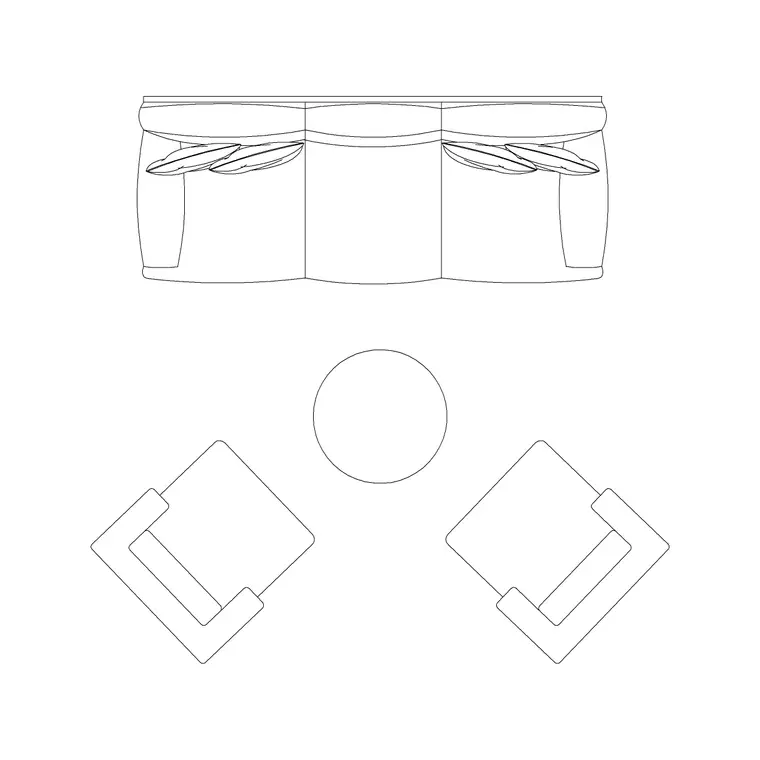
Popular blocks to download
Related categories
Related guides
How-to guide
How to Edit a Block in AutoCAD (BEDIT)
Edit a block in AutoCAD with BEDIT — open the Block Editor, change the geometry, save, and update every inserted instance at once. Tips and pitfalls.
How-to guide
How to Explode a Block in AutoCAD (EXPLODE)
How to explode a block in AutoCAD with EXPLODE — break a block into editable lines, handle nested blocks, and use BURST to keep attributes.
How-to guide
How to Rename a Block in AutoCAD (RENAME)
How to rename a block in AutoCAD with RENAME — change a block's name without breaking its references, fix imported names, and apply a convention.