How-to guide · how to draw a window in plan and elevation in autocad
How to draw a window in plan and elevation in AutoCAD
By Sumana Kumar · Published 12 Jan 2026 · Updated 26 Feb 2026
A window has to be drawn twice to be useful: once in plan, where it sits inside the wall thickness as a set of parallel lines, and once in elevation, where it appears as a framed opening on the building face. The two views tell different stories — the plan fixes the opening width and where the glass sits in the wall, while the elevation shows the proportions, the frame and which sashes open. Drawing both, and keeping them consistent, is a core architectural drafting skill.
This guide draws a single openable window in both views. The method extends to fixed lights, sliders and full-height glazing — the geometry changes but the logic of plan-then-elevation does not. The windows category also has scaled window blocks that ship both views in one DWG if you want a head start.
Step 1 — Set the opening width and sill height
Two numbers govern a window: the opening width in plan and the sill height in elevation. Domestic windows commonly span 600–1800 mm wide, with the sill (the bottom of the opening) often set around 800–1000 mm above finished floor for a habitable room, lower for a feature window and higher for a kitchen or bathroom where worktops or privacy intervene. Head heights frequently align with door heads at roughly 2100 mm.
Fix these before drawing so the plan and elevation agree. The opening width you use in the plan is the same width you draw the elevation to, and the sill and head heights from the elevation are what a section through the wall would confirm.
Step 2 — Break the wall and draw the plan symbol
In plan, a window is an opening in the wall filled with glass lines. Use OFFSET and TRIM to break the wall to the opening width, just as you would for a door. Then represent the window within that gap: the standard convention is three or four thin parallel lines running across the opening — the two wall faces, plus one or two lines for the glazing and frame sitting between them.
The glass line shows roughly where the window plane sits within the wall thickness, which matters for reveals and for how the window reads against the inside and outside faces. Keep these lines lighter than the wall so the window reads as glazing, not masonry.
Step 3 — Set up the elevation alignment
Now move to the elevation. The cleanest way to keep the two views consistent is to project the opening down (or up) from the plan: draw vertical construction lines from the two jambs in plan into the elevation area so the elevation window lands at exactly the plan width. This 'projecting' discipline is what stops the elevation drifting out of step with the plan.
Draw a horizontal datum for the finished floor level in the elevation, then mark the sill and head heights above it using the figures from Step 1. You now have a rectangle defined by jamb projections and sill/head lines — the raw opening, ready to dress with a frame.
Step 4 — Draw the elevation frame and sashes
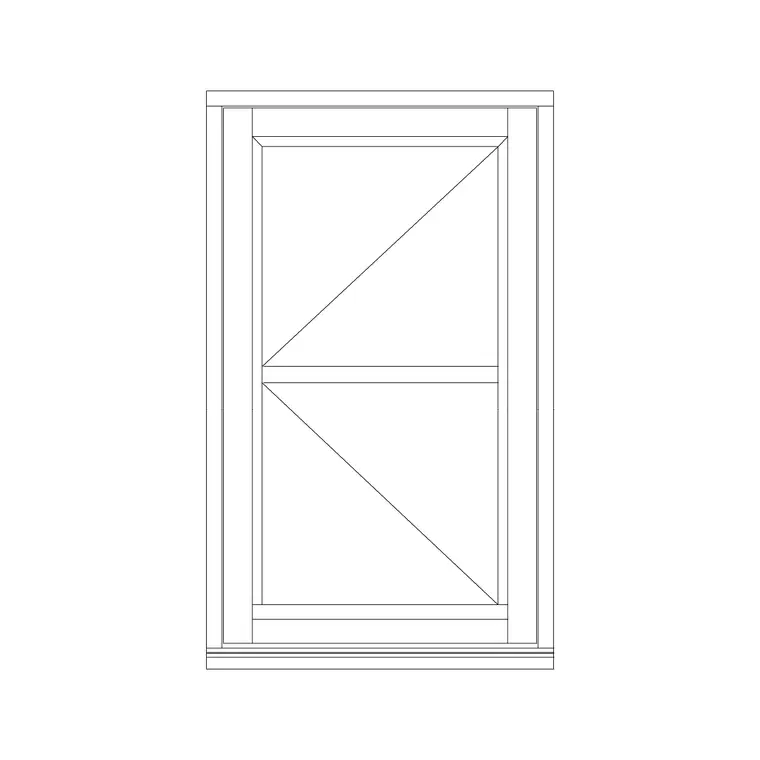
Inside the opening rectangle, draw the frame with a small OFFSET inward — a token frame thickness of around 50–70 mm reads well at most scales. Then divide the opening into sashes or lights: a single openable window might show one large pane, a casement pair shows two, and a sash window shows an upper and lower light split by a meeting rail.
If the window opens, the convention is to show it with dashed lines forming a triangle (or a pair of triangles) whose apex points to the hinge side — top-hung, bottom-hung or side-hung each have their own pattern. These dashed marks tell the reader which way the sash swings, the elevation equivalent of the door's swing arc.
Step 5 — Keep plan and elevation on coordinated layers
Put the window glass, frame and opening marks on sensible layers so each view can be controlled. A common setup keeps a glazing layer, a frame layer and a dashed 'opening direction' layer. That way you can produce a clean architectural plan, a glazing schedule plan and a presentation elevation from the same geometry.
Coordinated layers also make it trivial to check that the plan opening and the elevation width still match after an edit. If you widen the window in plan, re-project the jambs and stretch the elevation to suit; keeping both on tidy layers means that update is a quick STRETCH rather than a redraw.
Step 6 — Save plan and elevation as one block
Because a window is almost always needed in both views, the efficient move is to save them together. Draw the plan symbol and the matching elevation side by side, then WBLOCK them into a single DWG so the file carries both. When you insert it, you explode or freeze the view you do not need.
Name it to reflect the size and type, such as WINDOW-CASEMENT-1200, and set the units to millimetres. This is exactly how the scaled window blocks on this site are organised — one download gives you the in-wall plan symbol and the face-on elevation, already consistent with each other, so you are not reconciling two separately drawn views.
Pitfalls when drawing windows
The most common error is a plan and elevation that disagree — a 1200 mm window in plan that somehow becomes 1000 mm in elevation. Projecting the jambs from one view to the other prevents this; never eyeball the second view. The second pitfall is forgetting the sill: a window drawn straight off the floor in elevation looks like a door, so always set the sill height above the floor datum.
A third slip is omitting the opening direction in the elevation, leaving a reader unable to tell a fixed light from an opener. Add the dashed hinge marks even on simple drawings — they carry real information about ventilation and cleaning access that a coordinator relies on.
Free download
Browse the full library — DWG & DXF, no signup.
Questions
Frequently asked
How is a window shown in a floor plan?+
As a break in the wall filled with three or four thin parallel lines — the two wall faces plus glazing and frame lines running across the opening. The glass line shows where the window plane sits within the wall thickness.
What sill height should I use for a window?+
Sill height varies with the room, but around 800–1000 mm above finished floor is common for habitable rooms, lower for feature windows and higher where a worktop or privacy needs it. Head heights often align with door heads near 2100 mm.
How do I keep the plan and elevation the same width?+
Project the opening from one view to the other. Draw vertical construction lines down from the two jambs in plan into the elevation so the elevation window lands at exactly the plan width, then add the sill and head lines.
How do I show which way a window opens in elevation?+
Use dashed lines forming a triangle whose apex points to the hinge side — side-hung, top-hung and bottom-hung each have a recognised pattern. These dashed marks are the elevation equivalent of a door's swing arc.
Related downloads
Blocks for this guide
Popular blocks to download
Related categories
Related guides
How-to guide
How to Insert a Window Block in AutoCAD
Insert a window block in AutoCAD — cut the opening, set sill and head heights, place the plan symbol and the matching elevation, and layer it cleanly.
Explainer
DWG vs DXF: Complete Guide to CAD File Formats in 2026
DWG vs DXF explained — what each CAD format is, how they differ, which to use, file size and compatibility, and how to convert between them in AutoCAD.
Curated pack
15 Free Door CAD Blocks — Plan & Elevation DWG in 2026
Download 15 free door CAD blocks in DWG and DXF — single, double, sliding, bifold and pocket doors with swing arcs, in plan and elevation. No signup.