How-to guide · how to draw a north arrow in autocad
How to draw a north arrow in AutoCAD
By Sumana Kumar · Published 25 Apr 2024 · Updated 25 Feb 2026
A north arrow is a tiny symbol that does an outsized job: it orients the whole drawing. Without it, a site plan is just a shape on a page — a reader cannot tell which way the building faces, where the sun comes from, or how the site sits against the road. Drawing one is quick, but doing it well means a clean, legible symbol, the letter N unmistakably at the top, and the arrow rotated to point at true (or project) north rather than just up the page.
This guide draws a simple, professional north arrow from scratch, then shows how to rotate it to the correct bearing and save it as a reusable block you drop on every drawing. The same symbol works at any scale because, unlike furniture or a car, a north arrow is an annotation — it stays a constant size on the printed sheet. The building-symbols category has ready-made north marks if you want to place one straight away.
Step 1 — Choose a clear, simple style
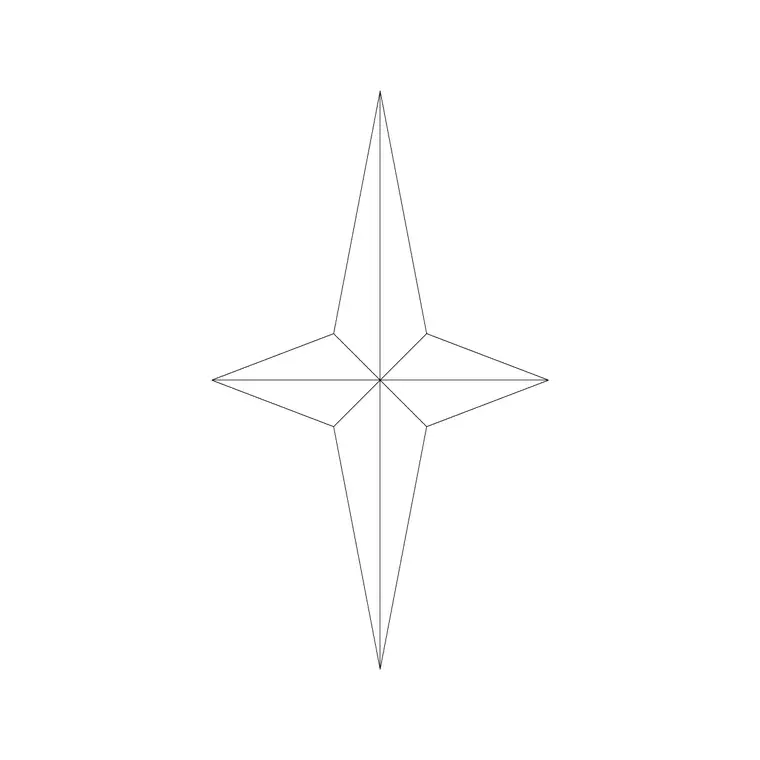
North arrows come in many styles — a plain arrow, a half-filled arrowhead, a compass star, an elaborate decorative rose — but the best one for a working drawing is clean and unambiguous. A common professional choice is a slim arrow or a narrow filled triangle with the letter N at the top, or a four-point star with the north point emphasised. Avoid anything so ornate that it competes with the drawing for attention.
The symbol's only job is to say 'this way is north', instantly and without confusion. Pick a style you can reproduce consistently across a project, because a drawing set looks more professional when every sheet carries the same north symbol.
Step 2 — Draw the arrow geometry
Build the arrow pointing straight up the page to begin with — you will rotate it to the real bearing later. For a simple filled arrow, draw a narrow triangle for the head with the apex at the top, and a thin shaft below it; use SOLID or HATCH to fill the head so it reads boldly. For a half-filled style, fill only one side of the head, which is a classic, elegant convention.
For a star, draw the four points from a centre, making the north (upward) point longer or filled to distinguish it. Keep the geometry tidy and symmetrical — MIRROR one half to guarantee symmetry — and draw it on an annotation or symbols layer rather than mixing it with the drawing geometry.
Step 3 — Add the letter N
Place the letter N at the top of the arrow, above or on the north point, using the TEXT or MTEXT command. Pick a clean font and a size that reads clearly at your plot scale. Centre it on the arrow's axis so the symbol stays balanced. The N is what removes all ambiguity — even a reader unfamiliar with your arrow style knows instantly which point is north.
Keep the N on the same layer as the arrow so the whole symbol moves and rotates as one. Some conventions use only the N and a simple point with no full arrow at all; that is perfectly acceptable on a clean drawing, as long as the direction is unmistakable.
Step 4 — Rotate it to true north
Here is the step that matters most: the arrow must point at the actual north of the site, not just up the sheet. Drawings are usually laid out to suit the page, so north rarely points straight up. Find the bearing of north relative to your drawing (from the survey, the site plan or the project's stated orientation), then ROTATE the whole north-arrow symbol by that angle about its centre so it points correctly.
If you set the rotation as a value, you can type the exact bearing; otherwise rotate to align with a known north reference line on the survey. Getting this right is the entire purpose of the symbol — a beautifully drawn arrow pointing the wrong way is worse than no arrow at all, because it actively misleads.
Step 5 — Save it as a block
Turn the finished, rotated symbol into a block with BLOCK so you can reuse it. Pick the centre of the arrow as the base point, select the arrow and the N, and name it clearly, such as NORTH-ARROW. Because a north arrow is an annotation that should stay a fixed size on the printed sheet, consider making it an annotative block, so it scales automatically to the right size at any plot scale rather than being drawn too big or too small.
Write it out with WBLOCK to reuse across every project. From then on you insert the north arrow in seconds, rotate the single instance to each drawing's bearing, and your whole drawing set carries a consistent, professional north symbol.
Step 6 — Place it consistently on every sheet
Position the north arrow where readers expect it — commonly a top corner of the drawing area or near the title block — and keep it in the same place across the sheet set so people find it instantly. It belongs on plans and site plans especially; sections and elevations rarely need one because they are not orientation-dependent in the same way.
Keep it on a dedicated annotation or symbols layer so it plots correctly and can be controlled separately. A north arrow that is consistent, correctly oriented and predictably placed is one of those small touches that signals a careful, professional drawing — and it takes seconds once the block is built.
Common north arrow mistakes
The cardinal error — literally — is an arrow that points up the page instead of at true north. Always rotate the symbol to the site's actual bearing; an arrow that ignores the real orientation misleads everyone who reads the plan. The second mistake is making it too large or too elaborate, so it dominates the drawing; a north arrow should be quiet and clear.
A third slip is inconsistency across a set — a different arrow style or a different position on each sheet, which looks careless. Build one block, place it the same way every time, and rotate each instance to its drawing's north. Get the bearing, the clarity and the consistency right, and the smallest symbol on the sheet does its job perfectly.
Free download
Browse the full library — DWG & DXF, no signup.
Questions
Frequently asked
How do I make a north arrow point at true north?+
Draw it pointing up first, then use ROTATE about its centre by the bearing of north relative to your drawing. Take that angle from the survey or the project's stated orientation. An arrow left pointing up the page when north is elsewhere misleads the reader.
Should a north arrow be a block?+
Yes. Build one clean arrow and save it with BLOCK and WBLOCK so you reuse it across every drawing. Consider making it annotative so it stays a fixed size on the printed sheet at any plot scale, and rotate each instance to its drawing's north.
Where should the north arrow go on a drawing?+
Place it where readers expect it — usually a top corner of the drawing area or near the title block — and keep it in the same position across the whole sheet set. It belongs on plans and site plans; elevations and sections rarely need one.
What style of north arrow is best?+
A clean, simple one: a slim filled or half-filled arrow, or a four-point star with the north point emphasised, always with a clear letter N at the top. Avoid ornate symbols that compete with the drawing — the arrow's only job is to show north unmistakably.
Related downloads
Blocks for this guide
Related guides
How-to guide
How to Insert a Tree CAD Block in AutoCAD
Step-by-step guide to inserting a tree CAD block in AutoCAD — download the DWG, set units, use INSERT, scale and place it, then array trees across a site plan.
How-to guide
How to Create a Block in AutoCAD (BLOCK & WBLOCK)
Learn how to create a block in AutoCAD with the BLOCK and WBLOCK commands — pick a base point, choose objects, set units, and save a reusable DWG block library.
How-to guide
How to Array Trees Along a Path in AutoCAD
Use ARRAYPATH to line trees along a road, footpath or curve in AutoCAD — set spacing, align to the path, vary the look, and keep planting on its own layer.