How-to guide · how to draw a bathroom layout in autocad
How to draw a bathroom layout in AutoCAD
By Saumyajit Maity · Published 12 Feb 2023 · Updated 16 Apr 2026
Bathrooms are small, tightly serviced rooms where a few millimetres decide whether a layout works, so drawing one in AutoCAD is as much about clearances as about fixtures. Place a WC too close to a wall, or a basin where the door fouls it, and the plan fails however neat it looks. The trick is to let the drainage lead, set the fixtures down in a sensible order, and keep checking the activity zone in front of each one.
This guide lays out a compact bathroom from the room shell to a coordinated plan: the soil stack, the WC, the basin, the bath or shower, and the clearances and door swing that tie them together. We will work in millimetres against standard sanitaryware sizes. The bathroom and fixtures categories have scaled WC, basin, bath and shower blocks drawn to those sizes, so you can place rather than draw once the logic is clear.
Step 1 — Draw the room and find the soil stack
Start with the room outline, the door and its swing, and the window. Then locate the soil stack — the large-bore drainage pipe the WC connects to — because in most bathrooms the services lead the design as much as the aesthetics do. The WC almost always sits against the wall carrying the stack, since a long horizontal run of large drainage is something to avoid.
Marking the stack position first tells you where the WC must go, and that one decision cascades into where the basin, bath and shower can follow. Keep the room and fixtures on their own layers so the porcelain reads clearly against the walls.
Step 2 — Place the WC first
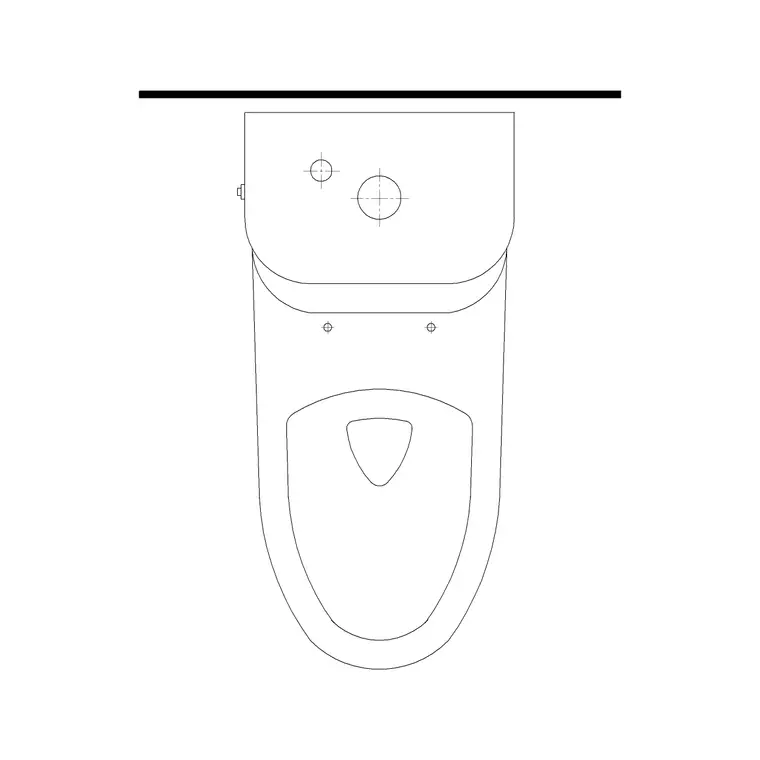
Drop the WC block against the soil-stack wall. A typical WC footprint is roughly 360–400 mm wide and 600–700 mm deep, and it needs about 600 mm of clear activity space in front for a person to use it. Draw that clear zone — even lightly — so you can see it is protected from the door swing and the other fixtures.
The WC is the anchor of a bathroom layout the way the sink anchors a kitchen. With it fixed against the drainage wall, the rest of the room arranges itself around it and the clear floor it demands. Centre a setting-out line on the pan; you will dimension to it later.
Step 3 — Add the basin within reach
Place the wash basin next, within easy reach of the WC but with its own clear space in front. A standard basin is 500–600 mm wide; a cloakroom basin can be as little as 400 mm; the rim usually sits around 800–850 mm above the floor, which matters in elevation rather than plan. Allow roughly 600 mm of clear floor in front of the basin so a person can stand and lean to use it.
Tuck the basin into a position where its waste can reach the same drainage zone as the WC with a sensible fall. Keeping wastes grouped is what keeps the under-floor pipework simple, and the scaled block lets you check the basin does not collide with the WC activity zone or the door.
Step 4 — Set the bath or shower on the longest wall
The bath or shower is the largest fixture, so it usually claims the longest wall. A classic bath is 1700 × 700 mm, with compact baths around 1500 × 700 mm; shower trays run from 800 × 800 mm up to 1200 × 800 mm. Place it along the wall where it fits cleanly and where its waste can again reach the drainage zone.
Check the access: you need clear floor alongside a bath to get in and out, and a clear approach to a shower door or opening. With all three or four fixtures down, step back and look at how the clear zones overlap — a little overlap of activity space is usually acceptable, but a fixture you cannot physically reach is not.
Step 5 — Check the door swing and circulation
Now stress-test the layout against the door. The door swing must not foul any fixture — a door that opens onto the WC or clips the basin is a common and serious plan error in a tight bathroom. If the inward swing clashes, consider swinging it outward, sliding it, or rehanging it on the other jamb. The scaled door arc makes the clash obvious the moment you draw it.
For an accessible WC the clearances grow considerably, with a 1500 mm turning circle and transfer space beside the pan, so draw that zone around the block and check the whole room can accommodate it. In a standard bathroom, just confirm a person can move between the fixtures without the door or another fitting in the way.
Step 6 — Dimension, layer and coordinate
Finish by setting out the fixtures for the installer. Snap a centreline to each WC, basin, bath and shower, and dimension from a finished wall to those centrelines — these setting-out dimensions are what the plumber and tiler actually work to. Split the porcelain, the setting-out dimensions and the tiling onto separate layers so each drawing in the set reads cleanly.
Because many fixtures ship plan and elevation views together, you can also produce the sanitary elevations for tiling from the same blocks — the basin, WC cistern, bath and shower drawn face-on at their real heights. Producing the layout, the setting-out and the elevations from one coordinated block library is what avoids the classic clash where fixtures, tiling and drainage were each drawn to slightly different positions.
Common bathroom layout mistakes
The first and worst mistake is ignoring the activity zones — cramming fixtures in until the room is full but there is no clear floor to actually use the WC or basin. Always draw and protect the roughly 600 mm space in front of each fixture. The second is a door that clashes: check the swing against every fixture and rehang or reswing it if needed.
The third is fighting the drainage — placing the WC away from the soil stack and creating an awkward, long drainage run. Let the stack lead, place the WC first, and group the other wastes toward the same zone. Get the services, the clearances and the door right, and even a very small bathroom resolves into a layout that builds and works.
Free download
Browse the full library — DWG & DXF, no signup.
Questions
Frequently asked
Where should the toilet go in a bathroom plan?+
Against the wall carrying the soil stack, because a long horizontal run of large-bore drainage is best avoided. Place the WC first; it anchors the layout, and it needs about 600 mm of clear activity space in front.
How much clearance does a bathroom fixture need?+
Allow roughly 600 mm of clear floor in front of each WC and basin so a person can use it. Baths and showers need clear access alongside. Accessible WCs need much more — a 1500 mm turning circle plus transfer space beside the pan.
What are standard bathroom fixture sizes?+
A WC is about 360–400 mm wide and 600–700 mm deep, a standard basin 500–600 mm wide, a classic bath 1700 × 700 mm (compact 1500 × 700 mm), and shower trays from 800 × 800 mm up to 1200 × 800 mm.
How do I stop the door clashing with fixtures?+
Draw the door swing arc and check it against every fixture. If an inward swing fouls the WC or basin, swing the door outward, fit a sliding door, or rehang it on the opposite jamb. The scaled arc shows the clash immediately.
Related downloads
Blocks for this guide
Related guides
How-to guide
How to Insert a Tree CAD Block in AutoCAD
Step-by-step guide to inserting a tree CAD block in AutoCAD — download the DWG, set units, use INSERT, scale and place it, then array trees across a site plan.
How-to guide
How to Create a Block in AutoCAD (BLOCK & WBLOCK)
Learn how to create a block in AutoCAD with the BLOCK and WBLOCK commands — pick a base point, choose objects, set units, and save a reusable DWG block library.
How-to guide
How to Array Trees Along a Path in AutoCAD
Use ARRAYPATH to line trees along a road, footpath or curve in AutoCAD — set spacing, align to the path, vary the look, and keep planting on its own layer.