How-to guide · how to download free cad blocks
How to download free CAD blocks, step by step
By Saumyajit Maity · Published 26 Jul 2022 · Updated 30 Apr 2026
Downloading a free CAD block sounds trivial until you end up with a file you can't open, a unit mismatch, or a licence you're not sure you're allowed to use commercially. This guide walks the whole thing end to end: choosing the right block, picking DWG over DXF (or the reverse), getting the file onto disk, confirming the licence, and dropping it into a drawing without surprises.
The site this guide lives on hands you blocks with no signup, no watermark and no attribution requirement, free for commercial work, so most of the friction other libraries add simply isn't here. What follows is the reliable routine experienced drafters use so a downloaded block lands correctly the first time, every time.
Step 1 — Find the right block before you download anything
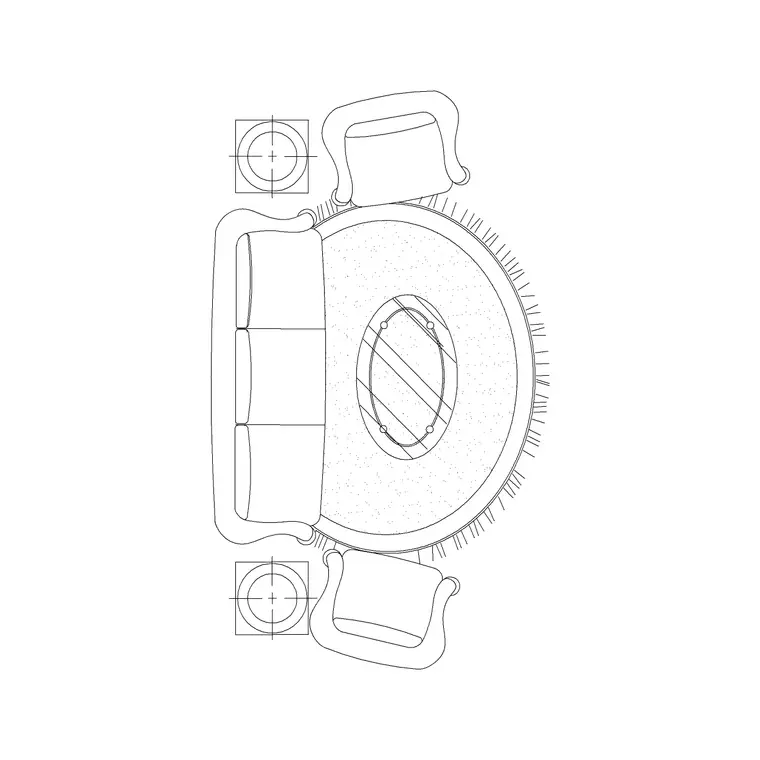
Resist the urge to grab the first matching result. A block is only a time-saver if it's the right view and roughly the right size, so decide two things first: which view you need (plan for layouts, elevation for face-on drawings, section for cuts) and what the block is actually for. A reception layout wants a plan-view sofa; an interior elevation wants the same sofa drawn face-on.
Browse by category rather than hunting one keyword. The furniture, office and other categories group blocks the way you actually use them, so you can compare a few candidates side by side. Check the preview image and the listed views before committing — it takes ten seconds and saves the annoyance of downloading a block that turns out to be the wrong projection.
Step 2 — Choose DWG or DXF
Almost every block here offers DWG, and many also offer DXF. For ordinary drafting in AutoCAD, AutoCAD LT, BricsCAD or DraftSight, take the DWG: it's compact, opens fastest, and keeps every layer and block definition intact.
Reach for DXF only when the geometry is leaving the CAD world — feeding a laser cutter or CNC router, importing an outline into Illustrator or Inkscape, or handing the file to a program that can't read DWG. When in doubt, DWG is the safe default for AutoCAD users. The download page shows the available formats as separate buttons, so you're never guessing which one you're getting.
Step 3 — Click download and find the file
Click the DWG (or DXF) button and the file saves to your browser's download location — usually a Downloads folder unless you've changed it. The file arrives as a single .dwg or .dxf, not a zip, so there's nothing to extract.
Don't leave it languishing in Downloads. The single biggest habit that pays off later is moving the file into a structured library folder right away — something like a CAD-Library folder with sub-folders by category. A block you can find again is a block you'll actually reuse; a block buried in a Downloads pile of three hundred files is one you'll re-download next month.
Step 4 — Confirm the licence before you use it commercially
This matters more than people assume. Plenty of 'free' block sites quietly require attribution, ban commercial use, or gate the real file behind an account. Always read the licence line on the page before you put a block into paid work.
The blocks on this site are explicitly free for personal and commercial projects, with no signup, no watermark and no credit required — so you can drop them straight into client drawings without a second thought. That clean licensing is the whole point: it means a student portfolio board and a multi-unit residential set can both use the same file with zero legal friction.
Step 5 — Insert it and check the scale
Open your drawing, type INSERT (or I), browse to the DWG you saved, and place it. The block comes in as a single block reference you can move, copy and rotate as one object.
Now check the scale. These blocks are drawn full size in millimetres. If your drawing is in millimetres, set INSUNITS to Millimeters and the block lands at true size automatically. If a block arrives microscopic or enormous, it's almost never a broken file — it's a units mismatch, and the fix is the UNITS dialog, not manual scaling. Set the insertion scale to match, re-insert, and the block snaps to its real dimensions.
Common download mistakes to avoid
A few recurring traps. First, downloading the wrong view — a plan block where you needed an elevation — because the preview wasn't checked; always read the listed views first. Second, dumping every download into one folder until the library is unusable; sort as you go. Third, ignoring the licence and discovering, after delivery, that a block needed attribution or barred commercial use — read the licence line every time.
A quieter mistake is downloading the same block repeatedly across projects instead of saving it once into a reusable library and pulling it from a tool palette thereafter. The first download is the cost; every reuse after that should be free in both money and effort, and that only happens if you file the block somewhere permanent the first time you grab it.
Free download
Browse the full library — DWG & DXF, no signup.
Questions
Frequently asked
Do I need to sign up to download these CAD blocks?+
No. Every block here downloads directly with no signup, no email wall and no watermark. Click the DWG or DXF button and the file saves straight to your computer, ready to insert into AutoCAD.
Can I use the downloaded blocks in paid client work?+
Yes. The blocks are free for both personal and commercial projects, with no attribution required. You can place them in client drawings, construction sets and portfolios without any licensing fee or credit line.
The block came in the wrong size — what happened?+
That's a units mismatch, not a corrupt file. The blocks are drawn in millimetres; type UNITS, set the insertion scale to Millimeters, and re-insert. Setting INSUNITS correctly makes AutoCAD rescale the block automatically on insertion.
Should I download DWG or DXF?+
Download DWG for normal drafting in AutoCAD, LT, BricsCAD or DraftSight — it's smaller and keeps everything intact. Download DXF only when the geometry is going to a laser cutter, CNC machine, or a non-CAD program like Illustrator.
Related downloads
Blocks for this guide
Related categories
Related guides
How-to guide
How to Edit a Block in AutoCAD (BEDIT)
Edit a block in AutoCAD with BEDIT — open the Block Editor, change the geometry, save, and update every inserted instance at once. Tips and pitfalls.
How-to guide
How to Explode a Block in AutoCAD (EXPLODE)
How to explode a block in AutoCAD with EXPLODE — break a block into editable lines, handle nested blocks, and use BURST to keep attributes.
How-to guide
How to Rename a Block in AutoCAD (RENAME)
How to rename a block in AutoCAD with RENAME — change a block's name without breaking its references, fix imported names, and apply a convention.