How-to guide · how to create a dynamic block in autocad
How to create a dynamic block in AutoCAD
By Saumyajit Maity · Published 27 Apr 2026 · Updated 29 May 2026
A dynamic block is a single block definition that can flex into many variants — a door that stretches to different widths and flips its hinge, a desk that switches between three sizes, a window that lengthens — all driven by grips you pull on the drawing. Instead of keeping twelve near-identical door blocks, you keep one smart one. This guide shows how to build that intelligence in the Block Editor using parameters and actions.
Dynamic blocks are the step beyond plain static blocks, so this assumes you already know how to define a block with BLOCK. We'll work through the Block Editor, the parameter-and-action pairing that drives every dynamic behaviour, and three of the most useful behaviours — stretch, flip and a lookup table of fixed sizes. Get comfortable with those and you can make almost any repetitive symbol adjustable from one definition.
Open the Block Editor
Every dynamic block is built inside the Block Editor. Start from an existing block: select it and type BEDIT (or double-click the block and confirm), or run BEDIT and pick a block name to open a fresh editing session. If you're starting from scratch, define the basic geometry as a normal block first, then open it in BEDIT to add the smart behaviour.
The editor opens with its own ribbon tab and a distinctive background, plus the Block Authoring Palettes docked at the side. Those palettes carry the two ingredient types you'll use constantly: Parameters and Actions. Everything dynamic is a parameter paired with an action, so getting familiar with that palette is the whole game.
Understand parameters and actions
The core concept is simple once it clicks: a parameter defines what can change and an action defines what happens when it does. A Linear parameter, for instance, defines a distance with grips at each end; on its own it does nothing. Pair it with a Stretch action and now pulling the grip stretches part of the geometry along that distance.
Think of the parameter as the question ('how wide?') and the action as the answer ('stretch this much geometry to match'). Almost every dynamic behaviour is one parameter wired to one action: Linear + Stretch for resizing, Flip + Flip for mirroring, Rotation + Rotate for spinning, a Visibility parameter for showing and hiding states. Build them one pair at a time and test each before adding the next.
Add a stretch behaviour (resize a door)
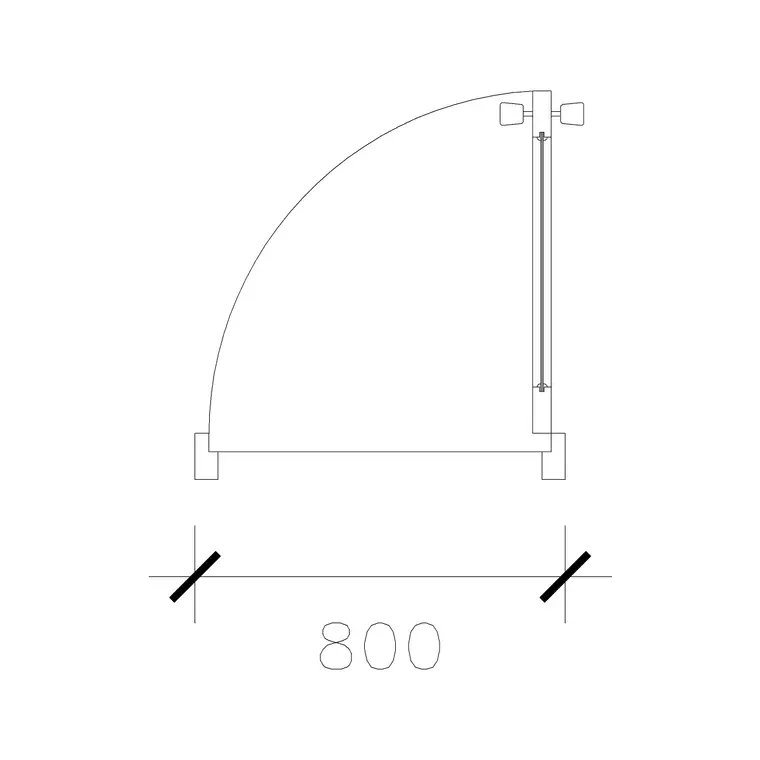
Take a door block you want to resize. In the Block Editor, drop a Linear parameter from the start of the opening to the end so it measures the door width, then add a Stretch action: select the parameter, choose the grip end that should move, draw a crossing window around the geometry that must travel with it (the leaf and the far jamb), and select those objects. Exit the editor and insert the block — now a grip lets you stretch the door to any width.
To constrain it to sensible sizes, edit the Linear parameter's properties and set a value set: a list (e.g. 700, 800, 900 mm) or an increment with a min and max. The grip then snaps only to allowed widths, so the block can't be dragged to a nonsensical 843 mm door. That single change turns a free-form stretch into a controlled, standards-aware size selector.
Add a flip behaviour (swap the hinge)
Doors and many asymmetric symbols need to mirror — a door that hinges left in one opening and right in the next. Add a Flip parameter: place its reflection line where the geometry should mirror about (down the centre of the door opening), then attach a Flip action and select the geometry to be mirrored.
Back in the drawing, the block now shows a flip grip — click it and the door swing reverses without you mirroring and re-inserting. Combine this with the stretch parameter from the previous step and a single door block now handles any width and either hand: two grips replace a folder of separate door blocks. This is the moment the value of dynamic blocks becomes obvious.
Offer fixed sizes with a lookup or visibility table
Sometimes you don't want free resizing — you want a few discrete presets. A desk that comes in 1200, 1400 and 1600 mm, say. Two tools handle this. A Lookup parameter with a Lookup action builds a table mapping a chosen size to the parameter values that produce it, surfacing a neat dropdown grip on the inserted block. A Visibility parameter goes further, letting you draw several distinct geometries in the same block and switch which one is shown.
Visibility states are powerful for blocks that aren't just scaled versions of each other — a fire symbol that switches between extinguisher types, a vehicle that toggles between car and van. You draw each variant, assign it to a visibility state, and the inserted block carries a dropdown to pick the state. Between stretch, flip, lookup and visibility you can express the overwhelming majority of real-world block variation from one definition.
Test, save, and avoid the common pitfalls
Always test before trusting a dynamic block. Inside the editor, use the 'Test Block' button to drive the grips without leaving; once it behaves, save the block definition and insert a real instance to confirm the grips, value sets and flips all work in a live drawing. Then WBLOCK it into your library so the smart version is the one you reuse.
Three pitfalls catch people out. First, an action selection set that misses an object — pull the grip and a stray line stays behind; re-edit the action and re-select. Second, forgetting a value set, leaving a stretch unconstrained so colleagues drag it to odd sizes. Third, overbuilding — a block with eight parameters nobody uses is harder to maintain than three separate static blocks. Add dynamic behaviour only where the variation is real and frequent, keep base points and naming consistent with the rest of your library, and the block stays a time-saver rather than a maintenance burden.
Free download
Browse the full library — DWG & DXF, no signup.
Questions
Frequently asked
What's the difference between a static and a dynamic block?+
A static block is fixed geometry, scaled and rotated as a whole on each insertion. A dynamic block carries parameters and actions, so one definition can stretch, flip, rotate or switch between sizes and states via grips — replacing many separate static blocks.
What are parameters and actions in a dynamic block?+
A parameter defines what can change (a Linear distance, a Flip line, a Rotation angle); an action defines what happens when it does (Stretch, Flip, Rotate). Almost every dynamic behaviour is one parameter paired with one action in the Block Editor.
How do I limit a dynamic block to standard sizes?+
Edit the parameter's value set. For a Linear parameter you can specify a list of allowed values (700, 800, 900 mm) or an increment with min and max, so the grip snaps only to valid sizes instead of stretching to arbitrary dimensions.
How do I test a dynamic block before using it?+
Use the 'Test Block' button inside the Block Editor to drive the grips without exiting. Once it behaves, save the definition and insert a real instance in a drawing to confirm the grips, value sets and flips work, then WBLOCK it to your library.
Related downloads
Blocks for this guide
Related categories
Related guides
How-to guide
How to Edit a Block in AutoCAD (BEDIT)
Edit a block in AutoCAD with BEDIT — open the Block Editor, change the geometry, save, and update every inserted instance at once. Tips and pitfalls.
How-to guide
How to Explode a Block in AutoCAD (EXPLODE)
How to explode a block in AutoCAD with EXPLODE — break a block into editable lines, handle nested blocks, and use BURST to keep attributes.
How-to guide
How to Rename a Block in AutoCAD (RENAME)
How to rename a block in AutoCAD with RENAME — change a block's name without breaking its references, fix imported names, and apply a convention.