How-to guide · how to convert dwg to jpg
How to convert a DWG to a JPG
By Saumyajit Maity · Published 2 May 2023 · Updated 8 May 2026
JPG is the everyday image format for sharing — small files, opens everywhere, ideal for emailing a CAD block, posting it online or dropping it into a document. Converting a DWG to JPG flattens the vector drawing into pixels with lossy compression, which keeps file sizes tiny but can soften the very thin lines that CAD drawings are made of. Knowing how to balance quality against size is what makes a usable JPG.
This guide covers the practical routes from a downloaded DWG block to a JPG: exporting from AutoCAD, using free viewers, and online converters. We will be honest about when JPG is the right choice and when PNG would serve the fine linework better, so you pick the format that matches how the image will be used.
JPG versus PNG for a CAD block
JPG and PNG both flatten a DWG to pixels, but they suit different jobs. JPG uses lossy compression that excels on photographs and gradients, producing small files that load fast and attach easily to email. PNG is lossless and handles sharp edges and transparency better, which matters for the thin, high-contrast lines in a CAD drawing.
The practical rule: choose JPG when the priority is a small, universally shareable file and the block will be viewed at a modest size. Choose PNG when you need crisp lines at large size or a transparent background. For most casual sharing of a furniture block, a good-quality JPG is perfectly fine.
Route 1 — Export a JPG from AutoCAD
AutoCAD's EXPORT command (Output > Export) lists JPEG as an output. Run it, choose JPG, and window the area around the block. AutoCAD asks for the image dimensions in pixels — set them generously so the lines stay sharp before compression. A white model-space background gives a clean white JPG, which is the usual choice since JPG cannot store transparency.
Freeze layers you do not want, and window tightly around the block so the export contains only the geometry you care about. Save, then open the JPG to check the line quality at the size you will actually use it.
Route 2 — Use a free DWG viewer
Without AutoCAD, a free DWG viewer can open the block and export it as a JPG. Desktop viewers usually offer a real image export with size and quality settings, which beats a screenshot because you control the output dimensions. Open the DWG, frame the block neatly, hide unwanted layers, and use the export-as-image function.
Choose JPG, set the resolution as high as the viewer allows, and pick the highest quality setting to minimise compression softening on the thin lines. This is the simplest free way to get a shareable image of a block when you only need it occasionally.
Route 3 — Free online DWG-to-JPG converters
Online converters turn a DWG into a JPG with no install: upload, choose JPG, download. They are convenient on the move, though you trade away control over framing and which layers render. For a quick image to drop into a chat or a document, that is usually acceptable.
If the converter offers a quality or resolution option, raise it — JPG quality settings make a real difference to how clean the lines look. If the result is soft or full of compression speckle around the geometry, that is a sign to either raise the quality or switch to PNG for that particular block.
Balancing quality and file size
JPG's quality slider is the lever that matters. At maximum quality the file is larger but the thin CAD lines stay crisp; at low quality you get a tiny file but visible blocky artefacts hugging every line. For a CAD block, lean toward higher quality, because the high-contrast linework shows compression damage more than a photograph would.
Resolution is the other half. Export at a comfortably larger pixel size than you will display, then let the viewer downscale, which hides minor compression. If the final JPG must be small for email, start from a high-quality large export and reduce it once, rather than exporting tiny and grainy from the start.
Common DWG-to-JPG issues
The classic problem is fuzzy lines surrounded by faint blocky halos — that is JPG compression at too low a quality setting biting the high-contrast geometry. Re-export at higher quality, or move to PNG if the block must stay razor-sharp. The second issue is an oversized frame full of empty space; window tightly around the block before exporting so it fills the image.
The third is the missing-transparency surprise: JPG cannot hold a transparent background, so a block always lands on a solid colour, normally white. If you need the block to float on a coloured page or a photo, JPG is the wrong format and PNG is the answer instead.
If you are preparing several blocks for the same document, keep the export settings consistent — same background, same quality, similar resolution — so the images sit together neatly rather than each looking slightly different. A consistent set of JPGs reads as a deliberate, professional sheet, whereas a mix of quality levels and frame sizes looks thrown together. It is a small discipline that lifts the whole document.
Free download
Browse the full library — DWG & DXF, no signup.
Questions
Frequently asked
How do I save a DWG as a JPG in AutoCAD?+
Use the EXPORT command (Output > Export), choose JPEG, then window the block. Set a generous pixel size for sharp lines. JPG lands on a solid background — usually white — since the format cannot store transparency.
Is JPG or PNG better for a CAD block image?+
PNG is better for crisp thin lines and transparency; JPG is better for small, easily shared files at modest sizes. For casual sharing of a block, a high-quality JPG is fine; for sharp large prints or transparent backgrounds, use PNG.
Why does my DWG-to-JPG image have blocky fuzz on the lines?+
That is JPG compression at too low a quality setting damaging the high-contrast CAD lines. Re-export at maximum quality and a higher resolution, or switch to PNG, which is lossless and keeps the linework clean.
Can I convert a DWG to JPG without AutoCAD?+
Yes. Free DWG viewers can open the block and export a JPG with quality and size settings, and free online converters output JPG directly from an uploaded DWG. No AutoCAD licence is needed for either route.
Related downloads
Blocks for this guide
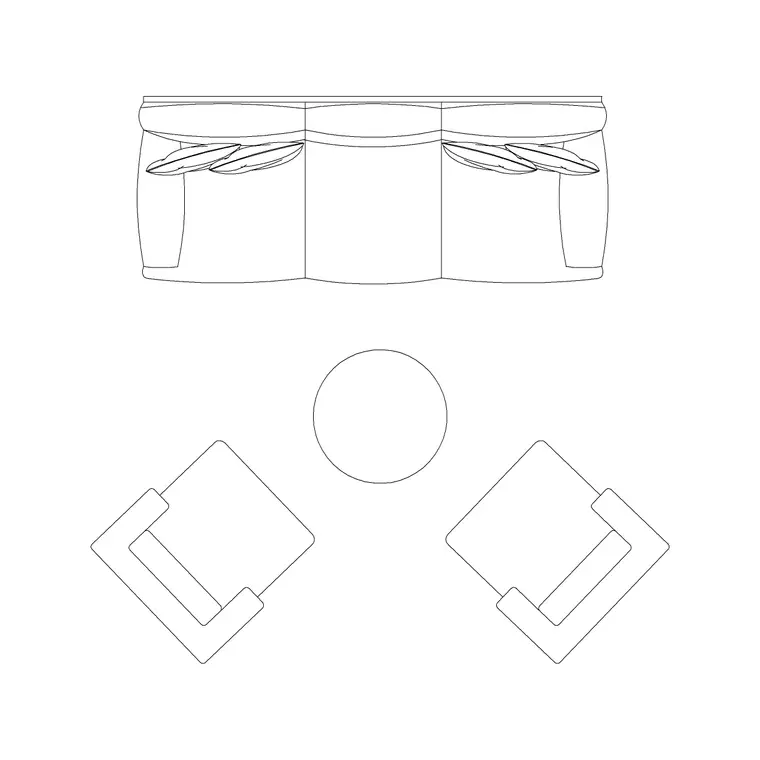
Popular blocks to download
Related categories
Related guides
How-to guide
How to Edit a Block in AutoCAD (BEDIT)
Edit a block in AutoCAD with BEDIT — open the Block Editor, change the geometry, save, and update every inserted instance at once. Tips and pitfalls.
How-to guide
How to Explode a Block in AutoCAD (EXPLODE)
How to explode a block in AutoCAD with EXPLODE — break a block into editable lines, handle nested blocks, and use BURST to keep attributes.
How-to guide
How to Rename a Block in AutoCAD (RENAME)
How to rename a block in AutoCAD with RENAME — change a block's name without breaking its references, fix imported names, and apply a convention.