Explainer · grip editing dynamic blocks
Grip editing dynamic blocks, explained
By Sumana Kumar · Published 21 Apr 2026 · Updated 16 May 2026
Grip editing is how you actually use a dynamic block once it is in your drawing. The coloured grips that appear when you click a dynamic block are not just selection handles — each one is a live control wired to a parameter, letting you stretch, move, rotate, flip or resize the block in place without exploding it or opening the Block Editor. Learning to read the grips turns a downloaded dynamic block into a tool you can shape with a drag.
This page explains the different grip shapes and what each does, how custom grips differ from the ordinary square node grips, the keyboard tricks that make grip editing precise, and the pitfalls that catch people out. It applies to any dynamic block — a resizable door, an adjustable table, a flippable fixture.
Custom grips versus standard grips
Select an ordinary object and you get square blue grips at its definition points — endpoints, midpoints, centres. Select a dynamic block and you get those, plus a set of custom grips drawn in a distinct colour (cyan by default) at the locations the block author defined. These custom grips are the dynamic part. Dragging one does not move a vertex; it changes a parameter, and the geometry responds through that parameter's action.
So the first habit is to recognise which grips are custom. They are the ones that make the block do its tricks. The plain square grips still let you move the whole block as usual, but the custom grips are the steering controls the author built in.
Reading grip shapes
Each grip shape signals a behaviour, so you can predict what a block will do before you touch it. A right-angle triangle (arrow) is a stretch grip — drag it to lengthen or shorten. A long thin arrow can indicate a linear or array stretch. A circular grip is a rotation grip — drag it to spin the block or the part it controls. A flip arrow (a lined-up double arrow) mirrors geometry when clicked. A lookup grip is a small down-arrow that opens a dropdown menu. A square custom grip is typically an XY or point move that shifts a part in two directions. An alignment grip lets the whole block snap its angle to nearby geometry.
Learning these shapes means you can look at an unfamiliar block and immediately see that it stretches here, rotates there and flips with that arrow — no documentation needed.
Stretching and resizing live
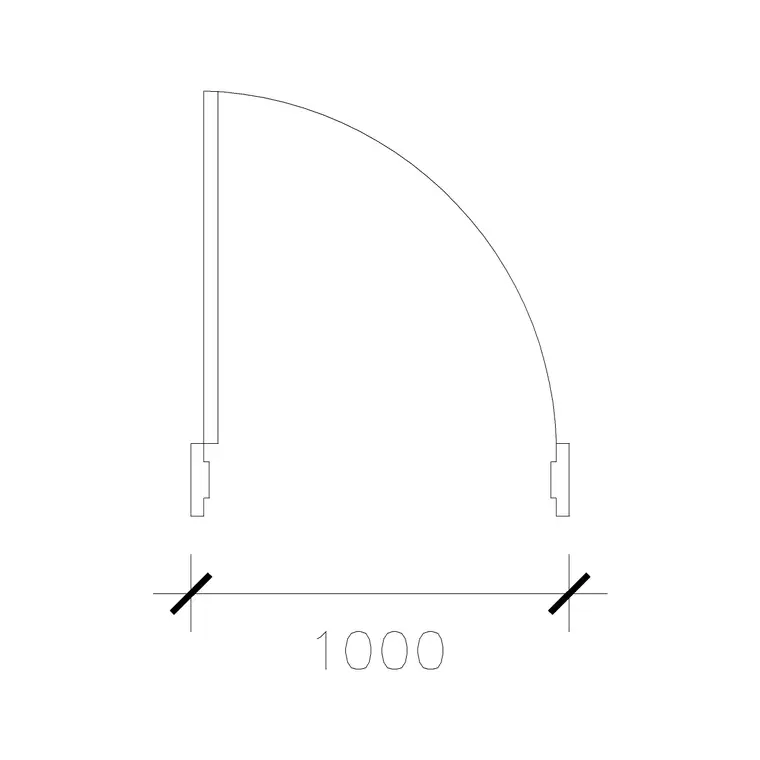
To resize a dynamic door, click it, hover the stretch arrow until it highlights, then drag. If the author attached a value set, the grip snaps to the allowed sizes — you feel it click into 900 then 1000. You can also click the grip and type a distance for an exact change, or watch the Properties palette where the parameter's value updates live as you drag.
The Properties palette is the precise counterpart to dragging. Under the Custom section it lists every parameter — Width, Height, Angle — and you can type an exact value instead of dragging. Many drafters drag for the rough size then fine-tune the number in Properties, getting both speed and precision.
Flipping, rotating and choosing
A flip grip is a single click, not a drag — click the flip arrow and the block mirrors about the flip line the author defined, turning a left-hand door into a right-hand one. Click again to flip back. A rotation grip is a drag: grab the circle and swing it, with polar tracking or a typed angle for accuracy, and the block (or the part the grip controls) rotates about its base.
Lookup grips open a menu. Click the small down-arrow and a list appears — door types, sizes, configurations — and picking one sets all the linked parameters at once. Visibility grips work the same way, listing the named states. These click-and-choose grips are how multi-option blocks expose their variants without any dragging at all.
Keyboard tricks that make grips precise
A few shortcuts transform grip editing. With a grip hot (clicked, glowing red), pressing Ctrl can cycle a flip or some multi-function grips through their options. Typing a value after clicking a stretch or rotation grip applies an exact change rather than an eyeballed drag. Holding the grip and watching the dynamic input tooltip lets you read the live value.
Object snaps still work while grip editing, so you can stretch a door's frame precisely to a wall endpoint. And if you change your mind mid-drag, Escape cancels the grip operation cleanly. These small habits are the difference between fighting a dynamic block and steering it confidently.
Pitfalls and how to avoid them
The most common mistake is exploding a dynamic block to edit it. Exploding destroys the dynamic behaviour and leaves you with dumb geometry — the grips are gone for good on that instance. Almost anything you want to change is available through the grips or the Properties palette, so explode only as a last resort.
Another trap is dragging a grip and getting an unexpected result because a value set is snapping you to the nearest allowed size — check the Properties palette to see the real value. And if a block seems to have no custom grips, confirm it is actually dynamic (the Properties palette shows a lightning-bolt block-type indicator); a plain static block only offers standard grips and must be edited in the Block Editor or by redefinition.
Free download
Browse the full library — DWG & DXF, no signup.
Questions
Frequently asked
What are the cyan grips on a dynamic block?+
They are custom grips wired to the block's parameters. Dragging or clicking them changes the block — stretching, rotating, flipping or resizing it — without exploding it or opening the Block Editor.
How do I resize a dynamic block to an exact size?+
Click the stretch grip and type the distance, or open the Properties palette and type the exact value into the parameter under the Custom section. If a value set is defined, the grip will snap to allowed sizes.
What does a triangular grip mean versus a circular one?+
A triangular arrow grip is a stretch control you drag to resize. A circular grip is a rotation control you drag to spin the block or the part it governs.
Should I explode a dynamic block to edit it?+
No. Exploding destroys the dynamic behaviour and removes the grips. Use the grips and the Properties palette for changes, and the Block Editor for authoring; explode only when you truly need plain geometry.
Related downloads
Blocks for this guide
Popular blocks to download
Related categories
Related guides
Explainer
Dynamic Blocks Explained — AutoCAD Guide in 2026
Dynamic blocks explained simply — what they are, how parameters, actions and grips let one AutoCAD block flex into many sizes, and when to use them over plain blocks.
Explainer
Static vs Dynamic Blocks in AutoCAD Compared
Static vs dynamic blocks in AutoCAD — the real difference, the pros and cons of each, when to choose which, and how to convert a static block into a dynamic one.
Explainer
What Are Block Attributes in AutoCAD?
What are block attributes in AutoCAD? Learn how attributes attach editable text and data to a block, how to define them with ATTDEF, and how to extract schedules.