Block landing · wall lamp cad block
Free wall lamp with shade CAD blocks for AutoCAD
By Sumana Kumar · Published 28 Oct 2024 · Updated 8 Jan 2026
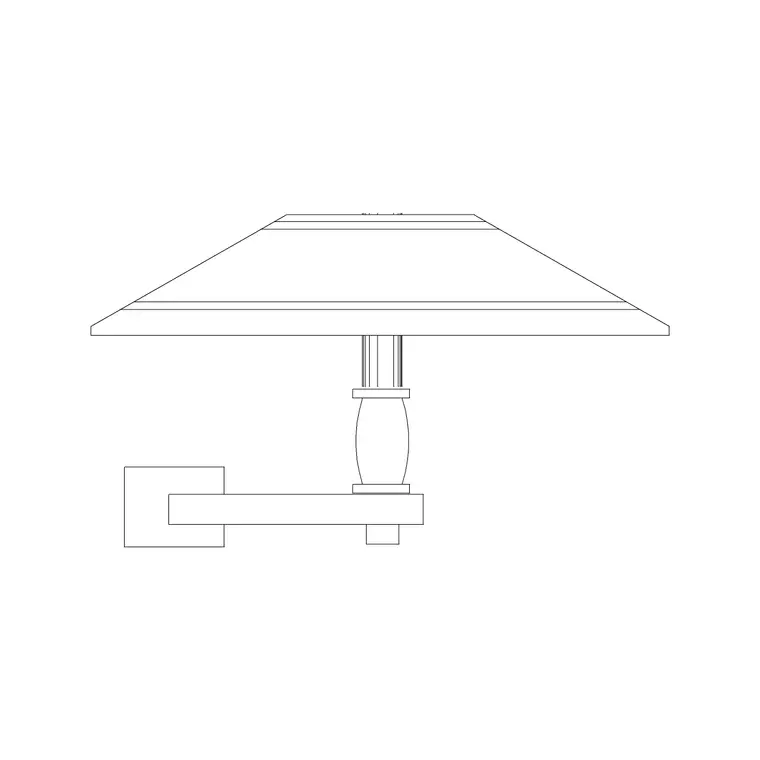
A wall lamp with a shade — a sconce — is the fitting that mounts to a wall rather than the ceiling, washing light up or down a vertical surface beside a bed, along a corridor or either side of a mirror. This page offers a free wall lamp CAD block in DWG and DXF, drawn at true millimetre size so its projection from the wall and its mounting height read accurately. It is free for personal and commercial work, with no signup and no watermark.
Wall lights live mostly on elevations and sections rather than the reflected ceiling plan, because the two dimensions that matter — how high they sit and how far they project — are vertical-surface decisions. Drop the scaled block onto an interior elevation and you can set the centreline height above the floor, check that the projecting shade clears a head walking past in a corridor, and space a symmetrical pair either side of a bed or a mirror, all from the geometry.
What a wall lamp with shade block is
A wall lamp with shade mounts on a back-plate fixed to the wall, with an arm or bracket carrying a shaded lamp that projects into the room. In a drawing it differs from ceiling fittings in two ways: it appears mainly on elevations (seen from the front) and sections (seen from the side, where the projection shows), and it carries a mounting height rather than a drop.
The block is a single clean reference — back-plate, arm and shade as one object you place, mirror and array along a wall. Because a sconce is usually placed as a symmetrical pair or an evenly-spaced run, the block is built to mirror cleanly so a matched pair either side of a bed, mirror or fireplace reads correctly.
Views and what's included
The elevation (front) view is the primary one: the sconce seen face-on against the wall, which you place on an interior elevation and set at its mounting height. The side-view or section shows the projection — how far the shade sticks out from the wall face — which is the dimension that governs clearance in a corridor or beside a door. A small plan symbol may also be included to mark the fitting's position on a layout where the wall lights need to appear on the floor plan.
Where multiple views ship together they sit in one DWG, so a single download covers the elevation, the section and the plan tag. Use the projection view whenever a sconce sits in a circulation route, because that is where a protruding shade becomes a clearance issue.
Typical sizing to design around
Treat these as typical ranges and confirm against the chosen fitting. A wall lamp with a shade commonly projects 100–250 mm from the wall face, and shade widths run roughly 150–350 mm. Mounting height depends on the use: a general corridor or living-room sconce is often centred around 1500–1700 mm above finished floor, a bedside wall light sits lower so it falls to hand by the bed, and a pair flanking a mirror is set to light the face rather than the top of the head.
The projection is the clearance number to watch: in a corridor, a sconce that sticks out more than about 100 mm at head height can be a hazard, so either keep the projection shallow or raise the fitting. Because the block is scaled, insert it on the elevation, dimension the centreline to the floor and the shade face to the wall, and these checks become visual.
How to insert and place the block
The block is drawn full size in millimetres; insert at scale 1 in a millimetre drawing, 0.001 in a metre template, or set INSUNITS to millimetres so AutoCAD rescales on insertion. For an elevation, run INSERT, snap the insertion point to the wall face at the back-plate, and move the fitting up to its mounting height — a quick way is to insert at floor level then MOVE it vertically by the mounting dimension.
To create a matched pair, insert one sconce, then MIRROR it about the centreline of the bed, mirror or window. For an even run along a corridor, ARRAY the block at the chosen spacing. Keep the fitting on the lighting layer so you can freeze it for a plain elevation and thaw it for the lighting elevation.
Where wall lamps with shades are used
Wall sconces appear beside beds and in bedroom schemes, down hotel and residential corridors, either side of bathroom and dressing mirrors, flanking fireplaces and artwork, and in stairwells where a ceiling fitting would be hard to reach. They provide layered, atmospheric light at eye level rather than the flat wash of a ceiling fitting, which is why interior designers reach for them constantly.
Use the wall lamp alongside the ceiling fittings in the lighting category so an elevation and its matching reflected ceiling plan tell a consistent story. On the services set, the wall-light position drives a switched wall outlet at the right height, so placing the scaled block accurately is what lets the electrical engineer set the back-box and the switch drop.
Layering, mirroring and scheduling
Keep wall lights on the lighting layer with their own colour and lineweight so they read clearly on a busy interior elevation and can be frozen for a plain wall view. Because sconces are so often symmetrical, build the habit of placing one and mirroring it rather than eyeballing a second — that guarantees the pair sits at an identical height and projection.
Tag each fitting with a luminaire-type attribute — a code such as WL-01 — so it appears in the lighting schedule alongside the ceiling fittings, and so the electrician can count the wall outlets the scheme needs. When the same sconce repeats down a corridor, array the block rather than copying by hand, so a substitution updates through the block definition. The mounting height note travels with the block, which keeps the elevation, the schedule and the back-box setting-out in step.
Free download
Browse the full library — DWG & DXF, no signup.
Questions
Frequently asked
At what height should a wall lamp with a shade be mounted?+
It depends on use — a general corridor or living-room sconce is often centred around 1500–1700 mm above finished floor, while a bedside light sits lower and a mirror pair is set to light the face. The block is to scale, so set the centreline on your elevation and dimension it.
Does the block show how far the sconce projects from the wall?+
Yes — the side-view or section shows the projection, typically around 100–250 mm, which is the clearance dimension to check where a sconce sits in a corridor or beside a door.
How do I make a symmetrical pair of wall lights?+
Insert one sconce, then use MIRROR about the centreline of the bed, mirror or window. The block mirrors cleanly, so the pair sits at an identical height and projection.
Is the wall lamp CAD block free for commercial use?+
Yes. It downloads free in DWG and DXF with no signup, no watermark and no attribution requirement, and it is cleared for commercial project use.
Related downloads
Blocks for this guide
Popular blocks to download
Related categories
Related guides
Block landing
Free Lighting Fixtures CAD Blocks — DWG Download
Download free lighting fixtures CAD blocks in DWG and DXF — chandeliers, wall lights, downlights and pendants in plan and elevation for AutoCAD.
Block landing
Free Table Lamp CAD Blocks — DWG Download
Download free table lamp CAD blocks in DWG and DXF — classical and decorative table lamps in plan and elevation for AutoCAD 2004+. No signup, commercial-use OK.
Block landing
Free Floor Lamp CAD Blocks — DWG Download
Download free floor lamp CAD blocks in DWG and DXF — straight and arc floor lamps in plan and elevation for AutoCAD 2004+. No signup, free for commercial use.