Block landing · table tennis table cad block
Free table tennis table CAD block in DWG and DXF
By Sumana Kumar · Published 21 Mar 2025 · Updated 11 Apr 2026
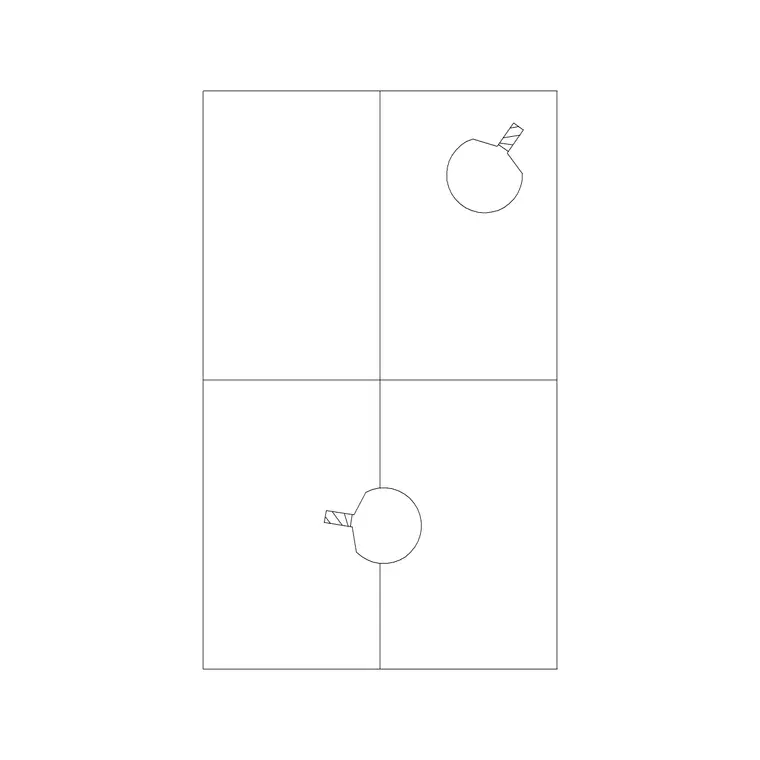
A table tennis table looks like a simple rectangle, but laying one out properly is all about the space around it: the run-back a player needs behind the baseline and the side clearance to move along the table. A scaled table tennis table CAD block lets you draw the table and that playing envelope together, which is what decides whether a games room or sports hall actually holds the number of tables a brief asks for. This page offers a free table tennis table block in DWG and DXF, drawn to true millimetre dimensions in plan and elevation, ready for AutoCAD 2004 or later — free for personal and commercial use, no signup, no watermark.
The table itself is a standardised size, which makes the block predictable, but the surrounding play area is where layouts go wrong. People place tables to the rectangle and then find players have nowhere to step back. Drawing the table with its recommended playing zone keeps a multi-table hall realistic from the first arrangement.
What's in the table tennis block
The plan view shows the full table outline divided by the centre line and net line, with the legs or folding frame indicated, and — where the block includes it — a dashed playing-area envelope around the table. That envelope is the useful part: a competitive playing area extends well beyond the table at both ends and along the sides, and it is what governs how close two tables can sit.
The elevation shows the table at its playing height with the net standing on top, and a folding-table block may also show the upright stored position, which is handy in a multi-use hall where tables are wheeled away for other activities. The table, the net and the playing-zone dashes sit on separate layers.
Standard table tennis dimensions
Table tennis has fixed regulation sizes you can design against. The table is 2740 mm long by 1525 mm wide (9 ft by 5 ft), standing 760 mm high. The net stands 152.5 mm above the playing surface and overhangs the sides slightly.
The space around the table is what drives the room. A recreational table wants a clear run-back behind each end and clearance along the sides; a competitive playing area is considerably larger — governing bodies specify a generous boxed zone per table. Use the regulation table size as your fixed rectangle and the recommended playing area as the spacing module, and a multi-table hall lays out correctly.
Plan for the room, elevation for presentation
Table tennis layouts are planned in plan: tables arrayed across a games room or sports hall with their playing zones lined up so they do not overlap. The plan block, with its playing-area envelope, is what you array to count how many tables a hall holds without players from adjacent tables colliding.
The elevation comes in for presentation drawings and for confirming clearance — a smash sends a player's bat and arm up, and on a low-ceilinged room or under a mezzanine you may want to check head height. For a hall that stores folding tables, the side view of the stored upright position helps you size the storage bay.
How to insert and lay out tables
The table is drawn full size in millimetres. Insert at scale 1 in a millimetre drawing, 0.001 in a metre drawing, or set INSUNITS to millimetres so AutoCAD converts on insertion. Run INSERT, snap the base point to the centre of the table, and rotate it to suit the room — usually with the long axis along the room so players run back towards the walls.
Use ARRAY to lay out a grid of tables, setting the spacing to the playing-area envelope rather than the table edge so each player has room to move. Keep the tables on a sports-equipment layer so a games-room layout and a clear-hall layout come from the same drawing.
Where table tennis blocks are used
Table tennis table blocks appear in sports-hall and leisure-centre drawings, school and university games rooms, youth and community centres, office breakout and games rooms, and residential games rooms and garages. Architects and facility designers use them to confirm how many tables a hall holds with proper playing space; office and interior designers use them to size a recreation room.
Because the playing area is generous, the block is a quick reality check on a brief that asks for 'six tables' in a room that may only hold four with safe spacing. Pair it with the basketball hoop and wider fitness and sports blocks to fit out a multi-use sports hall or recreation space.
Storage, multi-use halls and folding tables
Most halls that hold table tennis do other things too, so the tables rarely stay out all the time. Modern competition tables fold and roll on castors, which means the layout has to account for two states: deployed for play and folded for storage. Drawing the folded footprint — much narrower, standing upright on its trolley base — lets you size a storage bay or a cupboard that actually swallows the tables when the hall switches to badminton, an exam or an assembly.
The move from stored to deployed also needs a route. A folded table on castors has to be wheeled out of its store, down the hall and unfolded with clearance all around, so a sensible layout keeps the store near the playing zone and the doors wide enough for the trolley. Showing both the stored and the deployed positions on their own layers turns one drawing into proof that the hall works in every mode the brief demands, not just on tournament day.
Free download
Browse the full library — DWG & DXF, no signup.
Questions
Frequently asked
Is the table drawn at the regulation size?+
Yes. The table is drawn 2740 mm long by 1525 mm wide and 760 mm high — the standard regulation size — with the net at 152.5 mm. The playing-area envelope around it follows the recommended clear-space figures.
Does the block show the playing area around the table?+
The plan block includes a dashed playing-area envelope on its own layer. That zone, not the table edge, is what governs table spacing, so you can freeze it for a tidy plan and show it to prove a hall holds the tables safely.
What scale is the table tennis table drawn at?+
Full size in millimetres. Insert at scale 1 in a millimetre drawing, 0.001 in a metre drawing, or set INSUNITS to millimetres so AutoCAD rescales automatically on insertion.
Is the table tennis block free for commercial use?+
Yes. It downloads free in DWG and DXF with no signup, no watermark and no attribution, and it is cleared for commercial project use.
Related downloads
Blocks for this guide
Related categories
Related guides
Block landing
Free Gym Equipment CAD Blocks — DWG Download
Download free gym equipment CAD blocks in DWG and DXF — treadmills, weight machines, racks and benches in plan and elevation, AutoCAD 2004+, no signup.
Block landing
Free Treadmill CAD Block — DWG & DXF Download
Download a free treadmill CAD block in DWG and DXF — drawn in plan and elevation with the run-off zone, true to size for AutoCAD gym layouts. No signup.
Block landing
Free Exercise Bike CAD Block — DWG Download
Download a free exercise bike CAD block in DWG and DXF — upright, spin and recumbent bikes in plan and elevation, true to size for gym layouts. No signup.