Block landing · suv cad block
Free SUV CAD blocks for AutoCAD
By Saumyajit Maity · Published 26 Aug 2025 · Updated 22 May 2026
The SUV is the car that has quietly redrawn parking standards, and a scaled SUV block is how you keep a layout honest about the vehicles people actually drive now. Taller, wider and longer than a traditional saloon, the sport-utility vehicle and its crossover cousins are the realistic test case for bay width, headroom in a parking deck and sight lines in a street. This page collects free SUV CAD blocks in DWG and DXF, in both plan and elevation, drawn at true millimetre dimensions for AutoCAD 2004 and later. Every file is free for personal and commercial work, with no signup, no watermark and no attribution required.
Designing a car park or a driveway against an SUV rather than a 1990s saloon changes the numbers in ways that matter: wider bays, more door-swing clearance, and a height that interacts with deck soffits and barrier heights. Use these blocks to size parking for modern traffic, to populate suburban site plans where SUVs dominate, and to add a tall, contemporary vehicle to a streetscape or showroom drawing.
What an SUV block represents
An SUV block represents the tall, upright family of vehicles: compact crossovers, mid-size SUVs and full-size 4x4s. In plan the footprint is longer and noticeably wider than a saloon, with a more rectangular body. In elevation the defining feature is height — a tall glasshouse, a high roof line and large-diameter wheels — which is what distinguishes it instantly from a low sedan or coupe.
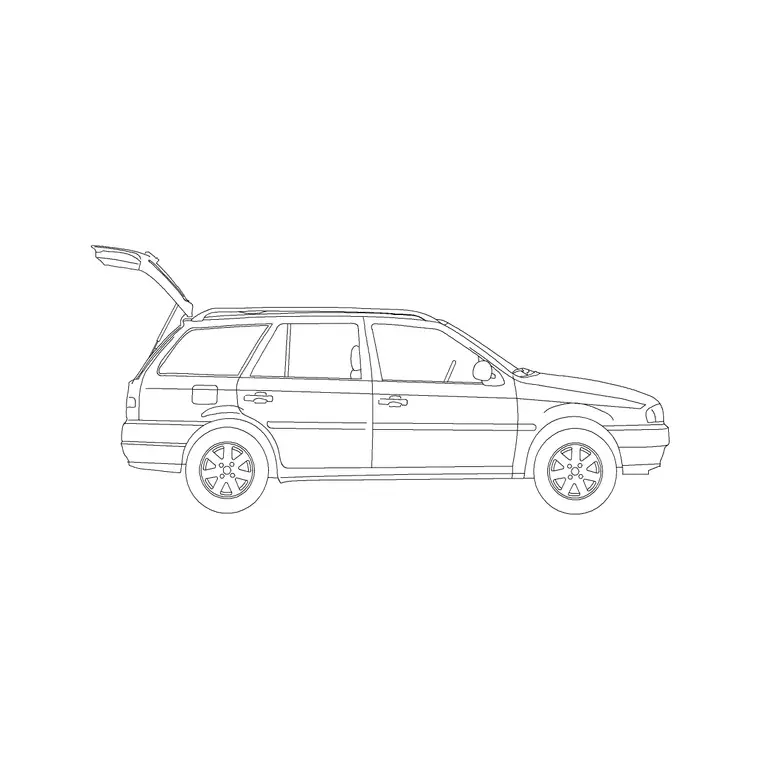
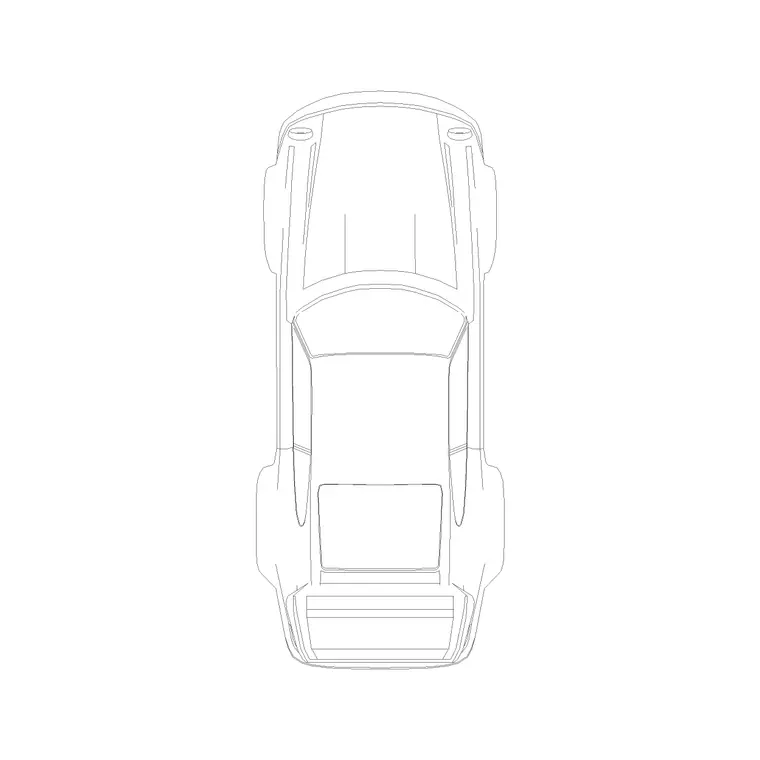
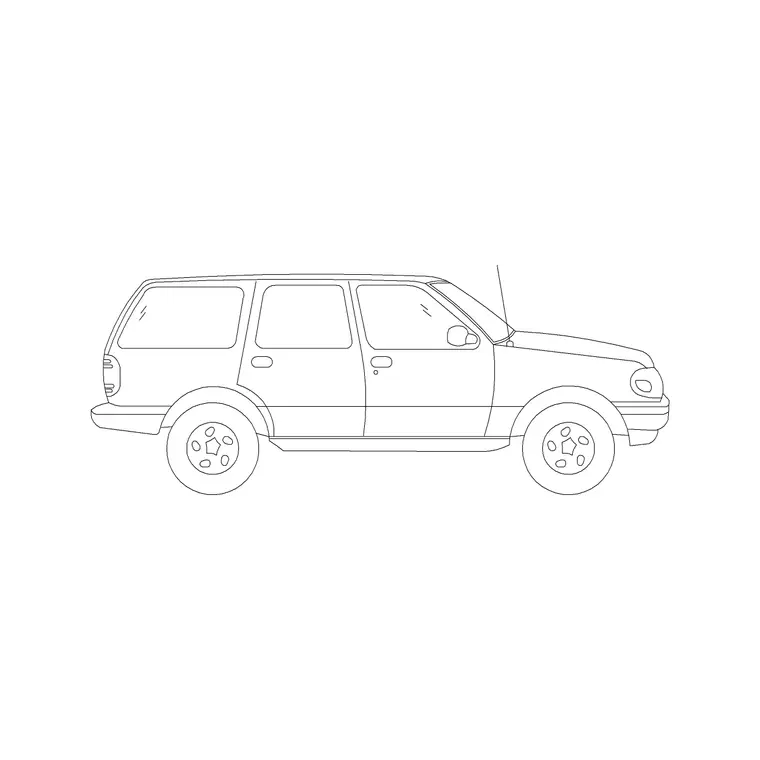
The blocks here span the range, and include both plan-view footprints for parking work and side elevations for streetscapes. Each is a clean block reference with the body, wheels and glasshouse on separable layers, so the SUV can serve as scaled context or as the subject of a 4x4 or off-road presentation.
SUV dimensions to design around
Design against the larger ranges. A compact crossover runs roughly 4300–4500 mm long and 1800–1850 mm wide; a mid-size SUV around 4600–4900 mm long and 1850–1950 mm wide; a full-size SUV past 5000 mm long and 2000 mm wide, before mirrors. Roof height is the headline figure: typically 1650–1800 mm, well above a saloon's 1450 mm.
That width and height drive real decisions. The wider body eats into a standard 2400–2500 mm bay, which is part of why some standards have grown bay widths. The roof height interacts with parking-deck headroom and barrier design. Drop the scaled SUV block in and the squeeze on a narrow bay, the door-swing clash with a neighbour and the headroom under a low soffit all become visible checks.
Why sizing against an SUV matters
There is a real risk in designing parking against an old, small standard car: the bays look fine on paper and fail in use. The modern vehicle mix is heavier in SUVs and crossovers, so testing a layout against an SUV block gives a result that holds up when the car park fills with real traffic. The wider body shows whether two cars can open doors between bays; the longer footprint shows the overhang past a wheel stop; the height flags any conflict with a deck soffit or a height barrier.
For suburban and out-of-town schemes especially, the SUV is arguably the more representative test vehicle than the saloon. Designing to it, and using the saloon or compact only for specific small-bay areas, produces a car park that works for the cars that actually arrive.
Inserting plan and elevation
SUV blocks are drawn full size in millimetres. Insert at scale 1 in a millimetre drawing, 0.001 in a metre drawing, or set INSUNITS to millimetres so AutoCAD rescales on insertion if your template differs.
For the plan, place the insertion point at the car centre and ARRAY the footprint across bays — note the wider body needs the bay width checked, not assumed. For the elevation, snap the insertion point to the kerb or ground line so the tall body sits correctly against the architecture. Keep both views on a dedicated vehicle layer so you can freeze the cars for a clean engineering plan and thaw them for a presentation.
Where SUV blocks are used
SUVs suit contemporary and suburban work. Parking layouts and capacity studies that need to reflect modern traffic. Suburban and out-of-town residential site plans where SUVs and crossovers dominate the driveway. Dealership and showroom plans for the 4x4 and crossover range. Streetscapes and building elevations that want a tall, current vehicle at the kerb rather than a dated saloon.
They are also the right block for drive-throughs, school drop-offs and family-oriented retail where the SUV is the typical visitor vehicle. Mix them with sedans, compacts and the occasional van from the vehicles category to show a realistic spread, with the SUV setting the upper bound on bay and headroom requirements.
SUV versus jeep, MPV and sedan
The SUV sits among several tall-vehicle blocks, and the distinctions guide your choice. A jeep or rugged off-roader is typically shorter and more squared-off, suited to an adventure or rural scene. An MPV or minivan is taller and boxier still, optimised for interior volume and people-carrying, and is the bigger test of bay length. A sedan is the low, formal contrast — the block to use when you specifically want a traditional, lower car.
For a general modern parking standard the SUV is the sensible upper-bound passenger vehicle, with the MPV and van reserved for layouts that must accommodate larger family and goods vehicles. All of these live in the vehicles category, so you can build a mixed, realistic fleet for any car park or street scene.
Free download
Browse the full library — DWG & DXF, no signup.
Questions
Frequently asked
Why should I size parking against an SUV rather than a saloon?+
Because the modern vehicle mix is heavier in SUVs and crossovers. Their wider, longer and taller bodies test bay width, door-swing clearance and deck headroom more honestly than an older, smaller standard car.
How tall is an SUV block in elevation?+
Typically 1650–1800 mm at the roof, well above a saloon's 1450 mm. That height is what interacts with parking-deck soffits and height barriers, so check it in any covered layout.
Do the SUV blocks come in plan and elevation?+
Yes. The set includes plan-view footprints for parking and site work and side elevations for streetscapes and showrooms. Use the plan to test fit and the elevation for presentation.
Are the SUV CAD blocks free for commercial use?+
Yes. Every SUV block downloads free in DWG and, where available, DXF, with no signup, no watermark and no attribution requirement, and they are cleared for commercial project use.
Related downloads
Blocks for this guide
Related categories
Related guides
Block landing
Free Car Plan View CAD Block — DWG Download
Download a free car plan-view CAD block in DWG and DXF — the top-down footprint for parking layouts and site plans. AutoCAD 2004+, no signup.
Block landing
Free Car Elevation CAD Block — DWG Download
Download a free car elevation CAD block in DWG and DXF — side and front views for streetscapes, showrooms and presentations. AutoCAD 2004+, no signup.
Block landing
Free Sedan Car CAD Blocks — DWG Download
Download free sedan car CAD blocks in DWG and DXF — saloon and luxury sedans in plan and elevation for parking and showrooms. AutoCAD 2004+, no signup.