Block landing · suit cad block
Free suit CAD block in DWG and DXF
By Sumana Kumar · Published 3 Sep 2025 · Updated 19 May 2026
A suit is a specific, recognisable thing to draw, and a generic garment block does not quite sell it. The lapels, the jacket break, the two-piece silhouette of jacket and trousers — those are what make a tailor's elevation or a menswear shopfit read as a suit rather than just "some clothing". This page offers a free suit CAD block in DWG and DXF: a men's suit drawn in clean elevation, ready for AutoCAD 2004 or later, free for personal and commercial use with no signup and no watermark.
The block is built for the drawings where formalwear actually appears — tailoring and bespoke-suiting shopfits, menswear retail elevations, hotel and concierge wardrobe details, and interior presentation sheets where a dressing area needs a touch of styling. Because it is a true block reference rather than a flat image, you can mirror it, scale it, recolour it onto a styling layer and array it along a rail without losing the crisp lapel and shoulder line that make it read as tailoring.
What the suit block depicts
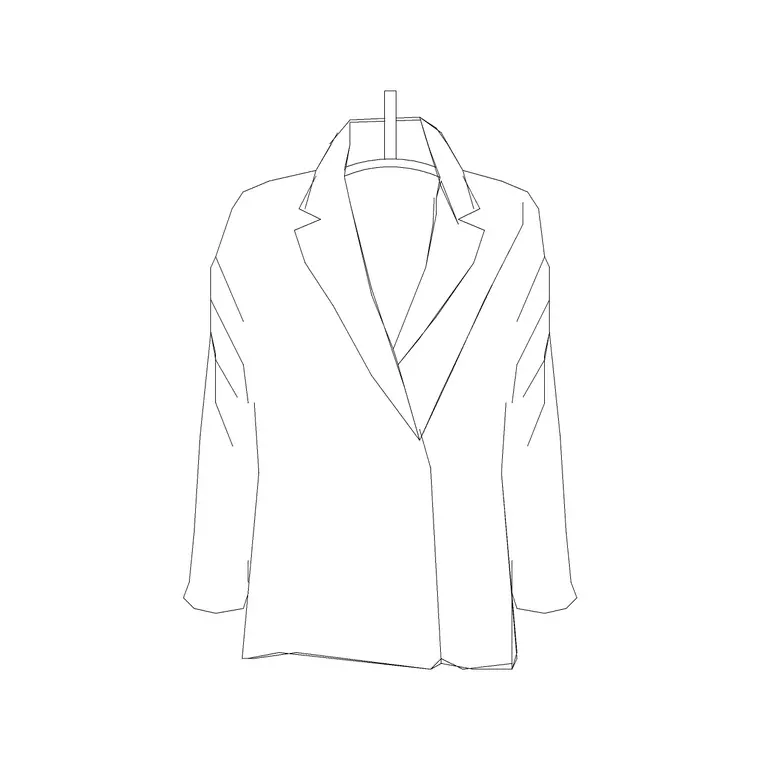
The suit block is an elevation drawing of a tailored two-piece: a jacket with a notch or peak lapel, a buttoned front and structured shoulders, shown either on a hanger or as a styled garment. Many versions pair the jacket above with trousers — folded over the hanger bar or hung full-length — so the block reads unmistakably as a suit rather than a single coat.
The internal linework is tuned for clarity: a collar and lapel break, a centre-front button line, a pocket suggestion, and a few drape lines so the fabric reads as soft rather than rigid. That is enough detail to look like tailoring at presentation scale while staying clean when the elevation prints at 1:50 or 1:25. As a single block reference it copies, mirrors and rotates as one object.
Built for elevation, not plan
A suit, like any hung garment, is an elevation symbol. You use it when you draw a menswear shopfit elevation, a bespoke tailor's fitting-room interior, or a wardrobe joinery sheet where a formal section of the rail needs to be shown occupied. In plan the suit is just the thin slice of a garment on a rail, so the symbol does its job face-on.
If you are laying out the floor of a tailoring shop in plan, draw the rails and gondolas as plan geometry and reserve the suit block for the matching elevations and the section drawings. That keeps each sheet legible: a plan that reads as circulation and fixtures, and elevations that show what hangs on them.
Suit sizing to draw against
Use these ranges to keep a tailoring elevation believable. On the hanger, a men's jacket spans roughly 450–520 mm across the shoulders and falls about 750–800 mm from the shoulder seam to the jacket hem. Hung trousers add another 1000–1100 mm if shown full-length, or fold to around half that over a trouser bar.
For the rail itself, a suit hangs comfortably from a rod set around 1700–1900 mm above finished floor when shown jacket-and-trousers full length, leaving the garment clear of the floor. Allow roughly 60–80 mm of rail length per suit on a packed retail rail, more on a styled display rail. Because the block is drawn to these real proportions, you can check at a glance that a jacket clears the shelf above and the trousers clear the floor below.
Inserting and scaling the block
The suit is drawn full size in millimetres. In a millimetre drawing insert at scale 1; in a metre drawing at 0.001; or set INSUNITS to millimetres and let AutoCAD rescale on insertion. Run INSERT or drag the DWG in from a tool palette, snap the insertion point to your rail line, and the suit hangs at the correct height.
To dress a full menswear rail, place one suit and ARRAY it along the rod, then mirror a couple and nudge the spacing so the row does not look mechanically repeated. If you want a slimmer or fuller cut for a particular display, a small non-uniform scale on the X axis adjusts the silhouette — but keep it subtle so the tailoring still reads true. Park the block on a styling layer so it can be frozen for the joiner's drawing and thawed for the client view.
Where the suit block is used
Bespoke tailors and menswear retailers use it to populate shopfit elevations and fitting-room interiors so the drawing reads as a suiting environment. Interior designers add it to dressing rooms, walk-in wardrobes and hotel suites where a formal garment styles the space. Architects use it for context on bedroom and cloakroom elevations, and on hospitality drawings where a concierge or valet area handles guests' jackets.
It sits alongside the other accessories blocks — hanging coats, dresses and handbags — so you can mix formal and casual garments on one styled rail. For a complete menswear vignette, pair it with furniture blocks for the seating and mirror, and a people block for scale and life.
Layering and reuse tips
Keep the suit on a styling or merchandising layer, distinct from the joinery and the rails, with a lighter lineweight so it reads as soft content behind the construction lines. That single habit lets you issue a clean cabinetmaker's elevation (suit frozen off) and a dressed presentation elevation (suit thawed on) from exactly the same drawing.
When you build a styled rail you are happy with — a run of suits, jackets and shirts at a pleasing rhythm — WBLOCK the lot as one reusable assembly. Dropping a pre-styled formalwear rail into the next menswear project then takes a single insert, and a later tweak to the source assembly updates every place you have used it.
Free download
Browse the full library — DWG & DXF, no signup.
Questions
Frequently asked
Is the suit CAD block free for commercial projects?+
Yes. The suit block downloads free in DWG and, where available, DXF, with no signup, no watermark and no attribution requirement. It is cleared for use on commercial tailoring, retail and interior drawings.
Is the suit drawn in plan or elevation?+
Elevation. A suit is shown face-on as it hangs, which is the view used for menswear shopfits, tailor's fitting rooms and wardrobe joinery sheets. In plan a hung suit reads as nothing more than a thin garment slice on the rail line.
What height should the suit rail be drawn at?+
For a jacket-and-trousers suit shown full length, a rail around 1700–1900 mm above finished floor keeps the garment clear of the floor. The block is drawn to true proportions so it sits correctly against your rail line.
Can I change the suit's cut or colour in the block?+
Yes. A subtle non-uniform X scale slims or widens the silhouette, and because it is a block reference you can recolour it onto a styling layer. Keep edits light so the lapel and shoulder lines still read as tailoring.
Related downloads
Blocks for this guide
Related categories
Related guides
Block landing
Free Picture Frame CAD Blocks — DWG Download
Download free picture frame CAD blocks in DWG and DXF — framed photos drawn in elevation for AutoCAD interior drawings. No signup, commercial use OK.
Block landing
Free Wall Art & Painting CAD Blocks — DWG
Download free wall art and painting CAD blocks in DWG and DXF — abstract art and canvases for AutoCAD interior elevations. No signup, commercial OK.
Block landing
Free Decorative Vase CAD Blocks — DWG Download
Download free decorative vase CAD blocks in DWG and DXF — designer vases and vases with flowers in plan and elevation for AutoCAD. No signup, commercial OK.