Block landing · small ornamental tree cad block
Free small ornamental tree CAD blocks
By Saumyajit Maity · Published 10 Nov 2022 · Updated 15 Jun 2026
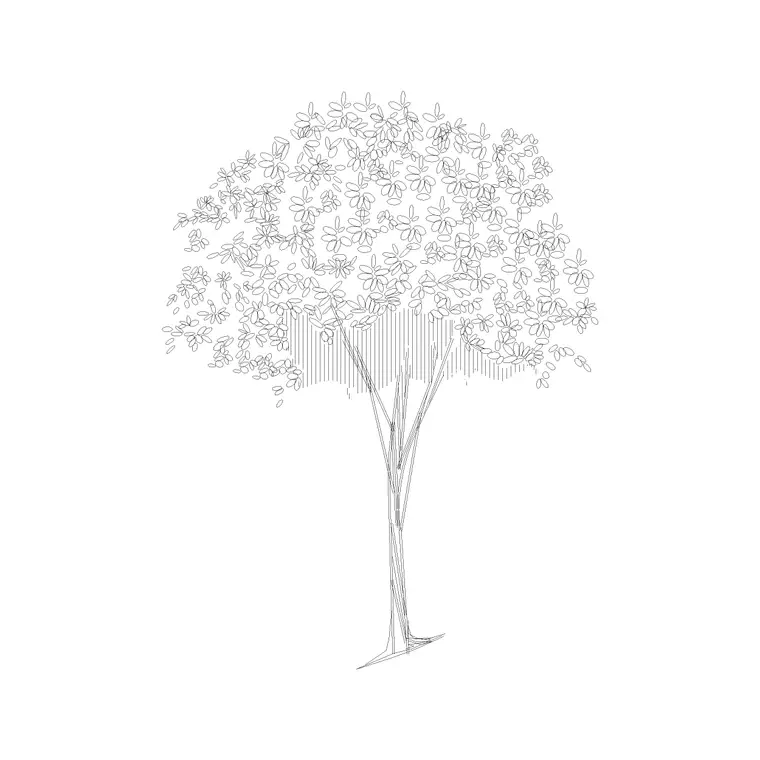
A small ornamental tree is the detail tree — the compact, often decorative specimen you place near a doorway, in a courtyard, beside a path or in a planter where a full-size tree would never fit. In elevation it is a modest trunk and a neat, sometimes shapely crown; in plan it is a small canopy circle that adds a point of interest rather than reserving a large footprint. This page collects free small ornamental tree CAD blocks in DWG and DXF, drawn to scale and ready for AutoCAD 2004 or later, free for personal and commercial use with no signup or watermark.
Ornamental trees are chosen as much for their character as their size — blossom, coloured foliage, a sculptural shape — and they tend to sit where people get close to them: entrances, terraces, small gardens and tight urban spaces. On a drawing they are the finishing touch that turns a layout from merely planted into designed.
What makes a tree ornamental
An ornamental tree is defined by its decorative role rather than a strict size. It is usually small and slow-growing, chosen for a feature quality — spring blossom, autumn colour, an unusual weeping or upright shape, attractive bark — and placed deliberately where it will be seen up close. Japanese maples, ornamental cherries, magnolias, crab apples and small acers are typical.
On a drawing, an ornamental tree is a detail element. It does not reserve a large canopy footprint or define a space the way a big tree does; instead it punctuates a composition — marking an entrance, anchoring a courtyard corner, or giving a small garden a focal point. The blocks here are drawn compact and shapely so they read as a chosen feature rather than generic filler.
Small ornamental dimensions to design around
Use these reference figures: a small ornamental tree typically stands 4–8 m tall with a 2–4 m crown spread at maturity, and many stay at the lower end of that range. Weeping and dwarf forms can be smaller still, while a few ornamentals are wider than they are tall. They are the smallest trees you will draw before the category shades into large shrubs.
That modest size is the whole point. An ornamental fits where a medium or large tree cannot — in a planter, a narrow bed, a small courtyard or right beside a building — without overhanging a roof, blocking a window or outgrowing its spot. Size the plan circle to the tight 2–4 m spread and the tree sits comfortably in the small, close-to-people spaces it is meant for.
Inserting and placing ornamental trees
Ornamental tree blocks are drawn full size in millimetres. Set INSUNITS to millimetres (or insert at 0.001 in a metre drawing) so the small canopy lands at the right diameter. For elevations, snap the trunk base to your ground line; for plans, snap the insertion to the trunk at the canopy centre.
Unlike big trees, ornamentals are usually placed individually and deliberately rather than arrayed in long rows — one at each side of an entrance, a single specimen in a courtyard, a small cluster in a feature bed. Position each one where it will be seen and appreciated up close, and vary the few you do group so they read as a designed planting rather than repeated symbols.
Ornamental trees as focal points
The strength of an ornamental tree on a drawing is that it directs the eye. A single specimen at the end of a path, framing a doorway, or set in a courtyard becomes a focal point that organises the space around it. Designers use them to mark thresholds, soften a hard corner, or give a small garden a centrepiece that a shrub could not provide.
Because they are seen close up, the symbol can carry more character than a background tree — a distinct shape or a richer canopy that hints at blossom or coloured foliage. Place ornamentals where people pause and look: by seats, at entrances, beside windows. Drawn at their true compact size, they show clearly that the design has thought about the human scale and the close view, not just the masterplan.
Where small ornamental tree blocks are used
Ornamental trees appear in domestic gardens, courtyards and atria, entrance and forecourt planting, roof gardens and balconies, planters and raised beds, and any space that is small, close to people, and wants a touch of designed character. They are common on residential, hospitality and commercial-entrance drawings where the planting near the building matters most.
Keep them on the planting layer, and pair these blocks with the medium tree, shrub and potted plant blocks in the trees-and-plants category. A typical detailed planting plan uses ornamentals as the feature trees near buildings and paths, shrubs to fill the beds, and medium or large trees beyond — and the ornamental is the tier that gives the close-up view its quality.
Pairing ornamentals with shrubs and planters
Ornamental trees rarely stand alone in a designed space; they usually sit within a composition of underplanting. A small feature tree rising from a bed of shrubs and groundcover reads as a layered, intentional planting, and the ornamental gives that bed a vertical accent the low planting lacks. On a drawing, place the ornamental first as the focal point, then arrange shrubs and groundcover around its base.
In hard landscape, ornamentals often appear in planters and raised beds where there is no open ground — a courtyard, a roof terrace, a paved forecourt. Pairing a small tree block with a planter or pot block shows exactly that arrangement, and because everything here is licence-clear you can build a complete close-up planting detail — feature tree, underplanting and container — from one free library.
Free download
Browse the full library — DWG & DXF, no signup.
Questions
Frequently asked
What size is a small ornamental tree on a drawing?+
A small ornamental tree is typically 4–8 m tall with a 2–4 m crown spread at maturity, with weeping and dwarf forms smaller still. Size the plan circle to that tight spread so it fits the small spaces it is meant for.
Are the small ornamental tree blocks free for commercial use?+
Yes. Every ornamental-tree block downloads free in DWG and, where available, DXF, with no signup, no watermark and no attribution requirement, and is cleared for commercial project use.
When should I use an ornamental tree instead of a larger one?+
Use an ornamental where the space is small or close to people — entrances, courtyards, planters, small gardens — and where you want a decorative focal point rather than a large shade canopy.
Do the ornamental tree blocks include both plan and elevation views?+
Many do. They ship with an elevation for sections and a small canopy circle in plan for site plans, in the same DWG where both views are included.
Related downloads
Blocks for this guide

Popular blocks to download
Related categories
Related guides
Block landing
Free Flower Plant CAD Blocks — DWG Download
Free flower plant CAD blocks in DWG and DXF — flowering annuals and perennials in plan and elevation for AutoCAD landscape plans. No signup, commercial OK.
Block landing
Free Flowering Shrub CAD Blocks — DWG Download
Free flowering shrub CAD blocks in DWG and DXF — ornamental shrubs in plan and elevation for AutoCAD planting and site plans. No signup, commercial OK.
Block landing
Free Herb Plant CAD Blocks — DWG Download
Free herb plant CAD blocks in DWG and DXF — herbs for kitchen gardens, raised beds and planters, in plan and elevation for AutoCAD. No signup, commercial OK.