Curated pack · scale figure cad blocks
Free scale figure entourage CAD blocks for AutoCAD
By Saumyajit Maity · Published 2 Feb 2024 · Updated 20 Feb 2026
Scale figures are the quiet workhorses of a presentation drawing. Drop one person beside a doorway and suddenly the viewer reads the door height; line a few along a corridor and the whole plan acquires a sense of how big the space really is. This free scale figure entourage pack collects the human blocks you reach for most — standing, walking and seated people, drawn in both plan and elevation, in DWG and ready to insert into AutoCAD 2004 or later. Everything is free for personal and commercial work, with no signup, no watermark and no attribution needed.
Use the pack to populate floor plans, section drawings, interior elevations and rendered presentation sheets. Because the figures are drawn at believable human proportions, they act as an instant ruler: a 1.7–1.8 m standing person next to a worktop, a stair or a reception desk tells the reader what they are looking at faster than any dimension string.
Entourage is also about feel. A lobby with three people walking through it reads as occupied and alive in a way an empty plan never does. Keeping the figures lightweight and on their own layer means you can lean on that feel for the client print, then freeze the whole crowd for the technical issue without touching a single line of the building.
What's in the scale figure pack
The pack spans the figures an architect actually places. For plans you get top-view people — single standing figures, small clusters and a few seated figures for furniture layouts — drawn as the simplified outline you see from above. For elevations and sections you get side-view and front-view people: standing, walking mid-stride, a figure with a bag or a child, and seated figures for showing someone at a desk or on a bench.
Because people come in a range of heights, the figures sit in a sensible band rather than one fixed size, so a layout doesn't read as a row of identical clones. Each block is a single reference you can mirror, rotate and copy, and they're drawn cleanly enough to print at small scale without turning into a black blob.
How to use the figures across a drawing
Treat entourage as a layer, not as decoration scattered through the model. Make a dedicated layer — something like A-ENTOURAGE or X-PEOPLE — give it a soft grey, and insert every figure onto it. That single habit lets you thaw the people for a client render and freeze them for a dimensioned construction plan, all from the same DWG.
In plan, place figures where they explain the space: at the entrance, around a meeting table, queuing at a counter. In elevation and section, stand a figure at the natural eye-line so the viewer can judge ceiling heights, balustrade heights and counter heights at a glance. Vary which block you use and flip a few horizontally so the crowd doesn't look stamped from one stencil.
Per-figure notes: plan vs elevation people
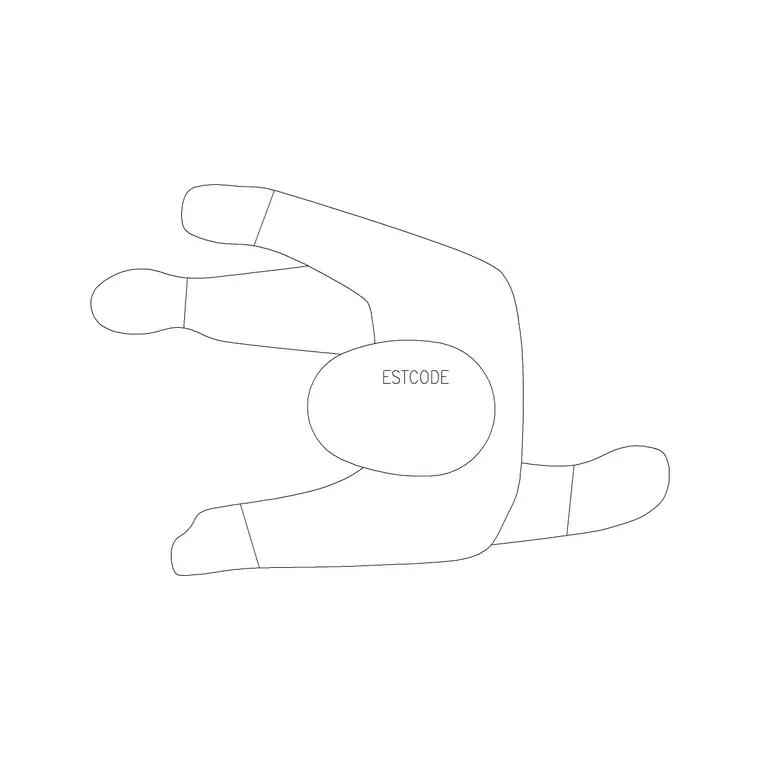
Plan figures are abstract on purpose. From above, a person is essentially a head-and-shoulders blob, so the block is a simple rounded outline roughly 450–550 mm across at the shoulders. That's all you need to show occupancy and to check that a corridor or a queue zone is wide enough for people to pass.
Elevation and section figures carry more detail because they're seen face-on. A standing adult block reads at roughly 1.6–1.85 m tall; a seated figure drops the eye-line to around 1.1–1.3 m. Walking figures with a stride read as movement and are perfect for circulation diagrams. Keep elevation figures simple in linework so they sit behind the architecture rather than competing with it for attention on the sheet.
Typical human dimensions to design around
Reach for these ranges when you scale and place figures. Standing adult height: 1.6–1.85 m. Shoulder width in plan: 450–550 mm. Seated eye-line: roughly 1.1–1.3 m above the floor. Walking stride for an array along a path: keep figures a comfortable couple of strides apart so a circulation diagram reads as flow rather than a traffic jam.
For clearances the figures help you check, allow about 600 mm of body width per person in a queue, 900 mm minimum for a single walking route, and 1200 mm where two people pass. Dropping a correctly-proportioned figure into the plan turns each of those into a visual check instead of a sum.
Where scale figures get used
Entourage people appear across nearly every drawing type: lobby and reception plans, retail and gallery layouts, transport interchanges, public realm and landscape masterplans, interior elevations and any presentation section. They're equally at home in a student portfolio, a competition board or a council planning submission, where a few well-placed figures make a scheme feel inhabited and considered.
Pair them with the furniture, vehicle and tree blocks elsewhere in the library to build a complete entourage layer — people at the bus stop, a car at the kerb, a street tree behind. Because every figure here is free and licence-clear, you can build that layer once, save it as a reusable WBLOCK, and carry it from concept sketch to final issue.
Keeping entourage light and tidy
The single biggest mistake with entourage is letting it bloat a drawing. Keep the figures as block references rather than exploded geometry so the file stays light even with a crowd in it. If you find yourself wanting twenty people in a lobby, build one small group as a block and array that, rather than inserting twenty separate references by hand.
Colour and lineweight matter too. Entourage should sit quietly behind the building, so give the people layer a light grey and a thin lineweight, and lower its plot priority if your output supports it. When the technical drawings need to go out clean, freeze the entourage layer; when the client print goes out, thaw it. One layer toggle, two completely different sheets, no duplicate geometry to maintain.
Free download
Browse the full library — DWG & DXF, no signup.
Questions
Frequently asked
Are these scale figure CAD blocks free for commercial work?+
Yes. Every figure in the pack downloads free in DWG with no signup, no watermark and no attribution requirement, and they are cleared for commercial project use including client presentations and planning submissions.
Do the figures come in both plan and elevation?+
Yes. The pack includes top-view figures for floor plans and side- or front-view figures for elevations and sections. Where a block ships more than one view they're in the same DWG, so you insert the one you need and freeze or explode the rest.
What height should I scale a standing figure to?+
Keep standing adults in the 1.6–1.85 m range so the crowd looks natural rather than uniform. The blocks are drawn full size in millimetres, so in a millimetre drawing they insert at the right height with no scaling needed.
How do I stop entourage from cluttering my plan?+
Put every figure on a dedicated entourage layer with a light grey and a thin lineweight, then freeze that layer for technical issues and thaw it for presentation prints. Keeping figures as block references rather than exploded lines also keeps the file light.
Related downloads
Blocks for this guide
Related categories
Related guides
Curated pack
Free Vehicle Entourage CAD Block Pack
Free vehicle entourage CAD block pack in DWG — cars, vans and bikes in plan and elevation for parking and site plans in AutoCAD. No signup, commercial-use OK.
Curated pack
Free CAD Block Bundle for Site Plans
Free CAD block bundle for site plans in DWG — trees, cars, people, furniture and external symbols ready for AutoCAD masterplans. No signup, commercial-use OK.
Explainer
What Are CAD Blocks? A Beginner's Guide in 2026
What are CAD blocks? A beginner's guide to AutoCAD blocks — what they are, why drafters use them, how blocks, attributes and libraries work, and where to download free DWG blocks.