Block landing · potted plant cad block
Free potted plant CAD blocks for AutoCAD
By Saumyajit Maity · Published 28 Aug 2022 · Updated 25 Apr 2026
A potted plant block is plant plus container — foliage rising from a pot or planter — and it is what you reach for whenever the planting sits in a vessel rather than open ground. Terraces, balconies, roof gardens, courtyards, shopfronts and paved forecourts all rely on potted plants because there is no soil to dig into, so the container becomes part of the design. In elevation a potted plant is a pot with a plant above it at full height; in plan it is the rim of the pot with the foliage spread inside or over it. This page collects free potted plant CAD blocks in DWG and DXF, drawn to scale and ready for AutoCAD 2004 or later, free for personal and commercial use with no signup or watermark.
Potted plants are a small but telling part of a drawing. They show that the planting has been thought through for hard-surfaced spaces, they soften paving and entrances, and they are easy to move and rearrange — which makes them the flexible, decorative layer of an external or interior scheme.
Plant and container together
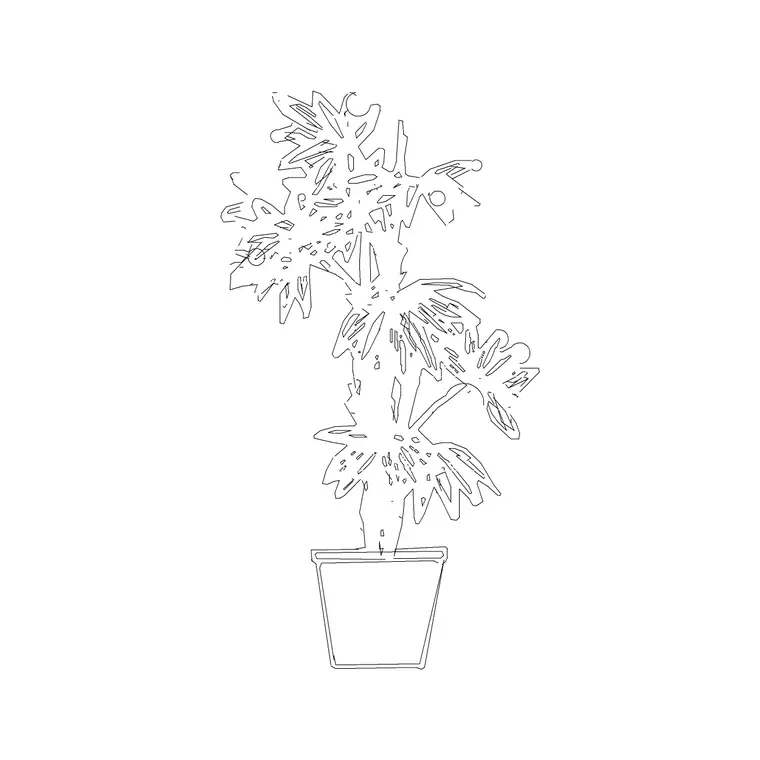
What distinguishes a potted plant block from a plain plant is the container: the pot or planter is drawn as part of the block, because in a hard-surfaced space the container is as visible and as designed as the plant itself. The block shows both — the pot's profile in elevation, its rim in plan — and the planting it holds, whether a single shrub, a small tree, a clump of grasses or a trailing display.
That pairing matters because the container governs where the plant can go. A potted plant sits on paving, against a wall, by a door, on a balcony — anywhere there is no open ground — and the pot's footprint is what you actually place and space on the plan. The blocks here draw the container clearly so it reads as a deliberate object, not just a base for the foliage.
Pot and planter sizes to design around
Containers vary widely, so use these reference figures as a guide. A small decorative pot is roughly 0.3–0.5 m across; a medium feature pot 0.5–0.8 m; a large planter or trough 0.8–1.5 m or more, with troughs running long and narrow. Height follows suit, and the plant adds its own height above the rim — a potted ornamental tree can stand 2–3 m overall even in a modest pot.
Size the container to its role: a small pot for a doorstep accent, a large planter for a feature or a row of them to define a terrace edge. In plan, draw the pot rim to its real diameter so the spacing of a run of planters along a balustrade or path is honest. A row of planters often does the same edge-defining job as a low wall, so their footprint matters.
Inserting potted plants in plan and elevation
Potted plant blocks are drawn full size in millimetres. Set INSUNITS to millimetres (or insert at 0.001 in a metre drawing) so the pot and plant land at the right size. For elevations, snap the base of the pot to your floor or ground line; for plans, snap the insertion to the centre of the pot rim.
Because potted plants live on hard surfaces, place them against the architecture: flanking a doorway, lined along a balustrade, marking the corners of a terrace, or dotted across a courtyard. To define a terrace edge, array a planter block along the boundary at a spacing that reads as a soft barrier. Keep them on a planting or furniture layer so they can be read with the external works and rearranged easily.
Defining and softening hard spaces
Potted plants earn their place by bringing greenery where open ground is impossible. On a roof terrace or balcony, they are often the only planting available, so they carry the whole landscape contribution. On a paved forecourt or courtyard, they soften the hard surfaces and add the human-scale detail that bare paving lacks. A run of planters can edge a seating area, channel movement, or screen a view without the permanence of a wall.
That flexibility is their advantage on a drawing. Because they are not planted in the ground, potted plants can be shown defining temporary or adaptable arrangements — a café terrace, a pop-up space, a seasonal display — and rearranged on the plan as the design develops. Drawing them at true size shows clearly how much green and how much screening the containers actually provide.
Where potted plant blocks are used
Potted plants appear on terrace and balcony plans, roof-garden layouts, courtyard and forecourt drawings, shopfront and hospitality frontages, café and restaurant outdoor seating, and interior schemes where planting sits in containers. They are common wherever paving meets planting and wherever the greenery has to be movable rather than fixed.
Keep them on a planting or furniture layer, and pair these blocks with the ornamental tree, shrub and indoor plant blocks in the trees-and-plants category. A terrace plan might use large planters for structure, smaller pots for accents, and an ornamental tree in a feature container as the focal point — and the potted plant blocks cover that whole container-planting layer of the drawing.
Outdoor planters versus indoor pots
Potted plants span both outdoor and indoor settings, and the drawing context shifts a little between them. Outdoors, planters are landscape and external-works elements — they define terraces, edge paths and soften paving, and they sit on the planting layer with the rest of the green. Their containers are usually robust, weatherproof and larger, chosen to anchor against wind on a roof or balcony.
Indoors, potted plants overlap with interior planting and furniture: smaller decorative pots on desks and counters, larger feature planters in lobbies and atria. The same potted plant blocks serve both, but indoors you will often place them alongside furniture rather than landscape. For dedicated interior greenery on stands and in decorative containers, the indoor plant blocks in the trees-and-plants category complement these, so you can fit out both a terrace and a lobby from one free library.
Free download
Browse the full library — DWG & DXF, no signup.
Questions
Frequently asked
What does a potted plant CAD block include?+
Both the container and the plant — the pot or planter drawn in profile in elevation and as a rim in plan, with the foliage it holds. The container is part of the block because in hard-surfaced spaces the pot is as visible as the plant.
Are the potted plant CAD blocks free for commercial use?+
Yes. Every potted plant block downloads free in DWG and, where available, DXF, with no signup, no watermark and no attribution requirement, and is cleared for commercial project use.
What size should I draw a planter?+
Size it to its role: roughly 0.3–0.5 m for a small accent pot, 0.5–0.8 m for a feature pot, and 0.8–1.5 m or more for a large planter or trough. Draw the pot rim to its real diameter so a run of planters spaces honestly.
Can I use potted plant blocks indoors and outdoors?+
Yes. The same blocks suit terraces, balconies and courtyards outdoors and lobbies, atria and interiors indoors. For dedicated interior greenery on stands, the indoor plant blocks complement these.
Related downloads
Blocks for this guide

Popular blocks to download
Related categories
Related guides
Block landing
Free Flower Plant CAD Blocks — DWG Download
Free flower plant CAD blocks in DWG and DXF — flowering annuals and perennials in plan and elevation for AutoCAD landscape plans. No signup, commercial OK.
Block landing
Free Flowering Shrub CAD Blocks — DWG Download
Free flowering shrub CAD blocks in DWG and DXF — ornamental shrubs in plan and elevation for AutoCAD planting and site plans. No signup, commercial OK.
Block landing
Free Herb Plant CAD Blocks — DWG Download
Free herb plant CAD blocks in DWG and DXF — herbs for kitchen gardens, raised beds and planters, in plan and elevation for AutoCAD. No signup, commercial OK.