Block landing · mpv cad block
Free MPV and minivan CAD blocks for AutoCAD
By Saumyajit Maity · Published 29 Jan 2025 · Updated 15 Mar 2026
The MPV — multi-purpose vehicle, or minivan in North American usage — is the people-carrier that shapes family-oriented parking and drop-off design. Longer and taller than a saloon, with sliding side doors and a tall tailgate, it is the realistic vehicle for school runs, places of worship, family retail, hospitals and any layout where larger family vehicles need to load and unload comfortably. This page collects free MPV and minivan CAD blocks in DWG and DXF, in plan and elevation, drawn at true millimetre dimensions for AutoCAD 2004 and later. Every file is free for personal and commercial work, with no signup, no watermark and no attribution required.
The MPV is a deceptively demanding vehicle to plan for. The length tests bay depth and aisle turning; the sliding doors change the clearance you need beside the vehicle; and the height matters in covered parking. Use these blocks to size family and drop-off parking honestly, to plan accessible loading zones, and to populate the kind of suburban and institutional schemes where MPVs are the typical visitor vehicle.
What an MPV block represents
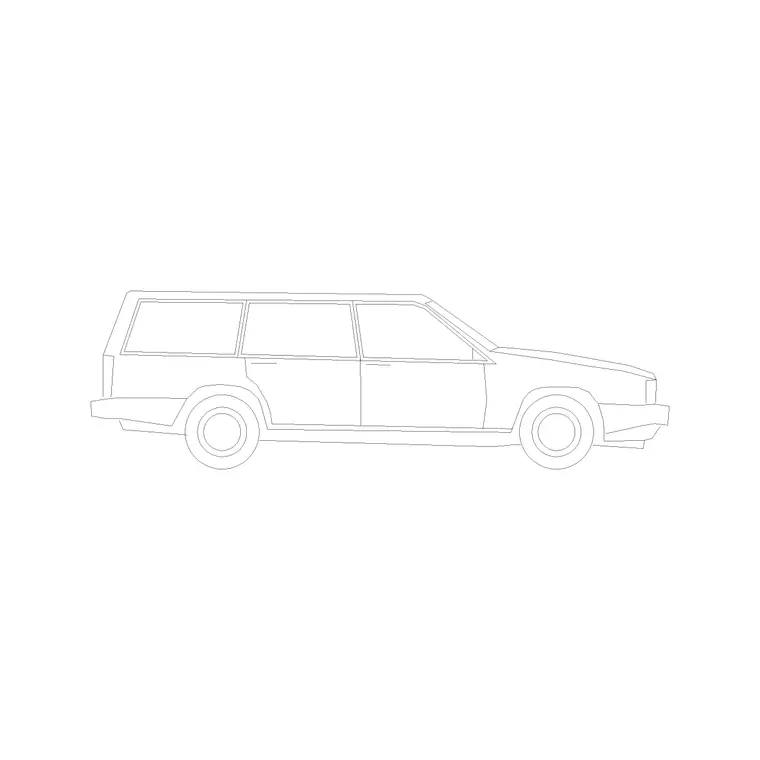
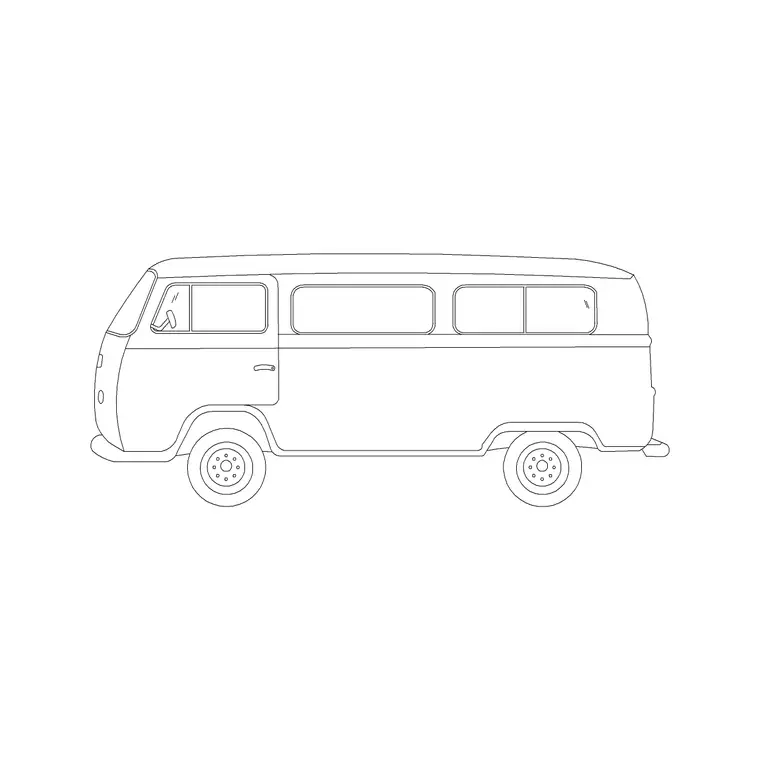
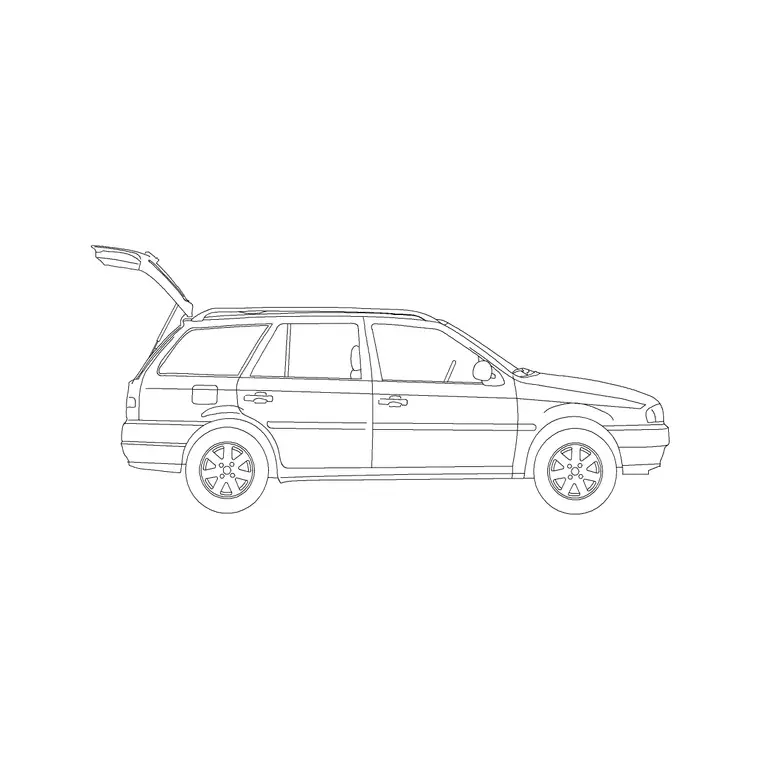
An MPV block represents the boxy, volume-maximising people-carrier: compact MPVs, full-size minivans and the larger seven- and eight-seat family vehicles. In plan the footprint is long and fairly wide, with a near-rectangular body that uses every millimetre for interior space. In elevation the tall, upright sides and high roof are the giveaway, along with the sliding-door line on the flank.
The blocks here capture that boxy profile as clean references, with the body, wheels and glasshouse on separable layers. The MPV serves both as a realistic test vehicle for family parking and drop-off studies, and as a subject in dealership and accessible-transport drawings where its loading character is the point.
MPV dimensions to design around
Design against these ranges. A compact MPV runs roughly 4300–4600 mm long and 1800–1850 mm wide; a full-size minivan around 4900–5200 mm long and 1900–2000 mm wide. Roof height is tall, typically 1700–1850 mm, similar to a large SUV. The wheelbase is long, which combined with the length makes the MPV a real test of bay depth and aisle-end turning.
The sliding side door is a planning quirk worth modelling: unlike a hinged door it does not swing out, but loading children or a wheelchair beside it needs generous clear space — often more than a standard bay offers. Drop the scaled MPV block in, then draw the loading zone beside it, and the adequacy of a family or accessible bay becomes a clear visual judgement.
Planning drop-offs and accessible bays
The MPV is the vehicle that drives good drop-off and accessible design. At a school, place or worship, or hospital, the queue and the loading space have to suit a long people-carrier with side-loading doors, not a compact car. Using the MPV block to lay out the drop-off lane shows whether the vehicle can pull in, load, and pull away without blocking the next car.
For accessible parking, the MPV is often the wheelchair-accessible vehicle, so the bay plus its hatched transfer zone needs to suit the side or rear loading of a tall van. Modelling the actual vehicle, with its real length and the clear space its doors demand, produces an accessible layout that works in practice rather than just meeting a minimum on paper.
Inserting plan and elevation
MPV blocks are drawn full size in millimetres. Insert at scale 1 in a millimetre drawing, 0.001 in a metre drawing, or set INSUNITS to millimetres so AutoCAD rescales on insertion if your template differs.
For the plan, place the insertion point at the centre and check the long footprint against bay depth before arraying. For the elevation, snap to the kerb or ground line so the tall body sits correctly. When planning loading, copy the MPV block and add the door-clearance and transfer zones beside it as separate hatched areas. Keep the vehicles on a dedicated layer for clean freezing and thawing across the sheet set.
Where MPV and minivan blocks are used
MPVs suit family and institutional work. School and nursery drop-off and pick-up zones. Places of worship and community centres with large-family visitors. Family retail, leisure and out-of-town shopping car parks. Hospitals and clinics, where accessible MPVs need generous loading space. Hotel and airport set-down areas. MPV and people-carrier dealership layouts.
They are also a sensible inclusion in any mixed parking study aimed at family-heavy traffic, setting the upper bound on bay depth and loading clearance. Mix the MPV with sedans, SUVs and a van from the vehicles category to show a realistic family-vehicle spread in a car park or drop-off scene.
MPV versus van, SUV and sedan
The MPV sits between the passenger and goods worlds, and the distinctions guide your choice. It is longer and taller than an SUV, optimised for people and interior volume rather than ground clearance, and it is the bigger test of bay depth. It is a passenger vehicle, unlike a panel van, so it belongs in family and drop-off scenes rather than loading-bay drawings — though a van block is the right choice for goods delivery. It is far larger than a sedan, so use the sedan only where you specifically want a smaller, lower car.
For family-oriented and accessible layouts the MPV is the representative larger vehicle. For goods and delivery, switch to the van; for general modern traffic, the SUV; for a low formal car, the sedan. All sit in the vehicles category so you can build the right mix for each study.
Free download
Browse the full library — DWG & DXF, no signup.
Questions
Frequently asked
What's the difference between an MPV and a minivan?+
They are the same class of vehicle — 'MPV' (multi-purpose vehicle) is the European term and 'minivan' the North American term for a tall, boxy people-carrier with sliding side doors. The blocks here suit either label.
Why does an MPV need special drop-off planning?+
Its length and sliding side doors mean loading passengers — including children or wheelchair users — needs more clear space beside the vehicle than a standard bay offers. Model the MPV and its loading zone to size drop-offs and accessible bays correctly.
How big is an MPV footprint?+
A compact MPV runs roughly 4300–4600 mm long; a full-size minivan around 4900–5200 mm long and up to 2000 mm wide, with a tall 1700–1850 mm roof. The long footprint tests bay depth and aisle turning.
Are the MPV and minivan blocks free for commercial use?+
Yes. Every MPV block downloads free in DWG and, where available, DXF, with no signup, no watermark and no attribution requirement, and they are cleared for commercial project use.
Related downloads
Blocks for this guide
Related categories
Related guides
Block landing
Free Car Plan View CAD Block — DWG Download
Download a free car plan-view CAD block in DWG and DXF — the top-down footprint for parking layouts and site plans. AutoCAD 2004+, no signup.
Block landing
Free Car Elevation CAD Block — DWG Download
Download a free car elevation CAD block in DWG and DXF — side and front views for streetscapes, showrooms and presentations. AutoCAD 2004+, no signup.
Block landing
Free Sedan Car CAD Blocks — DWG Download
Download free sedan car CAD blocks in DWG and DXF — saloon and luxury sedans in plan and elevation for parking and showrooms. AutoCAD 2004+, no signup.