Block landing · grandfather clock cad block
Free grandfather clock CAD blocks for AutoCAD
By Saumyajit Maity · Published 8 Oct 2024 · Updated 24 Mar 2026
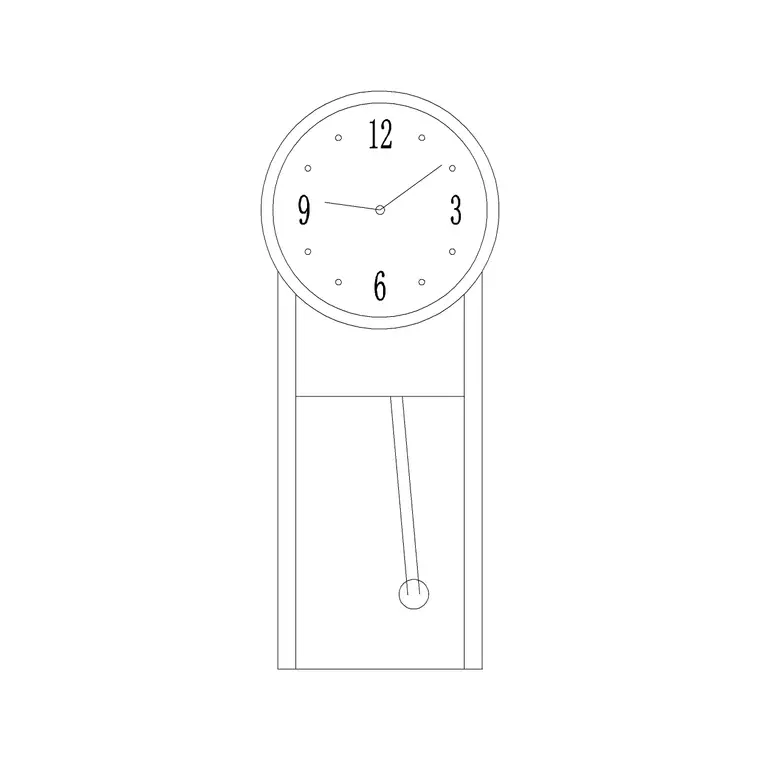
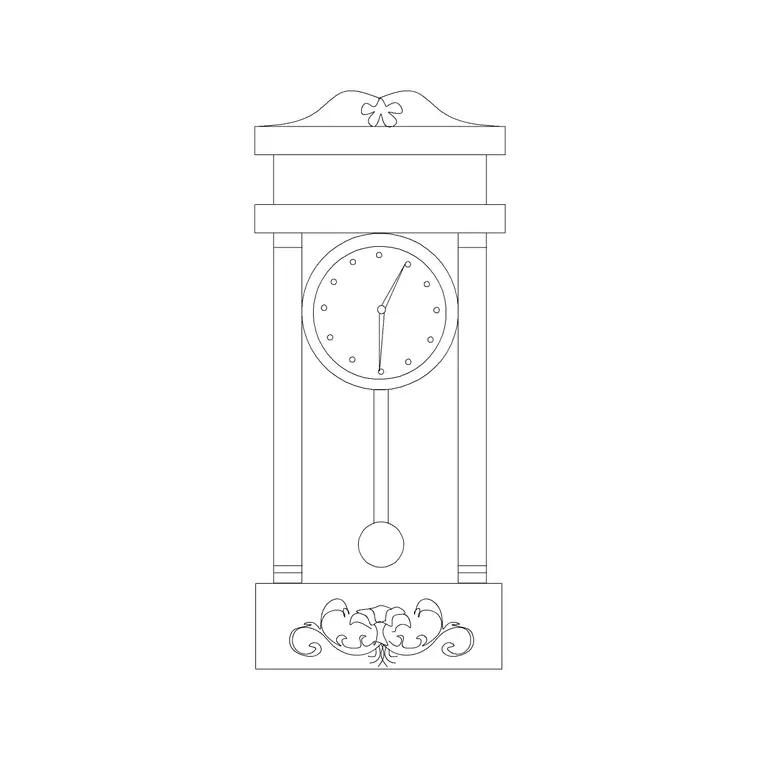
A grandfather clock is a piece of furniture as much as a timepiece, and in a drawing it does something no wall clock can: it occupies floor space and commands a corner. Standing nearly two metres tall in its tall wooden case, a longcase clock is a focal point for a hallway, a study, a library or a formal living room, and it signals a traditional, considered interior the moment it lands in an elevation. This page collects free grandfather clock CAD blocks in DWG and DXF — classic longcase and tall-case forms with hood, trunk and base — drawn in plan and elevation and ready for AutoCAD 2004 or later. Everything is free for personal and commercial work, with no signup and no watermark.
Unlike a wall clock, a grandfather clock has a real footprint, so it reads in both plan and elevation. In plan it is a substantial rectangle against a wall that you must allow space for; in elevation it is a tall, detailed silhouette with a glazed hood showing the dial and a long trunk housing the pendulum and weights. Use these blocks to anchor hallways, landings, studies and heritage interiors, and to give a traditional scheme a genuine statement piece.
A grandfather clock is furniture, not a wall fitting
The key thing that sets a grandfather clock apart from every other clock block is that it stands on the floor. A longcase clock is a tall freestanding cabinet — a hood at the top holding the dial and movement, a long slender trunk in the middle housing the pendulum and driving weights, and a wider base or plinth resting on the floor. That makes it furniture, with a footprint to plan around and weight to consider against a timber floor.
Because it is freestanding and against a wall, it behaves in a drawing more like a tall cabinet than like a hung clock. You allow floor space for it, you check it does not foul a door swing, and you place it where its height is an asset — typically a corner, the end of a hallway, or beside a chimney breast where its verticality balances the room.
Plan and elevation: using both views
Use the plan view when you lay out a room from above. A grandfather clock shows as a rectangle, roughly 350–550 mm deep and 450–650 mm wide, set against a wall. Because it has a real footprint, you place it on the furniture plan alongside the sofas and cabinets and check its clearances — it should not block a doorway, a window or a circulation route.
Use the elevation view for the face-on drawing where the clock's character lives. Here you see the full height: the hood with its glazed dial door, the long trunk often with a glazed or panelled door revealing the pendulum, and the base. This is the view that sells the piece to a client and the one you place in interior elevations and presentation drawings. Several blocks here ship both views in one DWG, so a single download covers the furniture plan and the matching elevation.
Typical grandfather clock dimensions
Longcase clocks are tall and slender. Useful ranges: overall height 1800–2400 mm, with many classic English longcase clocks around 2000–2200 mm to the top of the hood. Width across the case is typically 450–650 mm, and depth 300–450 mm, though the hood often projects slightly wider than the trunk. The dial itself sits high — usually around 1600–1900 mm above the floor — so it can be read across a room.
That height is the whole point and also the thing to watch: a 2200 mm clock needs a ceiling that gives it breathing room, so it suits rooms with generous head height and looks cramped under a low ceiling or beneath a sloping eaves line. Because the block is drawn full size, dropping it into your elevation immediately shows whether the room can carry it, and snapping the base to the floor line confirms the dial lands at a readable height.
How to insert and place the block
These grandfather clock blocks are drawn full size in millimetres. Insert at scale 1 in a millimetre drawing, 0.001 in a metre drawing, or set INSUNITS to millimetres so AutoCAD rescales automatically. Use INSERT or drag the DWG from a tool palette, and pick the centre of the base as your insertion point so the clock sits cleanly against a wall in plan and on the floor line in elevation.
In plan, place the footprint flush against the wall and rotate the block so its back is to the wall — a corner placement at 45 degrees is a classic and often the best use of the piece. Check the footprint against nearby door swings and circulation. In elevation, snap the base to the floor line and confirm the hood clears the ceiling, cornice or any picture rail. Because a longcase clock is a single statement piece, you rarely array it; place one deliberately where its height earns its keep.
Where grandfather clock blocks are used
Grandfather clocks belong to traditional and heritage interiors: hallways and entrance halls, where they greet visitors; studies and libraries, where they suit the book-lined, panelled character; formal living and drawing rooms; landings at the top of a staircase; and the interiors of heritage buildings, country hotels, gentlemen's clubs and period restorations. They are also a favourite in stage and film set drawings calling for a period look.
Pair the grandfather clock with traditional furniture, panelling, fireplaces and bookcases to build a coherent period elevation, and place it against the wall-art and picture-frame blocks from the accessories category so the wall above and beside it is dressed to match. Because every block is free and licence-clear, the same clock carries from a heritage concept elevation through to a detailed restoration drawing set without licensing concern.
Layering, scheduling and placement judgement
Because a grandfather clock is furniture, treat it like furniture in your drawing: put it on the furniture (or FF&E) layer rather than a generic decor layer, so it appears in the furniture plan and can be counted in a furniture schedule if you tag it with an attribute. That distinguishes it from a hung wall clock, which belongs on a lighter accessories layer and is rarely scheduled.
Placement is where judgement matters most with this piece. A grandfather clock is tall, heavy and visually dominant, so it wants a position that justifies the statement — a turn in a hallway, a corner of a study, an alcove beside a chimney breast — rather than being lost along a busy wall. Watch the head height above it, keep it clear of door swings and radiators, and remember that a real longcase clock needs to stand dead level and undisturbed to keep time, which is a subtle argument for a quiet corner rather than a high-traffic route. Drawing it as a scaled block with an honest footprint lets you test all of that before the piece ever arrives on site.
Free download
Browse the full library — DWG & DXF, no signup.
Questions
Frequently asked
Does a grandfather clock block come in plan as well as elevation?+
Yes. Because a longcase clock stands on the floor it has a real footprint — a rectangle roughly 450–650 mm wide and 300–450 mm deep in plan — as well as a tall, detailed elevation. Many blocks here ship both views in one DWG.
How tall is a typical grandfather clock block?+
Overall height is usually 1800–2400 mm, with many classic longcase clocks around 2000–2200 mm. The dial sits high, around 1600–1900 mm above the floor, so it reads across a room. Check the room's head height before placing one.
What units are the grandfather clock blocks drawn in?+
Full size in millimetres. Insert at scale 1 in a millimetre drawing, 0.001 in a metre drawing, or set INSUNITS to millimetres so AutoCAD rescales automatically on insertion.
Are the grandfather clock blocks free for commercial use?+
Yes. Every block downloads free in DWG and DXF with no signup, no watermark and no attribution requirement, and they are cleared for commercial project use.
Related downloads
Blocks for this guide

Related categories
Related guides
Block landing
Free Picture Frame CAD Blocks — DWG Download
Download free picture frame CAD blocks in DWG and DXF — framed photos drawn in elevation for AutoCAD interior drawings. No signup, commercial use OK.
Block landing
Free Wall Art & Painting CAD Blocks — DWG
Download free wall art and painting CAD blocks in DWG and DXF — abstract art and canvases for AutoCAD interior elevations. No signup, commercial OK.
Block landing
Free Decorative Vase CAD Blocks — DWG Download
Download free decorative vase CAD blocks in DWG and DXF — designer vases and vases with flowers in plan and elevation for AutoCAD. No signup, commercial OK.